MCQ
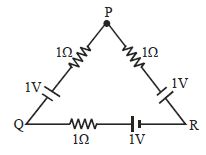
In given circuit find potential difference between $P$ and $Q$ .................. $V$
  • $0$
  • B
    $1$
  • C
    $2$
  • D
    $\frac{2}{3}$

Answer

Correct option: A.
$0$
a
$\mathrm{I}=\frac{3}{3}=1 \mathrm{\,A},$ from kirchoff's rule

$\mathrm{V}_{\mathrm{P}}+1-1=\mathrm{V}_{\mathrm{Q}}$

$\mathrm{V}_{\mathrm{P}}-\mathrm{V}_{\mathrm{Q}}=0$

Need a full question paper?

Generate a complete, print-ready paper with questions like this in minutes — across 16+ boards, with answer keys.
Start Generating Free

Similar questions

The electric field of a plane electromagnetic wave varies with time of amplitude $2\, Vm^{-1}$ propagating along $z$ -axis. The average energy density of the magnetic field  (in $J\, m^{-3}$) is 
The addition of antimony atoms to a sample of intrinsic germanium transforms it to a material which is
$64$ identical drops each charged upto potential of $10\,mV$ are combined to form a bigger dorp. The potential of the bigger drop will be $..........\,mV$
The correct relation for a triode is
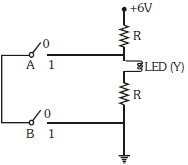
The correct Boolean operation represented by the circuit diagram drawn is
N identical spherical drops charged to the same potential V are combined to form a big drop. The potential of the new drop will be
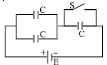
In the circuit shown, each capacitor has a capacitance $C$. The emf of the cell is $E$. If the switch $S$ is closed
An $a.c.$ source of voltage $V$ and of frequency $50\,Hz$ is connected to an inductor of $2H$ and negligible resistance. $A$ current of $r.m.s.$ value $I$ flows in the coil. When the frequency of the voltage is changed to $400\,Hz$ keeping the magnitude of $V$ the same, the current is now
Charges $Q, 2Q$ and $4Q$ are uniformly distributed in three dielectric solid spheres $1,2$ and $3$ of radii $R/2, R$ and $2 R$ respectively, as shown in figure. If magnitudes of the electric fields at point $P$ at a distance $R$ from the centre of spheres $1,2$ and $3$ are $E_1 E_2$ and $E_3$ respectively, then
The total energy of electron in the ground state of hydrogen atom is $-13.6\,\,eV$ . The kinetic energy of an electron in the first excited state is.....$ eV$