In meter bridge or Wheatstone bridge for measurement of resistance, the known and the unknown resistances are interchanged. The error so removed is
Easy
Download our app for free and get started
(a) In meter bridge experiment, it is assumed that the resistance of the $L$ shaped plate is negligible, but actually it is not so. The error created due to this is called, end error. To remove this the resistance box and he unknown resistance must be interchanged and then the mean reading must be taken.

Download our appand get started for free
Experience the future of education. Simply download our apps or reach out to us for more information. Let's shape the future of learning together!No signup needed.*
Similar Questions
- 1In an experiment of potentiometer for measuring the internal resistance of primary cell a balancing length $\ell $ is obtained on the potentiometer wire when the cell is open circuit. Now the cell is short circuited by a resistance $R$. If $R$ is to be equal to the internal resistance of the cell the balancing length on the potentiometer wire will beView Solution
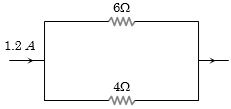
- 2In the figure given below, the current passing through $6\,\Omega $ resistor is ........... $ampere$View Solution
- 3A cell of $emf$ $E$ and internal resistance $r$ is connected in series with an external resistacne $nr.$ Then, the ratio of the terminal potential difference to $emf$ isView Solution
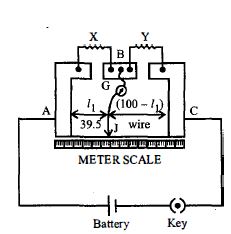
- 4In a meter bridge, as shown in the figure, it is given that resistance $Y=12.5\, \Omega $ and that the balance is obtained at a distance $39.5\, cm$ from end $A$ (by jockey $J$) . After interchanging the resistances $X$ and $Y$, a new balance point is found at a distance $l_2$ from end $A$. What are the values of $X$and $l_2$ ?View Solution
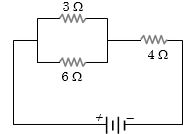
- 5In the figure, current through the $3\,\Omega $ resistor is $0.8\, ampere$, then potential drop through $4\,\Omega $ resistor is ........... $V$View Solution
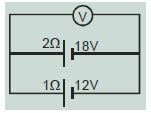
- 6Two batteries, one of $emf$ $18\, volts$ and internal resistance $2\,\Omega $ and the other of $emf$ $12\, volt$ and internal resistance $1\,\Omega $, are connected as shown. The voltmeter $V$ will record a reading of .............. $\mathrm{volt}$View Solution
- 7Electric bulb $50\, W$ - $100\, V$ glowing at full power are to be used in parallel with battery $120\, V$, $10 \,\Omega$. Maximum number of bulbs that can be connected so that they glow in full power isView Solution
- 8The two ends of a uniform conductor are joined to a cell of $e.m.f.$ $E$ and some internal resistance. Starting from the midpoint $P$ of the conductor, we move in the direction of current and return to $P$. The potential $V$ at every point on the path is plotted against the distance covered $(x)$. Which of the following graphs best represents the resulting curveView Solution
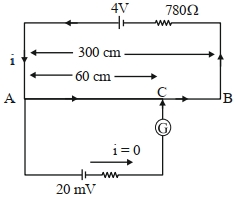
- 9A potentiometer wire of length $300\,cm$ is connected in series with a resistance $780\,\Omega$ and a standard cell of emf $4\,V$. A constant current flows through potentiometer wire. The length of the null point for cell of emf $20\,mV$ is found to be $60\,cm$. The resistance of the potentiometer wire is$...\Omega$View Solution
- 10In copper wire each atom releases one free electron. If diameter is $1\, mm$ and current is $1.1\,A$ find drift velocity. ($\rho = 9 \times 10^{+3}\, kg/m^3$ $M = 63\, gm/mole$)View Solution