Electric bulb $50\, W$ - $100\, V$ glowing at full power are to be used in parallel with battery $120\, V$, $10 \,\Omega$. Maximum number of bulbs that can be connected so that they glow in full power is
Diffcult
Download our app for free and get started
(c) When each bulb is glowing at full power,
Current from each bulb $ = i' = \frac{{50}}{{100}} = \frac{1}{2}\,A$
So main current $i = \frac{n}{2}\,A$
Also $E = V + ir$
$==>$ $120 = 100 + \left( {\frac{n}{2}} \right) \times 10 \Rightarrow n = 4$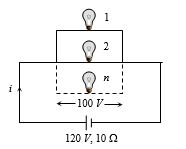

Download our appand get started for free
Experience the future of education. Simply download our apps or reach out to us for more information. Let's shape the future of learning together!No signup needed.*
Similar Questions
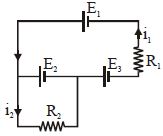
- 1The current $i_1$ and $i_2$ through the resistor $R_1 (= 10\,\Omega )$ and $R_2 (=30 \,\Omega )$ in the circuit diagram with $E_1 = 3\,V, E_2 = 3\,V$ and $E_3 = 2\,V$ are respectively:View Solution
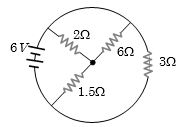
- 2The total current supplied to the circuit by the battery is ............. $A$View Solution
- 3Two wires of resistance $R_1$ and $R_2$ have temperature coefficient of resistance ${\alpha _1\,}{\rm{ and \,}}{\alpha _2}$, respectively. These are joined in series. The effective temperature coefficient of resistance isView Solution
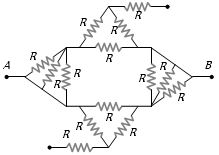
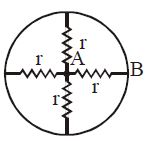
- 4The equivalent resistance betweent point $A$ and $B$View Solution
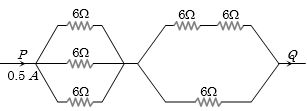
- 5Resistances of $6\, ohm$ each are connected in the manner shown in adjoining figure. With the current $0.5\,ampere$ as shown in figure, the potential difference ${V_P} - {V_Q}$ is .............. $V$View Solution
- 6A $220\, volt$, $1000\, W$ bulb is connected across a $110\, volt$ mains supply. The power consumed will be ............ $W$View Solution
- 7Potentiometer wire of length $1 \,m$ is connected in series with $490\,\Omega $ resistance and $2\,V$ battery. If $0.2\, mV/cm $ is the potential gradient, then resistance of the potentiometer wire is ................ $\Omega$View Solution
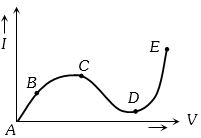
- 8From the graph between current $I$ and voltage $V$ shown below, identify the portion corresponding to negative resistanceView Solution
- 9Space between two concentric conducting spheres of radii $a$ and $b (b > a)$ is filled with $a$ medium of resistivity $\rho $. The resistance between the two spheres will beView Solution
- 10Find equivalent resistance between $A$ and $B$View Solution