Question
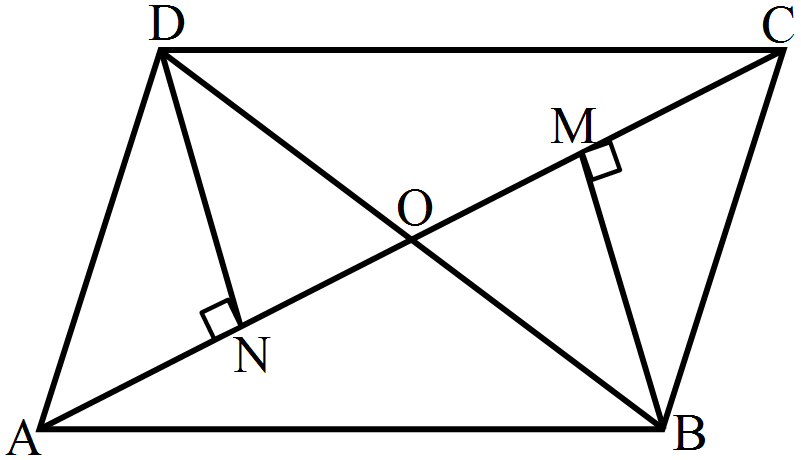
In the adjoining figure, $\text{BM}\perp\text{AC}$ and $\text{DN}\perp\text{AC}.$ If BM = DN, prove that AC bisects BD.

Answer

Given: A quadrilateral ABCD, in which $\text{BM}\perp\text{AC}$ and $\text{DN}\perp\text{AC}$ and BM = DN.
To prove: AC bisects BD; or DO = BO
Proof:
Let AC and BD intersect at O.
Now, in $\triangle\text{OND}$ and $\triangle\text{OMB},$ we have:
$\angle\text{OND}=\angle\text{OMB}$ (90° each)
$\angle\text{DON}=\angle\text{BOM}$ (Vertically opposite angles)
Also, $\text{DN = BM}$ (Given)
i.e., $\triangle\text{OND}\cong\triangle\text{OMB}$ (AAS congrurence rule)
$\therefore\text{OD = OB}$ (C.P.C.T.)
Hence, AC bisects BD.

Need a full question paper?

Generate a complete, print-ready paper with questions like this in minutes — across 16+ boards, with answer keys.
Start Generating Free

Similar questions

Locate $\sqrt{3}$ on the number line.
In a rhombus ABCD, the altitude from D to the side AB bisects AB. Find the angles of the rhombus.
Construct a frequency table with equal class intervals from the following data on the monthly wages (in rupees) of 28 laborers working in a factory, taking one of the class intervals as 210-230 (230 not included).
220, 268, 258, 242, 210, 268, 272, 242, 311, 290, 300, 320, 319, 304, 302, 218, 306, 292, 254, 278, 210, 240, 280, 316, 306, 215, 256, 236.
If $\text{x}=2+\sqrt{3},$ find the value of $\text{x}^3+\frac{1}{\text{x}^3}.$
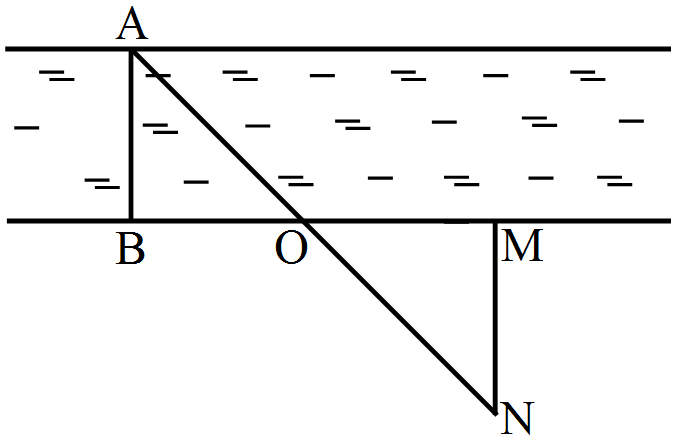
In the adjoining figure, explain how one can find the breadth of the river without crossing it.

Find the length of a chord which is at a distance of 5cm from the centre of a circle of radius 10cm.
ABCD is such a quadrilateral that A is the centre of the circle passing through B, C and D. Prove that $\angle\text{CBD}+\angle\text{CDB}=\frac{1}{2}\angle\text{BAD}$
A rectangular tank is 80m long and 25m broad. Water flows into it through a pipe whose cross-section is 25cm2, at the rate of 16km per hour. How much the level of the water rises in the tank in 45 minutes?
In a rhombus ABCD show that diagonal AC bisects $\angle\text{A}$ as well as $\angle\text{C}$ and diagonal BD bisects $\angle\text{B}$ as well as $\angle\text{D}.$
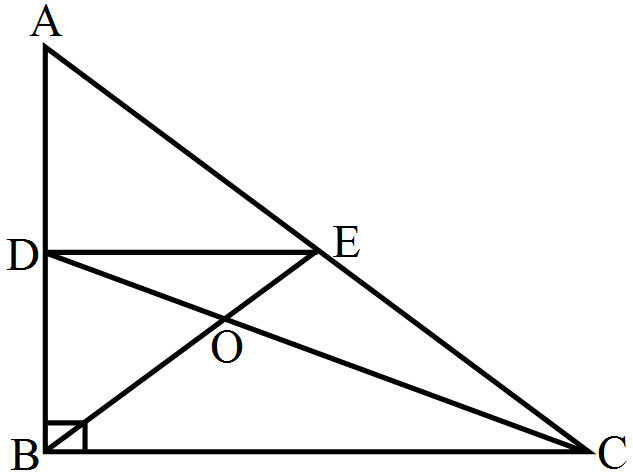
In figure, Triangle ABC is a right angled triangle at B. Given that AB = 9cm, AC = 15cm and D, E are the mid-points of the sides AB and AC respectively, calculate
  1. The length of BC
  2. The area of $\triangle\text{ADE}.$