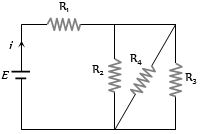
In the circuit given $E = 6.0 \,V, R_1 = 100\, ohms, R_2 = R_3 = 50\, ohms, R_4 = 75\, ohms$. The equivalent resistance of the circuit, in $ohms$, is
Medium
Download our app for free and get started
(c) In given circuit three resistance ${R_2},{R_4}$ and ${R_3}$ are parallel.
$\frac{1}{R} = \frac{1}{{{R_2}}} + \frac{1}{{{R_4}}} + \frac{1}{{{R_3}}}$
$ = \frac{1}{{50}} + \frac{1}{{50}} + \frac{1}{{75}}$
$ = \frac{{75 + 75 + 50}}{{50 \times 75}}$
$R = \frac{{50 \times 75}}{{75 + 75 + 50}} = \frac{{50 \times 75}}{{200}} = \frac{{75}}{4}\,\Omega = 18.75\,\Omega $
This resistance is in series with ${R_1}$
${R_{{\rm{resultant}}}} = {R_1} + R = 100 + 18.75 = 118.75\,\Omega $
$\frac{1}{R} = \frac{1}{{{R_2}}} + \frac{1}{{{R_4}}} + \frac{1}{{{R_3}}}$
$ = \frac{1}{{50}} + \frac{1}{{50}} + \frac{1}{{75}}$
$ = \frac{{75 + 75 + 50}}{{50 \times 75}}$
$R = \frac{{50 \times 75}}{{75 + 75 + 50}} = \frac{{50 \times 75}}{{200}} = \frac{{75}}{4}\,\Omega = 18.75\,\Omega $
This resistance is in series with ${R_1}$
${R_{{\rm{resultant}}}} = {R_1} + R = 100 + 18.75 = 118.75\,\Omega $

Download our appand get started for free
Experience the future of education. Simply download our apps or reach out to us for more information. Let's shape the future of learning together!No signup needed.*
Similar Questions
- 1View SolutionThe colour sequence in a carbon resistor is red, brown, orange and silver. The resistance of the resistor is
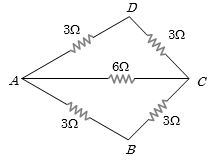
- 2The effective resistance between the points $A$ and $B$ in the figure is ............. $\Omega$View Solution
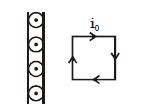
- 3Figure shows a cross-section of a large-section of an infinite metal sheet carrying an electric current along its surface. The current per unit length is $J$ . A current carrying square loop is placed nearby the metal sheet such that the plane of square is perpendicular to the plane of sheet thenView Solution
- 4The resistivity $(\rho)$ of semiconductor varies with temperature. Which of the following curve represents the correct behaviourView Solution
- 5View SolutionA piece of wire is cut into four equal parts and the pieces are bundled together side by side to form a thicker wire. Compared with that of the original wire, the resistance of the bundle is ..........
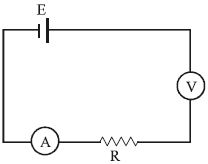
- 6Assertion : All electric devices shown in the circuit are ideal. The reading of each of ammeter $(a)$ and voltmeter $(V)$ is zero.View Solution
Reason : An ideal voltmeter draws almost no current due to very large resistance, and hence $(V)$ and $(a)$ will read zero.
- 7Current of $4.8\,A$ is flowing through a conductor. The number of electrons per second will beView Solution
- 8A potentiometer consists of a wire of length $4\, m$ and resistance $10\,\Omega $. It is connected to a cell of $e.m.f.$ $2\, V$. The potential difference per unit length of the wire will be ............. $V/m$View Solution
- 9A bulb has specification of one kilowatt and $250\, volts$, the resistance of bulb is .................. $\Omega$View Solution
- 10The circuit shown has been connected for a long time. The voltage across the capacitor is ............. $V$View Solution