MCQ
In the circuit shown below, calculate the current flowing through 20V cell.
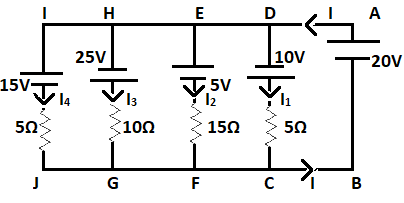
- A12A
- B15A
- C12.5A
- D12.3A
Explanation:
Here, we can apply Kirchhoff’s loop rule in closed loops ADCBA, AEFBA, AHGBA, and AIJBA. Thus, we get
20 + 10 – 5I1 = 0 → I1 = 6A
-5 + 20 – 15I2 = 0 → I2 = 1A
25 + 20 – 10I3 = 0 → I3 = 4.5A
-15 + 20 – 5I4 = 0 → I4 = 1A
Therefore, the current flowing through the 20V cell = 6 + 1 + 4.5 + 1 = 12.5A
Generate a complete, print-ready paper with questions like this in minutes — across 16+ boards, with answer keys.
A moving coil galvanometer has N number of turns in a coil of effective area A, it carries a current I. The magnetic field B is radial. The torque acting on the coil is
|
(a) |
(b) |
(c) |
(d) NABI |
In which of the following the final image is erect?
Two resistors are connected (a) in series (b) in parallel. The equivalent resistance in the two cases are 9 ohm and 2 ohm respectively. Then the resistances of the component resistors are
|
(a) 2 ohm and 7 ohm |
(b) 3 ohm and 6 ohm |
(c) 3 ohm and 9 ohm |
(d) 5 ohm and 4 ohm |
The magnetic field at a distance r from a long wire carrying current i is 0.4 Tesla. The magnetic field at a distance 2r is
|
(a) 0.2 Tesla |
(b) 0.8 Tesla |
(c) 0.1 Tesla |
(d) 1.6 Tesla |
A magnetic field
|
(a) Always exerts a force on a charged particle |
|
(b) Never exerts a force on a charged particle |
|
(c) Exerts a force, if the charged particle is moving across the magnetic field lines |
|
(d) Exerts a force, if the charged particle is moving along the magnetic field lines |


