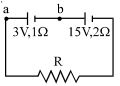
Two batteries one of the $\mathrm{emf}$ $3\,V$, internal resistance $1$ ohm and the other of $\mathrm{emf}$ $15\, V$, internal resistance $2$ $\mathrm{ohm}$ are connected in series with a resistance $R$ as shown. If the potential difference between $a$ and $b$ is zero the resistance of $R$ in $\mathrm{ohm}$ is
Medium
Download our app for free and get started
Let the current $I$ will flow in the anticlockwise direction.
By $KVL,$ $15+3=(1+2+R) I$ or $I=\frac{18}{3+R}$
Here, $V_{a b}=0$
or $3-1 I=0$
or $3=I=\frac{18}{3+R}$
or $R=3 \Omega$

Download our appand get started for free
Experience the future of education. Simply download our apps or reach out to us for more information. Let's shape the future of learning together!No signup needed.*
Similar Questions
- 1In the experiment of calibration of voltmeter, a standard cell of $e.m.f\,\,1.1\,volt$ is balanced against $440\,cm$ of potential wire. The potential difference across the ends of resistance is found to balance against $220\,cm$ of the wire. The corresponding reading of voltmeter is $0.5\,volt.$ The error in the reading of volmeter will be .................. $volt$View Solution
- 2View SolutionAssertion : Long distance power transmission is done at high voltage.
Reason : At high voltage supply power losses are less.
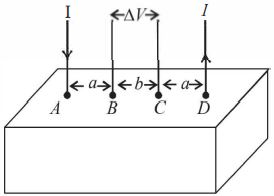
- 3Consider a block of conducting material ofresistivity '$\rho$' shown in the figure. Current '$I$' enters at '$A$' and leaves from '$D$'. We apply superp osition principle to find voltage '$\Delta V$ ' developed between '$B$' and '$C$'. The calculation is done in the following steps:View Solution
$(i)$ Take current '$I$' entering from '$A$' and assume it to spread over a hemispherical surface in the block.
$(ii)$ Calculatefield $E(r)$ at distance '$r$' from $A$ by using Ohm's law $E = \rho j$, where j is the current per unit area at '$r$'.
(iii) From the '$r$' dependence of $E(r)$, obtain the potential $V(r)$ at $r$.
(iv) Repeat $(i), (ii)$ and $(iii)$ for current '$I$' leaving '$D$' and superpose results for '$A$' and '$D$'.$\Delta V$ measured between $B$ and $C$ is
- 4View SolutionWhen current flows through a conductor, then the order of drift velocity of electrons will be
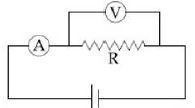
- 5The actual value of resistance $R$, shown in the figure is $30\,\Omega $. This is measured in an experiment as shown using the standard formula $R = \frac{V}{I}$ where $V$ and $I$ are the readings of the voltmeter and ammeter, respectively. If the measured value of $R$ is $5\%$ less, then the internal resistance of the voltmeter is ................. $\Omega$View Solution
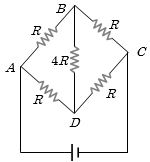
- 6Five resistors of given values are connected together as shown in the figure. The current in the arm $BD$ will beView Solution
- 7In a meter bridge, the null point is found at a distance of $25\, cm$ from $A$ . If now a resistance of $10\,\Omega $ is connected in parallel with $S$, the null point occurs at mid point of $AB$. The value of $R$ is .............. $\Omega$View Solution
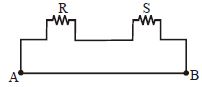
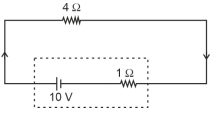
- 8The terminal voltage of the battery, whose emf is $10 \mathrm{~V}$ and internal resistance $1 \Omega$, when connected through an external resistance of $4 \Omega$ as shown in the figure is:View Solution
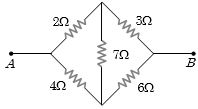
- 9Five resistances are connected as shown in the figure. The effective resistance between the points $A$ and $B$ isView Solution
- 10Time taken by a $836\; W$ heater to heat $1\; litre$ of water from $10^{\circ} C$ to $40^{\circ} C$ isView Solution