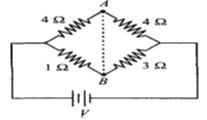
In the circuit shown, if a conducting wire is connected between points $A$ and $B,$ the current in this wire will
AIPMT 2006, Medium
Download our app for free and get started
Current through arm $C A D$, $I=\frac{V}{8}\, amp$
Potential difference between $C$ and $A=V_{C}-V_{A}$
$=\frac{V}{8} \times 4=\frac{V}{2}\, \mathrm{volt}$
Current through $C B D$, $I^{\prime}=\frac{V}{4}\, amp$
Potential difference between $C$ and $B=V_{C}-V_{B}$
$=\frac{V}{4} \times 1=\frac{V}{4} \,\text { volt. }$
Potential between $A$ and $B=V_{A}-V_{B}$
$\therefore \quad V_{A}-V_{B}=V_{C}-V_{B}-\left(V_{C}-V_{A}\right)=\frac{V}{4}-\frac{V}{2}=\frac{V}{4}$
$ \Rightarrow {V_A} - {V_B} < 0\quad or,\quad {V_A} < {V_B}$
As ${V_A} < {V_B}$, so direction of current will be from $B$ to $A$.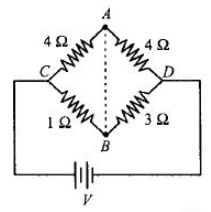

Download our appand get started for free
Experience the future of education. Simply download our apps or reach out to us for more information. Let's shape the future of learning together!No signup needed.*
Similar Questions
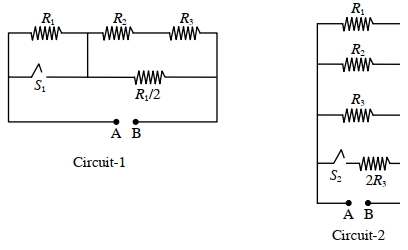
- 1In Circuit-$1$ and Circuit- $2$ shown in the figures, $R_1=1 \Omega, R_2=2 \Omega$ and $R_3=3 \Omega$. $P_1$ and $P_2$ are the power dissipations in Circuit-$1$ and Circuit-$2$ when the switches $S_1$ and $S_2$ are in open conditions, respectively. $Q_1$ and $Q_2$ are the power dissipations in Circuit-$1$ and Circuit-$2$ when the switches $S_1$ and $S_2$ are in closed conditions, respectively.View Solution
Which of the following statement($s$) is(are) correct?
$(A)$ When a voltage source of $6 V$ is connected across $A$ and $B$ in both circuits, $P_1$
$(B)$ When a constant current source of $2 Amp$ is connected across $A$ and $B$ in both circuits, $P_1>P_2$.
$(C)$ When a voltage source of $6 V$ is connected across $A$ and $B$ in Circuit-$1$, $Q_1>P_1$.
$(D)$ When a constant current source of $2 Amp$ is connected across $A$ and $B$ in both circuits, $Q_2$
- 2An unknown resistance $R_1$ is connected in series with a resistance of $10 \,\Omega$. This combinations is connected to one gap of a meter bridge while a resistance $R_2$ is connected in the other gap. The balance point is at $50\, cm$. Now, when the $10 \,\Omega$ resistance is removed the balance point shifts to $40\, cm$. The value of $R_1$ is (in $ohm$)View Solution
- 3The temperature coefficient of resistance of tungsten is $4.5 \times 10^{-3}{ }^{\circ} C ^{-1}$ and that of germanium is $-5 \times 10^{-2}{ }^{\circ} C ^{-1}$. A tungsten wire of resistance $100 \,\Omega$ is connected in series with a germanium wire of resistance $R$. The value of $R$ for which the resistance of combination does not change with temperature is .......... $\Omega$View Solution
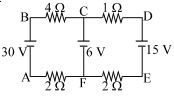
- 4View SolutionThe figure shows a network of four resistances and three batteries Which of the battery is getting charged.
- 5Three identical resistors $R_1=R_2=R_3$ are connected as shown to a battery of constant e.m.f. The power dissipated is ...........View Solution
- 6Two electric bulbs whose resistances are in the ratio of $1 : 2$ are connected in parallel to a constant voltage source. The powers dissipated in them have the ratioView Solution
- 7View SolutionSelect the correct statement
- 8When a potential difference $V$ is applied across a wire of resistance $R$, it dissipates energy at a rate $W$. If the wire is cut into two halves and these halves are connected mutually parallel across the same supply, the same supply, the energy dissipation rate will become:View Solution
- 9In a potentiometer, the null point is received at $7^{th}$ wire. If now we have to change the null point at $9^{th}$ wire, what should we do ?View Solution
- 10View SolutionAssertion : The electric bulbs glows immediately when switch is on.
Reason : The drift velocity of electrons in a metallic wire is very high.