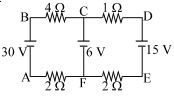
The figure shows a network of four resistances and three batteries Which of the battery is getting charged.
Diffcult
Download our app for free and get started
Left loop$:$
$V_{F}+6+4 I_{1}-30+2 I_{1}=V_{F}$
$I_{4}=4 A$
Right loop$:$
$V_{F}+6+1 I_{2}-15+2 I_{2}=V_{F} 30 V$
or $I_{2}=3 A$ Net current through $6 \mathrm{V}$ battery is
$I=I_{1}+I_{2}=4+3=7 A$
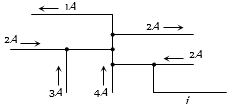
The $6 V$ battery is getting charged. Both $15 \mathrm{V}$ and $30 \mathrm{V}$ batteries produce current in $6 \mathrm{V}$ battery.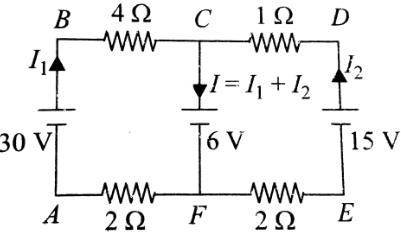

Download our appand get started for free
Experience the future of education. Simply download our apps or reach out to us for more information. Let's shape the future of learning together!No signup needed.*
Similar Questions
- 1A cylindrical conductor has uniform cross-section. Resistivity of its material increase linearly from left end to right end. If a constant current is flowing through it and at a section distance $x$ from left end, magnitude of electric field intensity is $E$, which of the following graphs is correctView Solution
- 2$A$ wire of cross-section area $A$, length $L_1$, resistivity $\rho_1$ and temperature coefficient of resistivity $\alpha_1$ is connected to a second wire of length $L_2$, resistivity $\rho_2$ , temperature coefficient of resistivity $\alpha_1$ and the same area $A$, so that wire carries same current. Total resistance $R$ is independent of temperature for small temperature change if (Thermal expansion effect is negligible)View Solution
- 3There are $0.8 \times 10^{23}$ free electrons $/ cm^3$ in copper. If $0.2\, A $ current is flowing is copper wire, then the drift velocity of electrons will be, if the cross sectional area of wire is $0.01 \,cm^2$View Solution
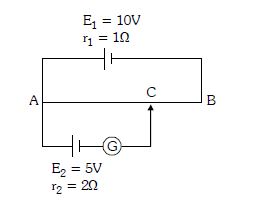
- 4In the figure the potentiometer wire of length $l =100\, cm$ and resistance $9\Omega$ is joined to a cell of emf $E_1 = 10V$ and internal resistance $r_1 = 1\Omega $. Another cell of emf $E_2 = 5\, V$ and internal resistance $r_2 = 2 \Omega $ is connected as shown. The galvanometer $G$ will show no deflection when the length $AC$ is ............... $cm$View Solution
- 5The resistance of a wire of uniform diameter $d$ and length $L$ is $R$. The resistance of another wire of the same material but diameter $2d$ and length $4L$ will beView Solution
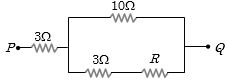
- 6In the circuit shown here, what is the value of the unknown resistor $R$ so that the total resistance of the circuit between points $P$ and $Q$ is also equal to $R$View Solution
- 7A steady current $I$ is set up in a wire whose cross-sectional area decreases in the direction of the flow of the current. Then, as we examine the narrowing region,View Solution
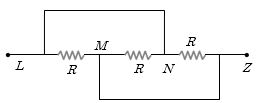
- 8Three equal resistances each of value $R$ are joined as shown in the figure. The equivalent resistance between $M$ and $N$ isView Solution
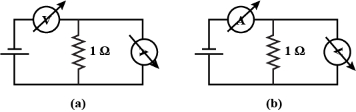
- 9A student uses the resistance of a known resistor $(1 \,\Omega)$ to calibrate a voltmeter and an ammeter using the circuits shown below. The student measures the ratio of the voltage to current to be $1 \times 10^3 \,\Omega$ in circuit $(a)$ and $0.999 \,\Omega$ in circuit $(b)$. From these measurements, the resistance (in $\Omega$ ) of the voltmeter and ammeter are found to be close toView Solution
- 10The figure here shows a portion of a circuit. What are the magnitude and direction of the current i in the lower right-hand wire .................... $A$View Solution