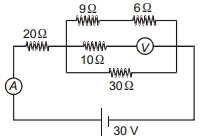
In the circuit shown in figure, if ammeter and voltmeter are ideal, then the power consumed in $9 \,\Omega$ resistor will be .......... $W$
Medium
Download our app for free and get started
(b)
No current goes through ideal voltmeter
$i=\frac{30}{30}=1 \,A$
$P=\frac{4}{9} .9=4 \,W$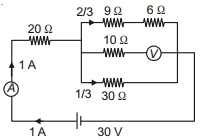

Download our appand get started for free
Experience the future of education. Simply download our apps or reach out to us for more information. Let's shape the future of learning together!No signup needed.*
Similar Questions
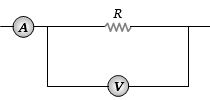
- 1The ammeter $A$ reads $2\, A$ and the voltmeter $V$ reads $20\, V$. the value of resistance $R$ is (Assuming finite resistance's of ammeter and voltmeter)View Solution
- 2$A$ potentiometer wire has length $10\, m$ and resistance $10\,\Omega$ . It is connected to a battery of $EMF$ $11\, volt$ and internal resistance $1\, \Omega$ , then the potential gradient in the wire is ............... $V/m$View Solution
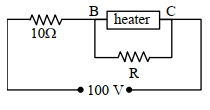
- 3A heater is designed to operate with a power of $1000 \mathrm{~W}$ in a $100 \mathrm{~V}$ line. It is connected in combination with a resistance of $10 \Omega$ and a resistance $R$, to a $100 \mathrm{~V}$ mains as shown in figure. For the heater to operate at $62.5 \mathrm{~W}$, the value of $\mathrm{R}$ should be .................. $\Omega$.View Solution
- 4A steady current $I$ flows through a wire of radius $r$, length $L$ and resistivity $\rho$. The current produces heat in the wire. The rate of heat loss in a wire is proportional to its surface area. The steady temperature of the wire is independent ofView Solution
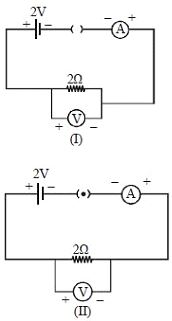
- 5For the circuits shown in figures $I$ and $II$, the voltmeter reading would beView Solution
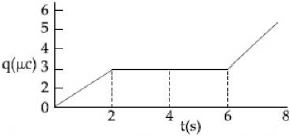
- 6The charge on a capacitor plate in a circuit, as a function of time, is shown in the figureView Solution
What is the value of current at $t = 4\,s$ ? ............... $\mu A$
- 7If $2.2\,kW$ power is transmitted through a $100\,\Omega $ line at $22,000\,V,$ the power loss in the form of heat will be ............. $W$View Solution
- 8View SolutionThe conductivity of a superconductor is
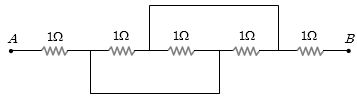
- 9Equivalent resistance between the points $A$ and $B$ is (in $\Omega$)View Solution
- 10In the given figure each plate of capacitance $C$ has partial value of chargeView Solution