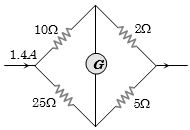
In the circuit shown in the figure, the current flowing in $2\,\Omega $ resistance ............... $A$
Medium


Download our appand get started for free
Experience the future of education. Simply download our apps or reach out to us for more information. Let's shape the future of learning together!No signup needed.*
Similar Questions
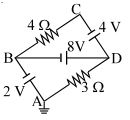
- 1The figure shows a network of resistances in which the point $A$ is earthed. The current through the $3\,\Omega$ resistor isView Solution
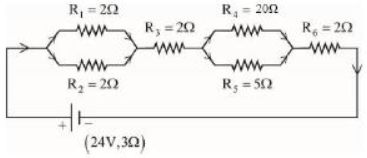
- 2As shown in the figure, a network of resistors is connected to a battery of $2\,V$ with an internal resistance of $3\,\Omega$. The currents through the resistors $R_4$ and $R_5$ are $I_4$ and $I_5$ respectively. The values of $I_4$ and $I_5$ are :View Solution
- 3In a balanced Wheatstone’s network, the resistances in the arms $Q$ and $S$ are interchanged. As a result of thisView Solution
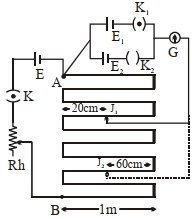
- 4In the given circuit of potentiometer, the potential difference $E$ across $AB$ ( $10\, m$ length) is larger than $E _{1}$ and $E _{2}$ as well. For key $K _{1}$ (closed), the jockey is adjusted to touch the wire at point $J_{1}$ so that there is no deflection in the galvanometer. Now the first battery $\left( E _{1}\right)$ is replaced by second battery $\left( E _{2}\right)$ for working by making $K _{1}$ open and $K _{2}$ closed. The galvanometer gives then null deflection at $J _{2}$. The value of $\frac{ E _{1}}{ E _{2}}$ is $\frac{ a }{ b },$ where $a =$ ...............View Solution
- 5Two electric bulbs whose resistances are in the ratio of $1 : 2$ are connected in parallel to a constant voltage source. The powers dissipated in them have the ratioView Solution
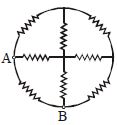
- 6Eight resistances each of resistance $5\,\Omega $ are connected in the circuit as shown in figure. The equivalent resistance between $A$ and $B$ isView Solution
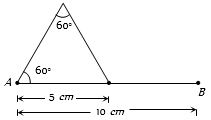
- 7A wire has resistance of $24\,\Omega$ is bent in the following shape. The effective resistance between $A$ and $B$ is .............. $\Omega$View Solution
- 8Three resistors are connected to form the sides of a triangle $ABC$, the resistance of the sides $AB$, $BC$ and $CA$ are $40\,ohms$, $60\,ohms$ and $100\,ohms$ respectively. The effective resistance between the points $A$ and $B$ in $ohms$ will beView Solution
- 9The drift velocity of electrons in silver wire with cross-sectional area $3.14 \times 10^{-6}\,m ^2$ carrying a current of $20\,A$ is. Given atomic weight of $Ag =108$ , density of silver $=10.5 \times 10^3\,kg / m ^3..........\times 10^{-4} m / sec$.View Solution
- 10In an electrical cable there is a single wire of radius $9\, mm$ of copper. Its resistance is $5\,\Omega $. The cable is replaced by $6$ different insulated copper wires, the radius of each wire is $3\,mm$. Now the total resistance of the cable will be ............... $\Omega$View Solution