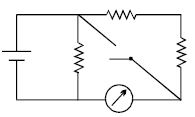
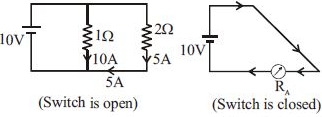
In the circuit shown, the reading of the Ammeter is doubled after the switch is closed. Each resistor has a resistance $ = 1\,\Omega $ and the ideal cell has an $e.m.f. = 10\, V$. Then, the Ammeter has a coil resistance equal to ................ $\Omega$
Medium


Download our appand get started for free
Experience the future of education. Simply download our apps or reach out to us for more information. Let's shape the future of learning together!No signup needed.*
Similar Questions
- 1What is the number density of donor atoms which must be added to a pure germanium semiconductor to make $n-$ type semiconductor of conductivity $6.4\ {\Omega ^{ - 1}}\,c{m^{ - 1}}$? The mobility of electr ons in $n-$ type germanium is $4 \times {10^3}\ cm^2\ V^{-1}\ s^{-1}$. Neglect the contribution of holes to conductivityView Solution
- 2In a metre-bridge when a resistance in the left gap is $2\ \Omega$ and unknown resistance in the right gap, the balance length is found to be $40\ \mathrm{~cm}$. On shunting the unknown resistance with $2\ \Omega$, the balance length changes by :View Solution
- 3A cell of internal resistance $1.5\,\Omega $ and of $e.m.f.$ $1.5\, volt$ balances $500\, cm$ on a potentiometer wire. If a wire of $15\,\Omega $ is connected between the balance point and the cell, then the balance point will shiftView Solution
- 4The current density in a cylindrical wire of radius $4 \; mm$ is $4 \times 10^{6} \; Am ^{-2}$. The current through the outer portion of the wire between radial distance $\frac{R}{2}$ and $R$ is $\dots \; \pi A .$View Solution
- 5Water of volume $2\, litre$ in a container is heated with a coil of $1\, kW$ at $27 \,^oC$. The lid of the container is open and energy dissipates at rate of $160\, J/s$. In how much time temperature will rise from $27\,^oC$ to $77\,^oC$ $[$ Given specific heat of water is $4.2\, kJ/kg$ $]$View Solution
- 6A resistance of $2 \Omega$ is comnected across one gap of a metre-bridge (the length of the wire is $100 \mathrm{~cm}$ ) and an unknown resistance, greater than $2 \Omega$, is connected across the other gap. When these resistance are interchanged, the balance point shifts by $20 \mathrm{~cm}$. Neglecting any corrections, the unknown resistance isView Solution
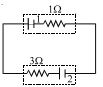
- 7In the figure shown, battery $1$ has $\mathrm{emf}$ $= 6\, V$ and internal resistance $= 1 \,\Omega$. Battery $2$ has $\mathrm{emf}$ $= 2\,V$ and internal resistance $= 3\, \Omega$ . The wires have negligible resistance. What is the potential difference across the terminals of battery $2$ ? ................ $V$View Solution
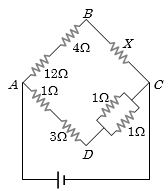
- 8In the circuit shown in the adjoining figure, the current between $B$ and $D$ is zero, the unknown resistance is of ................ $\Omega$View Solution
- 9The internal resistance of a $2.1\, V$ cell which gives a current of $0.2\, A$ through a resistance of $10\,\Omega$ is ............. $\Omega$View Solution
- 10View SolutionIf in the experiment of Wheatstone's bridge, the positions of cells and galvanometer are interchanged, then balance points will