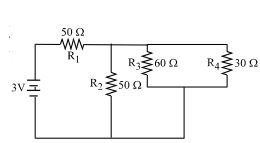
In the circuit shown, the resistances are given in ohms and the battery is assumed ideal with $\mathrm{emf}$ equal to $3.0$ $\mathrm{volts}.$ The resistor that dissipates the most power is
Advanced
Download our app for free and get started
Power is related to current and resistance by $P=I^{2} R \quad .$ The resistor that has
the most current would be $R_{1}$.
since all the other resistor share a current that is split from the main current running from battery to $R_{1}$
since $R_{e q} < R_{1},$ the most power is thus dissipated through $R_{1}$

Download our appand get started for free
Experience the future of education. Simply download our apps or reach out to us for more information. Let's shape the future of learning together!No signup needed.*
Similar Questions
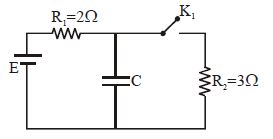
- 1In the circuit shown in the figure $K_1$ is open. The charge on capacitor $C$ in steady state is $q_1$. Now key is closed and at steady state charge on $C$ is $q_2$. The ratio of charges $q_1/q_2$ isView Solution
- 2If two wires having resistance $R$ and $2R$. Both joined in series and in parallel then ratio of heat generated in this situation, applying the same voltage,View Solution
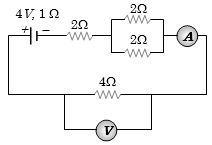
- 3What is the equivalent resistance of the circuit ............. $\Omega$View Solution
- 4Two resistance of $100\ \Omega$ and $200\ \Omega$ are connected in series with a battery of $4 \mathrm{~V}$ and negligible internal resistance. $A$ voltmeter is used to measure voltage across $100 \Omega$ resistance, which gives reading as $1 \mathrm{~V}$. The resistance of voltmeter must be ___$\Omega$.View Solution
- 5View SolutionThe resistivity of a wire depends on its
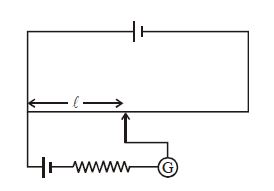
- 6In a potentiometer (see figure) a balance is obtained at a length of $400\ mm$ when using a known battery of emf $1.6\ V$. After removing this battery, another battery of unknown emf is used and balance is obtained at a length of $650\ mm.$ The emf of unknown battery is ............. $volt$View Solution
- 7$32$ cells, each of $emf$ $3V$, are connected in series and kept in a box. Externally, the combination shows an $emf$ of $84\, V$. The number of cells reversed in the combination isView Solution
- 8Space between two concentric conducting spheres of radii $a$ and $b (b > a)$ is filled with $a$ medium of resistivity $\rho $. The resistance between the two spheres will beView Solution
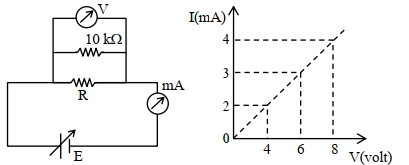
- 9To determine the resistance ($R$) of a wire, a circuit is designed below, The $V-I$ characteristic curve for this circuit is plotted for the voltmeter and the ammeter readings as shown in figure. The value of $\mathrm{R}$ is . . . . . . .$\Omega$View Solution
- 10A metal wire of specific resistance $64 \times {10^{ - 6}}\,ohm - cm$ and length $198\, cm$ has a resistance of $7\, ohm$, the radius of the wire will be ............. $cm$View Solution