Two resistance of $100\ \Omega$ and $200\ \Omega$ are connected in series with a battery of $4 \mathrm{~V}$ and negligible internal resistance. $A$ voltmeter is used to measure voltage across $100 \Omega$ resistance, which gives reading as $1 \mathrm{~V}$. The resistance of voltmeter must be ___$\Omega$.
JEE MAIN 2024, Diffcult
Download our app for free and get started
$\frac{R_V \cdot 100}{R_\gamma+100}=\frac{200}{3}$
$3 R_v=2 R_v+200$
$R_v=200$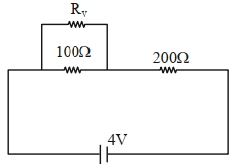

Download our appand get started for free
Experience the future of education. Simply download our apps or reach out to us for more information. Let's shape the future of learning together!No signup needed.*
Similar Questions
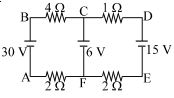
- 1View SolutionThe figure shows a network of four resistances and three batteries Mark the incorrect statement.
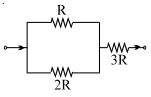
- 2A $2\, volt$ battery, a $15\,\Omega $ resistor and a potentiometer of $100\, cm$ length, all are connected in series. If the resistance of potentiometer wire is $5\,\Omega $, then the potential gradient of the potentiometer wire is ............... $V/cm$View Solution
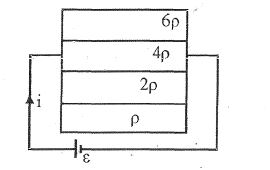
- 3If resistivity of all four wire connected in parallel is different as given in figure and all other dimensions of wire are same then current $i$ is (resistance of wire having resistivity $\rho $ is $R_0$ )View Solution
- 4A uniform wire of $16\,\Omega $ is made into the form of a square. Two opposite corners of the square are connected by a wire of resistance $16\,\Omega $. The effective resistance between the other two opposite corners is ............... $\Omega$View Solution
- 5A rod of length $l$ with thermally insulated lateral surface is made of a material whose thermal conductivity $K$ varies as $K = C/T$ , where $C$ is a constant. The ends are at temperatures $T_1$ and $T_2$ . The heat current density isView Solution
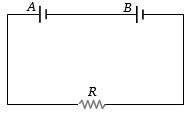
- 6Two batteries $A$ and $B$ each of $e.m.f.$ $2\, V$ are connected in series to an external resistance $R = 1 \,ohm$. If the internal resistance of battery $A$ is $1.9\, ohms$ and that of $B$ is $0.9\, ohm$, what is the potential difference between the terminals of battery $A$ ............. $V$View Solution
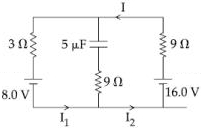
- 7The circuit shown here has two batteries of $8.0\,V$ and $16.0\,V$ and three resistors $3\,\Omega ,\,9\,\Omega $ and $9\,\Omega $ and a capacitor of $5.0\,\mu F.$View Solution
How much is the current $I$ in the circuit in steady state? ................... $A$
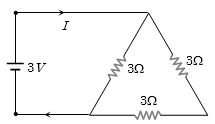
- 8A $3\, volt$ battery with negligible internal resistance is connected in a circuit as shown in the figure. The current $I$, in the circuit will be ............. $A$View Solution
- 9The $H$ amount of thermal energy is developed by a resistor in $10\,s$ when a current of $4\,A$ is passed through it. If the current is increased to $16\,A$, the thermal energy developed by the resistor in $10\,s$ will be $........\,H$View Solution
- 10The ratio of powers dissipatted respectively in $R$ and $3R$, as shown is:View Solution