MCQ
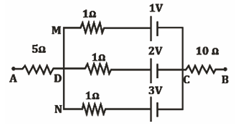
In the circuit, the potential difference between A and B is
Image
  • A
    6 V
  • B
    1 V
  • C
    3 V
  • 2 V

Answer

Correct option: D.
2 V
(D) 2 V
$V=\frac{\frac{1}{2}+\frac{2}{1}+\frac{3}{1}}{\frac{1}{1}+\frac{1}{1}+\frac{1}{1}}=2 V$

Need a full question paper?

Generate a complete, print-ready paper with questions like this in minutes — across 16+ boards, with answer keys.
Start Generating Free

Similar questions

When a hydrogen atom, initially at rest emits, a photon resulting in transition $n = 5\, \rightarrow \,n = 1$, its recoil speed is about
A stone thrown down with a speed $u$ takes a time $t_1$ to reach the ground, while another stone thrown upwards from the same point with the same speed takes time $t_2$. The maximum height the second stone reaches from the ground is
In a cyclotron, the angular frequency of a charged particle is independent of
Radon $({R_n})$ decays into Polonium (${P_0}$) by emitting an $\alpha - $ particle with half-life of $4\, days$. A sample contains $6.4 \times {10^{10}}$ atoms of $R_n$. After $12\, days$, the number of atoms of ${R_n}$ left in the sample will be
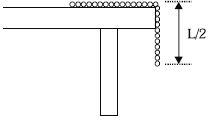
A uniform chain (mass $M,$ length $L$) is released from rest from a smooth horizontal surface as shown in the figure. Velocity of the chain at the instant it completely comes out of the table will be
When the distance between the charged particles is halved, the force between them becomes
The transition from the state $n = 4$ to $n = 3$ in a hydrogen like atom results in ultraviolet radiation. Infrared radiation will be obtained in the transition from
A force $F$ is applied on the wire of radius $r$ and length $L$ and change in the length of wire is $l.$ If the same force $F$ is applied on the wire of the same material and radius $2r$ and length $2L,$ Then the change in length of the other wire is
A block slides down a smooth inclined plane when released from the top, while another falls freely from the same point
There is a uniformly charged non conducting solid sphere made of material of dielectric constant one. If electric potential at infinity be zero, then the potential at its surface is $V$. If we take electric potential at its surface to be zero, then the potential at the centre will be