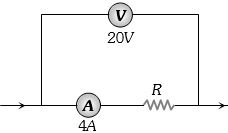
In the diagram shown, the reading of voltmeter is $20\, V$ and that of ammeter is $4\, A$. The value of $R$ should be (Consider given ammeter and voltmeter are not ideal)
Medium


Download our appand get started for free
Experience the future of education. Simply download our apps or reach out to us for more information. Let's shape the future of learning together!No signup needed.*
Similar Questions
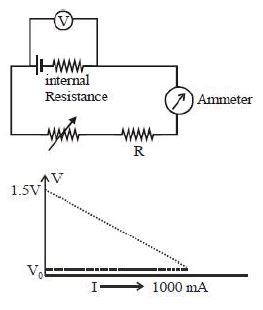
- 1To verify Ohm's law, a student connects the voltmeter across the battery as, shown in the figure. The measured voltage is plotted as a function of the current, and the following graph is obtained If $V_0$ is almost zero, identify the correct statementView Solution
- 2The length of the resistance wire is increased by $10\%$. What is the corresponding change in the resistance of wire ................ $\%$View Solution
- 3Two bulbs are working in parallel order. Bulb $A$ is brighter than bulb $B$. If ${R_A}$ and ${R_B}$ are their resistance respectively thenView Solution
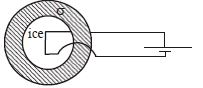
- 4Figure shows a thick shell made of electrical conductivity $\sigma$ and has inner & outer radii of $10\ cm$ & $20\ cm$ respectively and is filled with ice inside it. Its inside and outside surface are kept at different potentials by a battery of internal resistance $\frac{2}{\pi} \Omega \ \&\ \in = 5V$. Find value of $\sigma$ for which ice melts at maximum possible rate if $25\%$ of heat generated by shell due to joule heating is used to melt ice.View Solution
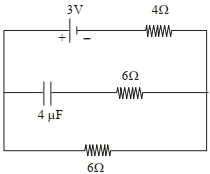
- 5In the network shown below, the charge accumulated in the capacitor in steady state will be ........... $\mu C$View Solution
- 6The potential difference between points $A$ and $B$ of adjoining figure isView Solution
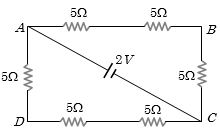
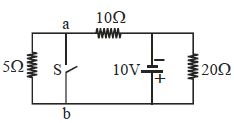
- 7In the circuit shown below, the current that flows from $a$ to $b$ when the switch $S$ is closed ............... $A$View Solution
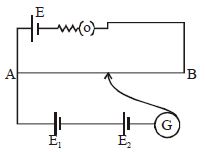
- 8In given arrangement $E_1 = 5\, volts$ $E_2 = 7\, volt$ balancing length is $6\,m$ if terminals of $E_2$ are reversed then new balancing length will beView Solution
- 9Potentiometer wire of length $1 \,m$ is connected in series with $490\,\Omega $ resistance and $2\,V$ battery. If $0.2\, mV/cm $ is the potential gradient, then resistance of the potentiometer wire is ................ $\Omega$View Solution
- 10Resistance of the wire is measured as $2\,\Omega$ and $3\,\Omega$ at $10^{\circ}C$ and $30^{\circ}C$ respectively. Temperature cocoefficient of resistance of the material of the wire is............$^{\circ}C ^{-1}$View Solution