In the experiment of calibration of voltmeter, a standard cell of $e.m.f\,\,1.1\,volt$ is balanced against $440\,cm$ of potential wire. The potential difference across the ends of resistance is found to balance against $220\,cm$ of the wire. The corresponding reading of voltmeter is $0.5\,volt.$ The error in the reading of volmeter will be .................. $volt$
JEE MAIN 2014, Diffcult


Download our appand get started for free
Experience the future of education. Simply download our apps or reach out to us for more information. Let's shape the future of learning together!No signup needed.*
Similar Questions
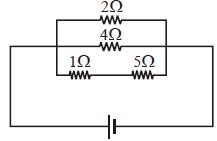
- 1A current of $3\,amp$ flows through the $2\,\Omega $ resistor shown in the circuit. The power dissipated in the $5\,\Omega $ resistor is ................. $watt$View Solution
- 2A certain wire has a resistance $R$. The resistance of another wire identical with the first except having twice its diameter isView Solution
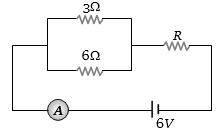
- 3If the ammeter in the given circuit reads $2\, A$, the resistance $R$ is ............ $ohm$View Solution
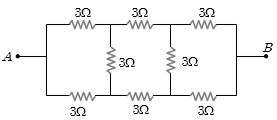
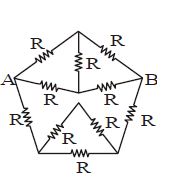
- 4Calculate the equivalent resistance between $A$ and $B$View Solution
- 5Two wires of equal diameters, of resistivities ${\rho _1}$ and ${\rho _2}$ and lengths $l_1$ and $l_2$, respectively, are joined in series. The equivalent resistivity of the combination isView Solution
- 6View SolutionExpress which of the following setups can be used to verify Ohm’s law
- 7A copper rod of cross-sectional area $A$ carries a uniform current $I$ through it. At temperature $T$, if the volume charge density of the rod is $\rho $, how long will the charges take to travel a distance $d$ ?View Solution
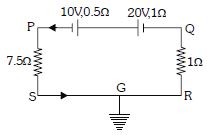
- 8View SolutionIn the circuit shown in the figure below, which of the following statement is incorrect ?
- 9The effective resistance between $A$ and $B$ of the shown network, where resistance of each resistor is $R$ , isView Solution
- 10The terminal voltage across a battery of $\mathrm{emf}$ $E$ can beView Solution