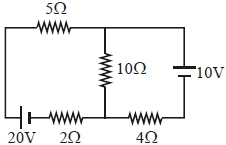
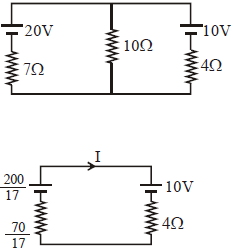
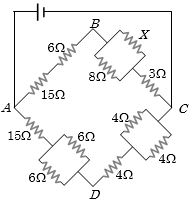
In the figure shown, the current in the $10\, V$ battery is close to
JEE MAIN 2020, Medium


Download our appand get started for free
Experience the future of education. Simply download our apps or reach out to us for more information. Let's shape the future of learning together!No signup needed.*
Similar Questions
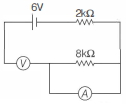
- 1In the circuit shown below, a student performing Ohm's law experiment accidently puts the voltmeter and the ammeter as shown in the circuit below. The reading in the voltmeter will be close to .......... $V$View Solution
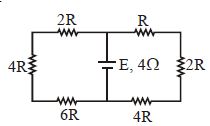
- 2A battery of internal resistance $4\,\Omega $ is connected to the network of the resistance as shown in Fig. If the maximum power can be delivered to the network, the magnitude of $R$ in $\Omega $ should beView Solution
- 3The electric current through a wire varies with time as $I=I_0+\beta t$. where $I_0=20 \mathrm{~A}$ and $\beta=3 \mathrm{~A} / \mathrm{s}$. The amount of electric charge crossed through a section of the wire in $20 \mathrm{~s}$ is :View Solution
- 4In the figure given the value of $X$ resistance will be, when the $p.d.$ between $B$ and $D$ is zero ................... $ohm$View Solution
- 5Which of the following wiring diagrams could be used to experimentally determine $R$ using ohm's law? Assume an ideal voltmeter and an ideal ammeter.View Solution
- 6For comparing the $e.m.f.$'s of two cells with a potentiometer, a standard cell is used to develop a potential gradient along the wires. Which of the following possibilities would make the experiment unsuccessfulView Solution
- 7Consider a metallic cube of edge length $L$. Its resistance, $R$, measured across its opposite faces is $R =\frac{ m _{ e } v }{ ne ^2 L ^2}$, where $n$ is the number density and $v$ is the drift speed of electrons in the cube, and $e$ and $m _{ e }$ are the charge and mass of an electron respectively. Assuming the de-Broglie wavelength of the electron to be $L$, the maximum resistance of the sample is closest to ............. $\,\Omega$ $\left(e=1.60 \times 10^{-19} \,C ; m _{ e }=9.11 \times 10^{-31} \,kg\right.$; Planck's constant, $h=6.63 \times 10^{-34} \,Js$ )View Solution
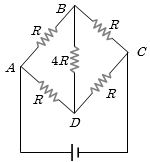
- 8Five resistors of given values are connected together as shown in the figure. The current in the arm $BD$ will beView Solution
- 9View SolutionThe internal resistance of a cell is the resistance of
- 10An electric wire is connected across a cell of $e.m.f.$ The current $I$ is measured by an ammeter of resistance $R$. According to ohm's lawView Solution