MCQ
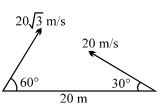
In the figure shown, the two projectiles are fired simultaneously. The minimum distance between them during their flight is  ........ $m$
  • A
    $20 $
  • B
    $10\sqrt 3$
  • $10$
  • D
    None

Answer

Correct option: C.
$10$
c
Talking origin at a and $x$ axis along $A B$ Velocity of $A$ $w.r.t.$ $B$ $=20 \sqrt{3}(\cos 60 \hat{i}+\sin 60 \hat{j})-20(\cos 150 \hat{i}+\sin 150 \hat{j})$

$=20 \sqrt{3}\left(\frac{1}{2} \hat{i}+\frac{\sqrt{3}}{2} \hat{j}\right)-20\left(-\frac{\sqrt{3}}{2} \hat{i}+\frac{1}{2} \hat{j}\right)=20 \sqrt{3} \hat{i}+20 \hat{j}$

$\tan \theta=\frac{20}{20 \sqrt{3}}=\frac{1}{\sqrt{3}} \Rightarrow \theta=30^{\circ}$

so $\frac{d_{\min }}{20}=\sin \theta=\sin 30^{\circ}=\frac{1}{2} \Rightarrow d_{\min }=10 \mathrm{m}$

Need a full question paper?

Generate a complete, print-ready paper with questions like this in minutes — across 16+ boards, with answer keys.
Start Generating Free

Similar questions

A particle excutes $SHM$ on a straight line path. The amplitude of oscillation is $2\,cm$. When the displacement of the particle from the mean position is $1\,cm$, the numerical value of magnitude of acceleration is equal to the numerical value of magnitude of velocity. The frequency of $SHM$ is (in $second^{-1}$)
In case of hydrogen and oxygen at $N.T.P.$, which of the following quantities is $/$ are the same?
The trajectory of a projectile in a vertical plane is $y =\alpha x -\beta x ^{2},$ where $\alpha$ and $\beta$ are constants and $x \& y$ are respectively the horizontal and vertical distances of the projectile from the point of projection. The angle of projection $\theta$ and the maximum height attained $H$ are respectively given by :-
A body A of mass 0.5 kg and specific heat 0.85 is at a temperature of $60^{\circ} C$. Another body B of mass 0.3 kg and specific heat 0.9 is at a temperature of $90^{\circ} C$. When they are connected to a conducting rod, heat will flow from
$n$ drops of $a$ liquid, each with surface energy $E$, joining to form a single drop
Three moles of an ideal gas $\left( {{C_P} = \frac{7}{2}R} \right)$ at pressure ${P_A}$ and temperature ${T_A}0$ is isothermally expanded to twice its initial volume. It is then compressed at constant pressure to its original volume. Finally the gas is compressed at constant volume to its original pressure ${P_A}.$ The correct $P-V$ and $P-T$ diagrams indicating the process are
A planet of mass $'m'$ is moving in an elliptical orbit about the sun with time period $'T'$. If $'A'$ be the area of orbit, then its angular momentum would be
An ideal gas goes from state $A$ to state $B$ via three different processes as indicated in the $P-V$ diagram. If $Q_1, Q_2, Q_3$ indicate the heat absorbed by the gas along the three processes and $\Delta U_1, \Delta U_2, \Delta U_3$ 
indicate the change in internal energy along the three processes respectively, then 
A small ball falling vertically downward with constant velocity $4m/s$ strikes elastically $a$ massive inclined cart moving with velocity $4m/s$ horizontally as shown. The velocity of the rebound of the ball is
For circular motion, if ${\vec a_t},\,{\vec a_c},\,\vec r$ and $\vec v$ are tangential acceleration, centripetal acceleration, radius vector and velocitym respectively, then find the wrong relation