MCQ
In the following transitions, which one has higher frequency
  • A
    $3 -2$
  • B
    $4 -3$
  • C
    $4 -2$
  • $3 -1$

Answer

Correct option: D.
$3 -1$
d
(d) $3 -1$ transition has higher energy so it has higher frequency $\left( {\nu = \frac{E}{h}} \right)$

Need a full question paper?

Generate a complete, print-ready paper with questions like this in minutes — across 16+ boards, with answer keys.
Start Generating Free

Similar questions

The charge density of a cone shaped object will be maximum:
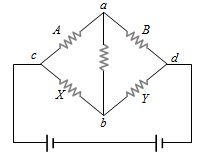
In the Wheatstone's bridge (shown in figure) X = Y and A > B. The direction of the current between ab will be
Two charged particles traverse identical helical paths in a completely opposite sense in a uniform magnetic field.
A parallel$-$plate capacitor is connected to a battery. A metal sheet of negligible thickness is placed between the plates. The sheet remains parallel to the plates of the capacitor:
Consider the points lying on a straight line joining two fixed opposite charges. Between the charges there is
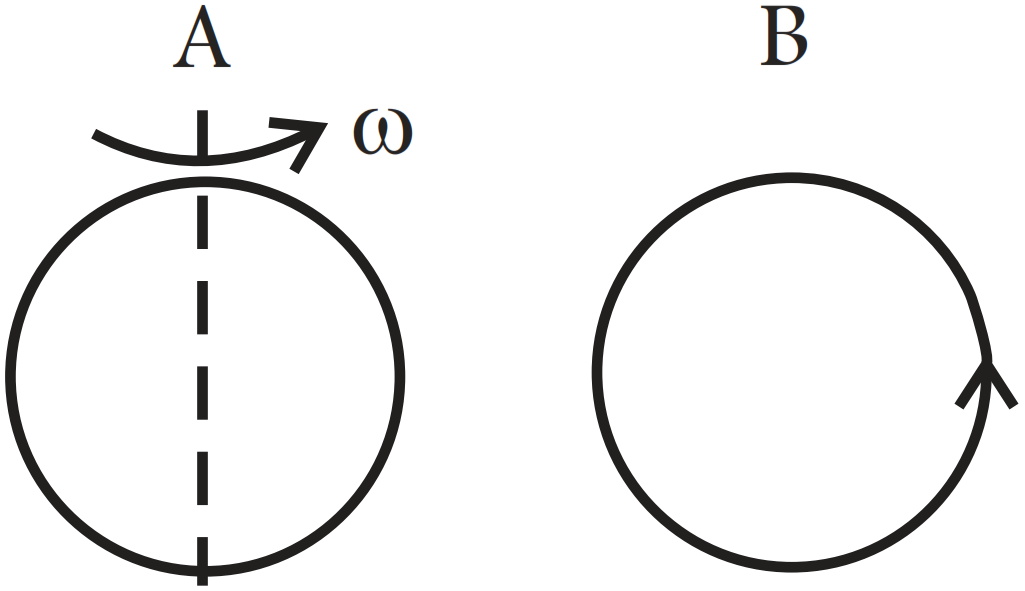
Same as problem $4$ except the coil A is made to rotate about a vertical axis $($Fig$)$. No current flows in $B$ if $A$ is at rest. The current in coil $A$, when the current in $B ($at $t = 0)$ is counterclockwise and the coil $A$ is as shown at this instant, $t = 0$, is:
Rutherford’s a - particle experiment showed that the atoms have
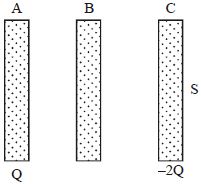
Three identical metal plates with large surface areas are kept parallel to each other as shown in figure. The left most plates is given a charge $Q$ and the right most plate $C$ is given a charge $-2Q.$ The middle plate $B$ is neutral. Then the charge appearing on the outer surface $S$ of the plate $C$ is :-
In the nuclear fusion reaction $_1^2H + _1^3H \to _2^4He + n,$ given that the repulsive potential energy between the two nuclei is $ - 7.7 \times {10^{ - 14}}J$, the temperature at which the gases must be heated to initiate the reaction is nearly [Boltzmann’s constant $k = 1.38 \times {10^{ - 23}}J/K$]
The half-life period of a radio-active element $X$ is same as the mean life time of another radio-active element $Y$ Initially they have the same number of atoms. Then