MCQ
In the given circuit what is the potential drop across resistance?
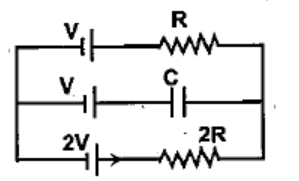
- A40 V
- B80 V
- C120 V
- Dzero
Explanation:
At resonance the voltage across L and C are same but opposite.
So, at resonance $\mid\text{V}_\text{L}\mid=\mid\text{V}_\text{C}\mid$
$\therefore\text{V}_\text{R}=\text{V}_\text{app}=120\text{V}$
Generate a complete, print-ready paper with questions like this in minutes — across 16+ boards, with answer keys.
Force of attraction between two point charges Q and -Q separated by d metre is  . When these charges are placed on two identical spheres of radius R = 0.3d whose centres are d metre apart, the force of attraction between them is
|
(a) Greater than
|
(b) Equal to
|
(c) Less than |
(d) Less than |
Which of one is correct
|
(a) |
(b) |
(c) |
(d) |
In a diffraction pattern by a wire, on increasing diameter of wire, fringe width
|
(a) Decreases |
|
(b) Increases |
|
(c) Remains unchanged |
|
(d) Increasing or decreasing will depend on wavelength |
Assertion : In Young’s experiment, the fringe width for dark fringes is different from that for white fringes.
Reason : In Young’s double slit experiment the fringes are performed with a source of white light, then only black and bright fringes are observed.
|
(a) If both assertion and reason are true and the reason is the correct explanation of the assertion. |
|
(b) If both assertion and reason are true but reason is not the correct explanation of the assertion. |
|
(c) If assertion is true but reason is false. |
|
(d) If the assertion and reason both are false. |


