Question
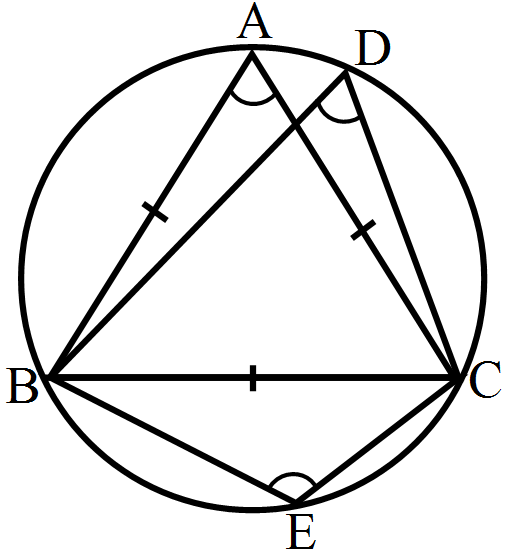
In the given figure, $\triangle\text{ABC}$ is equilateral. Find 
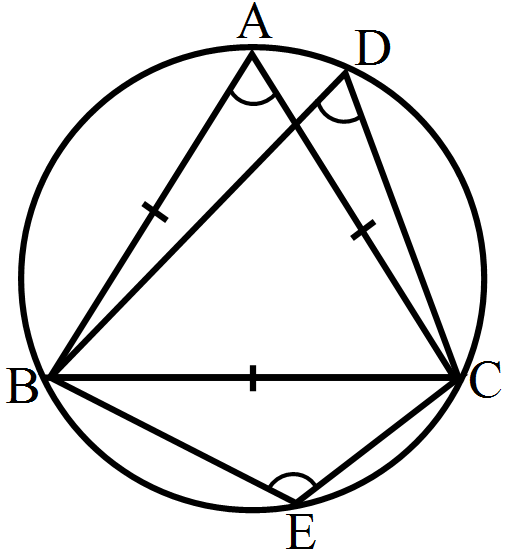
  1. $\angle\text{BDC}$
  2. $\angle\text{BEC}$

Answer

  1. Given: $\triangle\text{ABC}$ is an equilateral triangle
i.e., each of its angle = 60°
$\Rightarrow\ \angle\text{BAC}=\angle\text{ABC}=\angle\text{ACB}=60^\circ$
Angles in the same segment of a circle are equal.
$\text{i.e.},\angle\text{BDC}=\angle\text{BAC}=60^\circ$
$\therefore\ \angle\text{BDC}=60^\circ$
  1. The opposite angles of a cyclic quadrilateral are supplementary.
Then in cyclic quadrilateral ABEC, we have:
$\angle\text{BAC}+\angle\text{BEC}=180^\circ$
$\Rightarrow\ 60^\circ+\angle\text{BEC}=180^\circ$
$\Rightarrow\ \angle\text{BEC}=(180^\circ-60^\circ)=120^\circ$
$\therefore\ \angle\text{BDC}=60^\circ$ and $\angle\text{BEC}=120^\circ$

Need a full question paper?

Generate a complete, print-ready paper with questions like this in minutes — across 16+ boards, with answer keys.
Start Generating Free

Similar questions

In a parallelogram, opposite sides are equal.
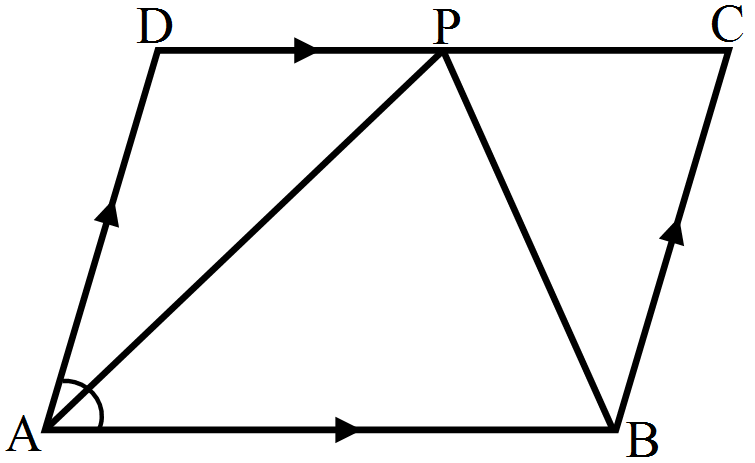
In the adjoining figure, ABCD is a parallelogram in which $\angle\text{A}=60^{\circ}.$ If the bisectors of $\angle\text{A}$ and $\angle\text{B}$ meet DC at P, prove that
  1. $\angle\text{APB}=90^{\circ},$
  2. AD = DP and PB = PC = BC,
  3. DC = 2AD.
​​​​​​​
Two triangles are congruent if two angles and the included side of one triangle are equal to two angles and the included side of other triangle.
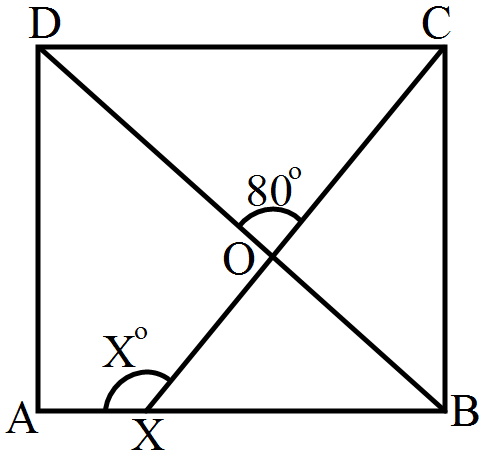
In the adjoining figure, ABCD is a square. A line segment CX cuts AB at X and the diagonal BD at O such that $\angle\text{COD}=80^{\circ}$ and $\angle\text{OXA}=\text{x}^{\circ}.$ Find the value of x.
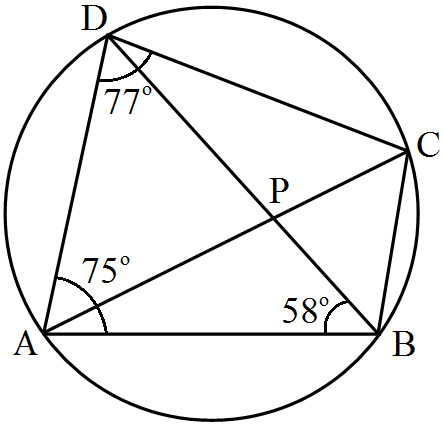
In the given figure, ABCD is a cyclic quadrilateral in which $\angle\text{BAD} = 75^\circ,\ \angle\text{ABD} = 58^\circ$ and $\angle\text{ADC} = 77^\circ, $ AC and BD intersect at P. Then, find $\angle\text{DPC}.$
Find the cost of sinking a tube well $280m$ deep, having diameter $3m$ at the rate of $₹ 3.60$ per cubic metre. Find also the cost of cementing its inner curved surface at $₹ 2.50$ per square metre.
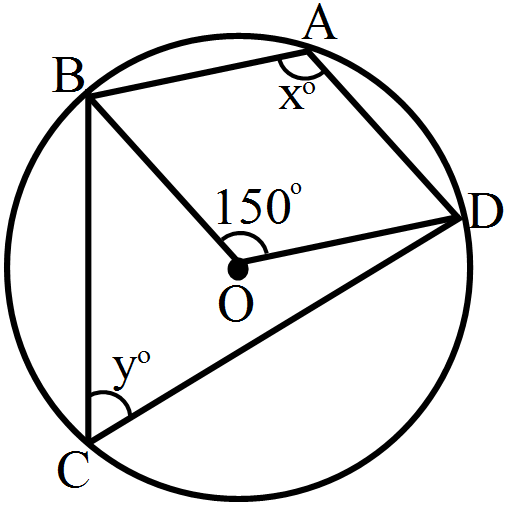
In the given figure, O is the centre of a circle and $\angle\text{BOD}=150^\circ.$ Find the values of x and y.
The diameter of a cylinder is 28cm and its height is 40cm. Find the curved surface, total surface area and the volume of the cylinder.
A soft drink is available in two packs:
  1. A tin can with a rectangular base of length $5\ cm,$ breadth $4\ cm$ and height $15\ cm.$
  2. A plastic cylinder with circular base of diameter $7\ cm$ and height $10\ cm.$
Which container has greater capacity and by how much?
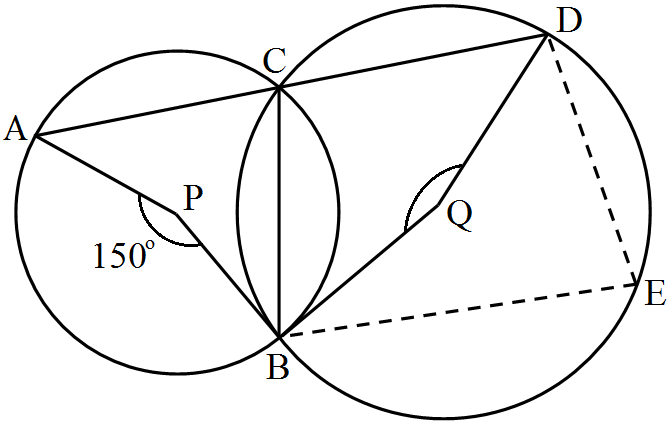
In the given figure, P and Q are centres of two circles intersecting at B and C. ACD is a straight line. Then, $\angle\text{BQD} =$