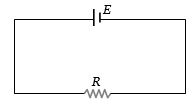
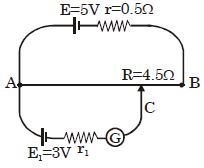
In the given potentiometer circuit length of the wire $AB$ is $3\,m$ and resistance is $R = 4.5 \,\Omega.$ The length $AC$ for no deflection in galvanometer is ................ $\mathrm{m}$
Medium


Download our appand get started for free
Experience the future of education. Simply download our apps or reach out to us for more information. Let's shape the future of learning together!No signup needed.*
Similar Questions
- 1A potentiometer has uniform potential gradient. The specific resistance of the material of the potentiometer wire is $10^{-7} \, ohm-meter$ and the current passing through it is $0.1\, ampere$; cross-section of the wire is $10^{-6}\, m^2$. The potential gradient along the potentiometer wire isView Solution
- 2View SolutionAssertion : In a simple battery circuit, the point of the lowest potential is positive terminal of the battery.
Reason : The current flows towards the point of the higher potential, as it does in such a circuit from the negative to the positive terminal.
- 3Time taken by a $836\; W$ heater to heat $1\; litre$ of water from $10^{\circ} C$ to $40^{\circ} C$ isView Solution
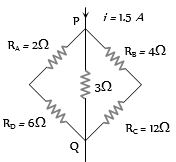
- 4Potential difference between the points $P$ and $Q$ in the electric circuit shown is ................. $V$View Solution
- 5Two resistors are joined in parallel whose, resultant is $\frac{6}{5} \,\Omega$. One of the resistance wire is broken and the effective resistance becomes $2 \,ohms$. Then the resistance (in $ohm$) of the wire that got broken is ..........View Solution
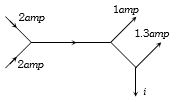
- 6The figure below shows currents in a part of electric circuit. The current $i$ is ............. $amp$View Solution
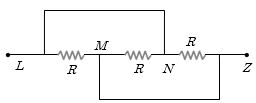
- 7Three equal resistances each of value $R$ are joined as shown in the figure. The equivalent resistance between $M$ and $N$ isView Solution
- 8A potentiometer consists of a wire of length $4\, m$ and resistance $10 \,\Omega$. It is connected to cell of $emf$ $2\, V$. The potential difference per unit length of the wire will be ............ $V/m$View Solution
- 9Two indentical electric lamps marked $500\, W, \,\,220\, V$ are connected in series and then joined to a $110\, V$ line. The power consumed by each lamp isView Solution
- 10Consider the circuit given here with the following parameters $E.M.F.$ of the cell = $12\, V$. Internal resistance of the cell $ = 2\,\Omega $. Resistance $R = 4\,\Omega $ Which one of the following statements in trueView Solution