A potentiometer consists of a wire of length $4\, m$ and resistance $10 \,\Omega$. It is connected to cell of $emf$ $2\, V$. The potential difference per unit length of the wire will be ............ $V/m$
Easy


Download our appand get started for free
Experience the future of education. Simply download our apps or reach out to us for more information. Let's shape the future of learning together!No signup needed.*
Similar Questions
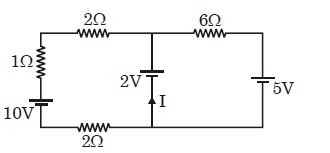
- 1Find the value of $I$ ?................ $\mathrm{A}$View Solution
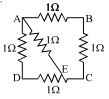
- 2$ABCD$ is a square where each side is a uniform wire of resistance $1\,\Omega$ . $A$ point $E$ lies on $CD$ such that if a uniform wire of resistance $1\,\Omega$ is connected across $AE$ and constant potential difference is applied across $A$ and $C$ then $B$ and $E$ are equipotential.View Solution
- 3If an electric heater is rated at $1000\, W$, then the time required to heat one litre of water from $20\,^oC$ to $60\,^oC$ isView Solution
- 4A battery has $e.m.f.$ $4\, V$ and internal resistance $r$. When this battery is connected to an external resistance of $2\, ohms$, a current of $1\, amp$. flows in the circuit. How much current will flow if the terminals of the battery are connected directly .......... $amp$View Solution
- 5The circuit shown has been connected for a long time. The voltage across the capacitor is ............. $V$View Solution
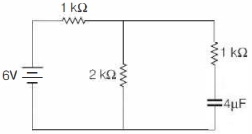
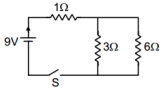
- 6After switch is closed, current drawn from the battery is (in $A$)View Solution
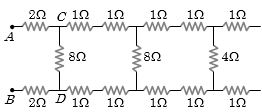
- 7In the figure shown, the total resistance between $A$ and $B$ is ............. $\Omega$View Solution
- 8A wire when connected to $220\,V$ mains supply has power dissipation ${P_1}$. Now the wire is cut into two equal pieces which are connected in parallel to the same supply. Power dissipation in this case is ${P_2}$. Then ${P_2}:{P_1}$ isView Solution
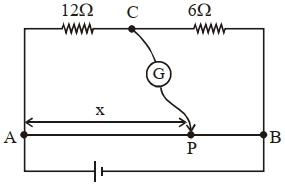
- 9Consider a $72\, cm$ long wire $AB$ as shown in the figure. The galvanometer jockey is placed at $P$ on $A B$ at a distance $x cm$ from $A$. The galvanometer shows zero deflection.View Solution
The value of $x,$ to the nearest integer, is ..... $cm$
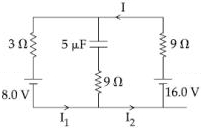
- 10The circuit shown here has two batteries of $8.0\,V$ and $16.0\,V$ and three resistors $3\,\Omega ,\,9\,\Omega $ and $9\,\Omega $ and a capacitor of $5.0\,\mu F.$View Solution
How much is the current $I$ in the circuit in steady state? ................... $A$