Two resistors are joined in parallel whose, resultant is $\frac{6}{5} \,\Omega$. One of the resistance wire is broken and the effective resistance becomes $2 \,ohms$. Then the resistance (in $ohm$) of the wire that got broken is ..........
Medium
Download our app for free and get started
(d)
$\frac{R_1 R_2}{R_1+R_2}=\frac{6}{5}$
$R_1=2$
$\frac{2 R_2}{2+R_2}=\frac{6}{5}$
$5 R_2=6+3 R_2$
$2 R_2=6$
$R_2=3 \,\Omega$

Download our appand get started for free
Experience the future of education. Simply download our apps or reach out to us for more information. Let's shape the future of learning together!No signup needed.*
Similar Questions
- 1An electron (charge $= 1.6 × 10^{-19}$ coulomb) is moving in a circle of radius $5.1 × 10^{-11}\,m$ at a frequency of $6.8 × 10^{15} $ revolutions/sec. The equivalent current is approximatelyView Solution
- 2View SolutionThe material of wire of potentiometer is
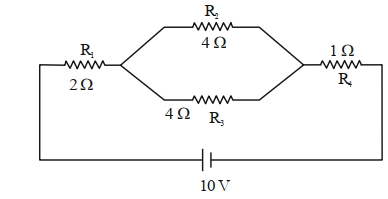
- 3In the given circuit, the current in resistance $\mathrm{R}_3 $ is :View Solution
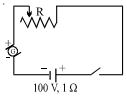
- 4The battery in the diagram is to be charged by the generator $G$. The generator has a terminal voltage of $120$ $\mathrm{volts}$ when the charging current is $10$ $\mathrm{amperes}.$ The battery has an $\mathrm{emf}$ of $100$ $\mathrm{volts}$ and an internal resistance of $1$ $\mathrm{ohm}.$ In order to charge the battery at $10$ $\mathrm{amperes}$ charging current, the resistance $R$ should be set at ................ $\Omega$View Solution
- 5In a region $10^{19}$ $\alpha -$ particels and $10^{19}$ protons per second move to the left, while $10^{19}$ electrons moves to the right per second. The current isView Solution
- 6A $3\,^oC$ rise in temperature is observed in a conductor by passing a certain current. When the current is doubled, the rise in temperature will be ............. $^oC$View Solution
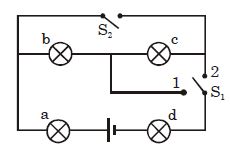
- 7Four lamps are connected in the way shown in the figure. When switch $S_2$ is open and switch $S_1$ is on position $-2$ , lamp $-b$ is the brightest, and lamp $-c$ and lamp $-d$ are the dimmest and are of the same brightness. Now $S_2$ is closed and $S_1$ is on position $-1$ , the sequence in brightness of the lamps is (with the first in the sequence being the brightest)View Solution
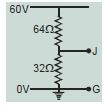
- 8Find potential of $J$ with : respect to $G -$ ............. $V$View Solution
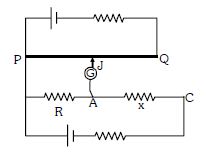
- 9Circuit for the measurement of resistance by potentiometer is shown. The galvanometer is first connected at point $A$ and zero deflection is observed at length $P J = 10\ cm$ . In second case it is connected at point $C$ and zero deflection is observed at a length $30\ cm$ from $P$ . Then the unknown resistance $X$ isView Solution
- 10The electromotive force of a primary cell is $2\, volts$. When it is short-circuited it gives a current of $4$ amperes. Its internal resistance in $ohms$ isView Solution