MCQ
In the given reaction :

$C{H_3} - C{H_2} - \mathop S\limits_{ \bullet \,\, \bullet }^{ \bullet \,\, \bullet }  - \mathop C\limits^* {H_2} - C{H_2} - Br\xrightarrow{{HOH}}[X]$

$[X]$ will be :

  • A
    $C{H_3} - C{H_2} - S - \mathop C\limits^* {H_2} - C{H_2} - OH$
  • B
    $C{H_3} - C{H_2} - S - C{H_2} - \mathop C\limits^* {H_2} - OH$
  • $1 : 1$ mixture of $(A)$ and $(B)$
  • D
    $2 : 1$ mixture of $(A)$ and $(B)$

Answer

Correct option: C.
$1 : 1$ mixture of $(A)$ and $(B)$
c

Need a full question paper?

Generate a complete, print-ready paper with questions like this in minutes — across 16+ boards, with answer keys.

Start Generating Free

Similar questions

The standard compound for determination of configuration in the ‘sugar chemistry’ is
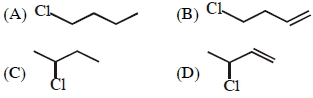
The decreasing order of reactivity towards dehydrohalogenation $(E_1)$ reaction of the following compounds is
Which of following do not react with $HN{O_2}$
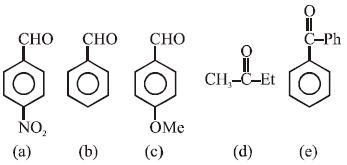
The correct order of rate of reaction towards nucleophilic addition reaction
Artificial sweetner that is unstable at cooking temperature is
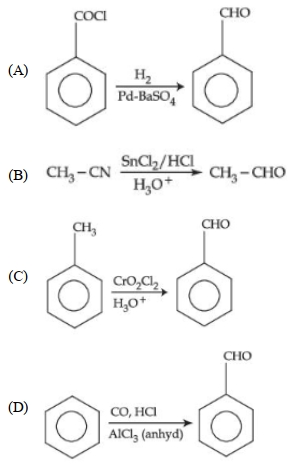
Match $List-I$ with $List-II$.

Match $List-I:in\, Figure$

Lits$-II$

$(I)$ Gatterman Koch reaction

$(II)$ Etard reaction

$(III)$ Stephen reaction

$(IV)$ Rosenmund reaction

Choose the correct answer from the options given below.

Geometrical isomerism can be shown by
In the reaction, ${C_6}{H_5}CHO + {(C{H_3}CO)_2}O\xrightarrow{{C{H_3}COONa}}(A)$ product $(A)$ is
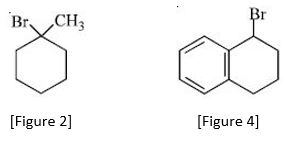
Consider the $S_N1$ solvolysis of the following halides in aqueous formic acid :

$(I)$ $\begin{array}{*{20}{c}}  {C{H_3}\,\,\,\,\,\,Br} \\   {|\,\,\,\,\,\,\,\,\,\,\,\,\,\,\,\,|\,\,} \\   {C{H_3} - CH - CH - C{H_3}} \end{array}$

$(II)$ $[Figure\,2]$

$(III)$ $\begin{array}{*{20}{c}}  {{C_6}{H_5} - CH - {C_6}{H_5}} \\   {|\,\,\,} \\   {Br} \end{array}$ 

$(IV)$ $[Figure\,4]$

Which one of the following is correct sequence of the halides given above in the decreasing order of their reactivity ?

An acidic solution of dichromate is electrolyzed for $8$ minutes using $2$ $A$ current. As per the following equation

$Cr _{2} O _{7}^{2-}+14 H ^{+}+6 e ^{-} \rightarrow 2 Cr ^{3+}+7 H _{2} O$

The amount of $Cr ^{3+}$ obtained was $0.104\, g$. The

efficiency of the process(in\%) is

(Take : $F =96000\, C$, At. mass of chromium $=52$ )