MCQ
It two parallel wires carry current in opposite directions:
  • A
    The wires attract each other.
  • B
    The wires repel each other.
  • C
    The wires experience neither attraction nor repulsion.
  • D
    The forces of attraction or repulsion do not depend on current direction.

Answer

  1. The wires repel each other.

Explanation:

If two parallel wires carry current in opposite directions, they repel each other whereas if two parallel wires carry current in same direction, they attract each other.

Need a full question paper?

Generate a complete, print-ready paper with questions like this in minutes — across 16+ boards, with answer keys.

Start Generating Free

Similar questions

Energy stored in a coil of self inductance 40mH carrying a steady current of 2 A is

(a) 0.8 J   

(b) 8 J

(c) 0.08 J

(d) 80 J

Assertion  : Radioactive nuclei emit   particles.

Reason      : Electrons exist inside the nucleus.

(a) If both assertion and reason are true and the reason is the correct explanation of the assertion.

(b) If both assertion and reason are true but reason is not the correct explanation of the assertion.

(c) If assertion is true but reason is false.

(d) If the assertion and reason both are false.

The specific resistance of a wire is ρ, its volume is 3  and its resistance is 3 ohms, then its length will be

(a)  

(b)  

(c)

(d)

Which of the following increases the maximum kinetic energy of the photoelectrons emitted?

In Millikan oil drop experiment, a charged drop of mass 1.8   is stationary between its plates. The distance between its plates is 0.90 cm and potential difference is 2.0 kilo volts. The number of electrons on the drop is

(a) 500    

(b) 50

(c) 5  

(d) 0

According to Joule's law, if potential difference across a conductor of material of resistivity remains constant, then heat produced in the conductor is directly proportional to

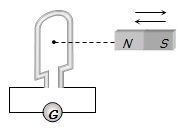
When a magnet is pushed in and out of a circular coil C connected to a very sensitive galvanometer G as shown in the adjoining diagram with a frequency v, then

(a) Constant deflection is observed in the galvanometer

(b) Visible small oscillations will be observed in the galvanometer if v is about 50 Hz

(c) Oscillations in the deflection will be observed clearly if v = 1 or 2 Hz

(d) No variation in the deflection will be seen if v = 1 or 2 Hz

A strip of copper and another of germanium are cooled from room temperature to 80 K. The resistance of

(a) Each of these increases

(b) Each of these decreases

(c) Copper strip increases and that of germanium decreases

(d) Copper strip decreases and that of germanium increases

The coefficient of self induction of a coil is given by.
The constant k in Coulomb's law depends upon: