Kinetic energy of a particle executing simple harmonic motion in straight line is $pv^2$ and potential energy is $qx^2$, where $v$ is speed at distance $x$ from the mean position. It time period is given by the expression
Medium
Download our app for free and get started
$\mathrm{KE}=\mathrm{TE} \propto \mathrm{pA}^{2} \omega^{2}$
$\mathrm{PE}=\mathrm{TE} \propto \mathrm{q} \mathrm{A}^{2}$
$\mathrm{PA}^{2} / \omega^{2}=\mathrm{q} \mathrm{A}^{2}$
$\mathrm{T}=2 \pi \sqrt{\frac{p}{q}}$

Download our appand get started for free
Experience the future of education. Simply download our apps or reach out to us for more information. Let's shape the future of learning together!No signup needed.*
Similar Questions
- 1Two particles are in $SHM$ on same straight line with amplitude $A$ and $2A$ and with same angular frequency $\omega .$ It is observed that when first particle is at a distance $A/\sqrt{2}$ from origin and going toward mean position, other particle is at extreme position on other side of mean position. Find phase difference between the two particlesView Solution
- 2The maximum velocity and the maximum acceleration of a body moving in a simple harmonic oscillator are $2\,m/s$ and $4\,m/{s^2}.$ Then angular velocity will be ..... $rad/sec$View Solution
- 3A simple harmonic motion having an amplitude $A$ and time period $T$ is represented by the equation : $y = 5 \sin \pi (t + 4) m$View Solution
Then the values of $A$ (in $m$) and $T$ (in $sec$) are :
- 4The bob of a simple pendulum of mass m and total energy $E$ will have maximum linear momentum equal toView Solution
- 5One end of a long metallic wire of length $L$ is tied to the ceiling. The other end is tied to massless spring of spring constant $K$. A mass $ m$ hangs freely from the free end of the spring. The area of cross-section and Young's modulus of the wire are $A$ and $Y$ respectively. If the mass is slightly pulled down and released, it will oscillate with a time period $T$ equal toView Solution
- 6The potential energy of a simple harmonic oscillator when the particle is half way to its end point is (where $E$ is the total energy)View Solution
- 7A pendulum suspended from the ceiling of a train has a period $T$ when the train is at rest. When the train travels same distance per unit time, the period of oscillation isView Solution
- 8A block of mass $m$ attached to massless spring is performing oscillatory motion of amplitude $'A'$ on a frictionless horizontal plane. If half of the mass of the block breaks off when it is passing through its equilibrium point, the amplitude of oscillation for the remaining system become $fA.$ The value of $f$ isView Solution
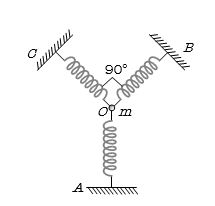
- 9A particle of mass $m$ is attached to three identical springs $A, B$ and $C$ each of force constant $ k$ a shown in figure. If the particle of mass $m$ is pushed slightly against the spring $A$ and released then the time period of oscillations isView Solution
- 10The bob of simple pendulum having length $l$, is displaced from mean position to an angular position $\theta$ with respect to vertical. If it is released, then velocity of bob at lowest positionView Solution