MCQ
Kirchhoff ’s junction rule is a reflection of:
  • A
    Conservation of current density vector.
  • B
    Conservation of charge.
  • C
    The fact that the momentum with which a charged particle approaches a junction is unchanged (as a vector) as the charged particle leaves the junction.
  • D
    The fact that there is no accumulation of charges at a junction.

Answer

  1. Conservation of charge.
  1. The fact that there is no accumulation of charges at a junction.

Solution:

Key concept: Junction rule: At any junction, the sum of the currents entering the junction is equal to the sum of currents leaving the junction.
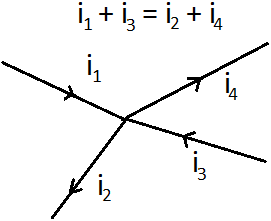
Or
Algebraic sum of the currents flowing towards any point in an electric network is zero, i.e., charges are conserved in an electric network.

The proof of this rule follows from the fact that when currents are steady, there is no accumulation of charges at any junction or at any point in a line.

Thus, the total current flowing in, (which is the rate at which charge flows into the junction), must equal the total current flowing out.

Kirchhoffs junction rule is also known as Kirchhoff’s current law.

So, Kirchhoffs junction rule is the reflection of conservation of charge

Important point: Sign convention of current from a junction: We are taking outgoing current from a junction as negative. And we are taking incoming current towards a junction as positive.

Need a full question paper?

Generate a complete, print-ready paper with questions like this in minutes — across 16+ boards, with answer keys.

Start Generating Free

Similar questions

In the lowest energy level of hydrogen atom, the electron has the angular momentum

(a)  

(b) h/ 

(c) h/2  

(d)  

Consider the two idealized systems: (i) a parallel plate capacitor with large plates and small separation and (ii) a long solenoid of length L > > R, radius of cross-section. In (i) E is ideally treated as a constant between plates and zero outside. In (ii) magnetic field is constant inside the solenoid and zero outside. These idealised assumptions, however, contradict fundamental laws as below:
In physics, chemistry, and electronic engineering, _______________ is the lack of an electron at a position where one could exist in an atom or atomic lattice.

A 60 watt bulb operates on 220V supply. The current flowing through the bulb is

(a) 11/3 amp

(b) 3/11 amp

(c) 3 amp     

(d) 6 amp

If an object possesses an electric charge, it is said to be electrified or ... A ... When it has no charge, it is said to be ... B ... Here, A and B refer to:

What type of modulation is employed in India for radio transmission

(a) Amplitude modulation

(b) Frequency modulation

(c) Pulse modulation

(d) None of these

If m is mass of electron, v its velocity, r the radius of stationary circular orbit around a nucleus with charge Ze, then from Bohr's first postulate, the kinetic energy K =  of the electron in C.G.S. system is equal to

(a)   

(b)   

(c)       

(d)   

To convert mechanical energy into electrical energy, one can use:
  1. DC dynamo.
  2. AC dynamo.
  3. Motor.
  4. Transformer.

What is the ratio of wavelength of radiations emitted when an electron in hydrogen atom jump from fourth orbit to second orbit and from third orbit to second orbit

(a) 27 : 25

(b) 20 : 27

(c) 20 : 25

(d) 25 : 27

When the speed of a dc motor increases the armature current

(a) Increases

(b) Decreases

(c) Does not change

(d) Increases and decreases continuously