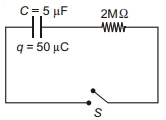
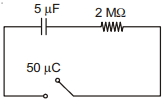
The following circuit consist of a $5 \,\mu F$ capacitor, having charge $50 \,\mu C$ as shown. The switch is closed at $t=0$. The value of current in $2 \,M \Omega$ resistor at $t=0$ is ........... $\mu A$
Medium


Download our appand get started for free
Experience the future of education. Simply download our apps or reach out to us for more information. Let's shape the future of learning together!No signup needed.*
Similar Questions
- 1A beam contains $2 \times 10^8$ doubly charged positive ions per cubic centimeter, all of which are moving with a speed of $10^5 \,m/s$. The current density is ............. $A/m^2$View Solution
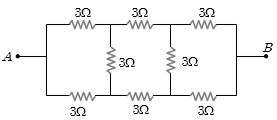
- 2Calculate the equivalent resistance between $A$ and $B$View Solution
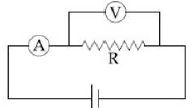
- 3The actual value of resistance $R$, shown in the figure is $30\,\Omega $. This is measured in an experiment as shown using the standard formula $R = \frac{V}{I}$ where $V$ and $I$ are the readings of the voltmeter and ammeter, respectively. If the measured value of $R$ is $5\%$ less, then the internal resistance of the voltmeter is ................. $\Omega$View Solution
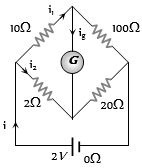
- 4In the circuit shown below the resistance of the galvanometer is $20\, \Omega$ . In which case of the following alternatives are the currents arranged strictly in the decreasing orderView Solution
- 5If the resistance of a conductor is $5\,\Omega\,\,$ at $\,50\,^oC$ and $7\, \Omega\,$ at $\,100\,^oC$ then the mean temperature coefficient of resistance of the material is ............... $^oC$View Solution
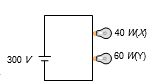
- 6Two bulbs $X$ and $Y$ having same voltage rating and of power $40\, watt$ and $60\, watt$ respectively are connected in series across a potential difference of $300\, volt$, thenView Solution
- 7Three unequal resistors in parallel are equivalent to a resistance $1\, ohm$. If two of them are in the ratio $1 : 2$ and if no resistance value is fractional, the largest of the three resistances in $ohms$ isView Solution
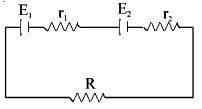
- 8Under what condition current passing through the resistance $R$ can be increased by short circuiting the battery of emf $E_2$. The internal resistances of the two batteries are $r_1$ and $r_2$ respectively.View Solution
- 9The $V-i$ graph for a conductor makes an angle $\theta $ with $V-$ axis. Here $ V$ denotes the voltage and $i$ denotes current. The resistance of conductor is given byView Solution
- 10In given arrangement $E_1 = 5\, volts$ $E_2 = 7\, volt$ balancing length is $6\,m$ if terminals of $E_2$ are reversed then new balancing length will beView Solution