Question
Let f(x) be a real valued function, then its
  • Left Hand Derivative (L.H.D.) : $\operatorname{Lf}^{\prime}(a)=\lim _{h \rightarrow 0} \frac{f(a-h)-f(a)}{-h}$
    Right Hand Derivative (R.H.D.) : $\operatorname{Rf}^{\prime}(a)=\lim _{h \rightarrow 0} \frac{f(a+h)-f(a)}{h}$
    Also, a function f(x) is said to be differentiable at x = a if its L.H.D. and R.H.D. at x = a exist and are equal.
    For the function $\text{f}(\text{x})=\begin{cases}|\text{x}-3|,\text{x}\geq1\\\\\frac{\text{x}^2}{4}-\frac{3\text{x}}{2}+\frac{13}{4},\text{x}<1\end{cases},$ answer the following questions.
    1. R.H.D. of f(x) at x = 1 is:
    1. 1
    2. -1
    3. 0
    4. 2
    1. L.H.D. of f(x) at x = 1 is:
    1. 1
    2. -1
    3. 0
    4. 2
    1. f(x) is non-differentiable at:
    1. x = 1
    2. x = 2
    3. x = 3
    4. x = 4
    1. Find the value of f'(2).
    1. 1
    2. 2
    3. 3
    4. -1
    1. The value of f'(-1) is:
    1. 2
    2. 1
    3. -2
    4. -1

Answer

We have, $\text{f}(\text{x})=\begin{cases}\text{x}-3&,\text{x}\geq3\\3-\text{x}&,1\leq\text{x}<3\\\\\frac{\text{x}^2}{4}-\frac{3\text{x}}{2}+\frac{13}{4}&,\text{x}<1\end{cases}$
  1. (b) -1
Solution:
$\text{Rf}'(1)=\lim\limits_{\text{h}\rightarrow0}\frac{\text{f}(1+\text{h})-\text{f}(1)}{\text{h}}$
$\lim\limits_{\text{h}\rightarrow0}\frac{3-(1+\text{h})-2}{\text{h}}=\lim\limits_{\text{h}\rightarrow0}-\frac{\text{h}}{\text{h}}=-1$
  1. (b) -1
Solution:
$\text{Lf}'(1)=\lim\limits_{\text{h}\rightarrow0}\frac{\text{f}(1-\text{h})-\text{f}(1)}{-\text{h}}$
$=\lim\limits_{\text{h}\rightarrow0}\frac{-1}{\text{h}}\Big[\frac{(1-\text{h})^2}{4}-\frac{3(1-\text{h})}{2}+\frac{13}{4}-2\Big]$
$=\lim\limits_{\text{h}\rightarrow0}\frac{-1}{\text{h}}\Big(\frac{1+\text{h}^2-2\text{h}-6+6\text{h}+13-8}{-4\text{h}}\Big)$
$=\lim\limits_{\text{h}\rightarrow0}\Big(\frac{\text{h}^2+4\text{h}}{-4\text{h}}\Big)=-1$
  1. (c) x = 3
Solution:
Since, R.H.D. at x = 3 is 1
and L.H.D. at x = 3 is - 1
$\therefore$ f(x) is non-differentiable at x = 3.
  1. (d) -1
  1. (c) -2
Solution:
From above, we have
$\text{f}'(\text{x})=\frac{\text{x}}{2}-\frac{3}{2},\text{x}<1$
$\therefore\text{f}'(-1)=\frac{-1}{2}-\frac{3}{2}=-2$

Need a full question paper?

Generate a complete, print-ready paper with questions like this in minutes — across 16+ boards, with answer keys.

Start Generating Free

Similar questions

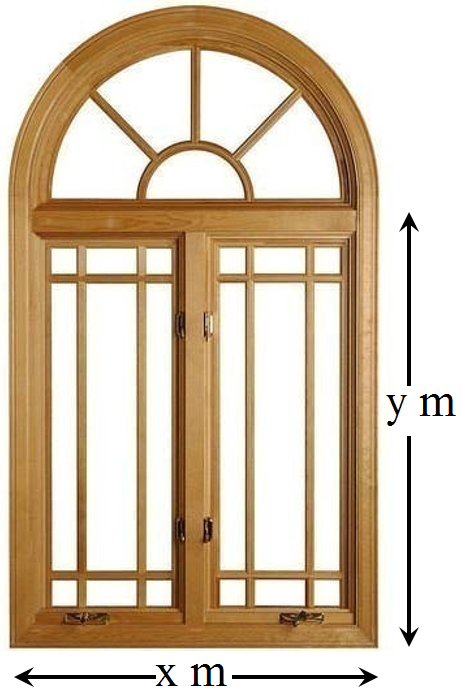
Rohan, a student of class XII, visited his uncle's flat with his father. He observe that the window of the house is in the form of a rectangle surmounted by a semicircular opening having perimeter 10m as shown in the figure.

Based on the above information, answer the following questions.
  1. If x and y represents the length and breadth of the rectangular region, then relation between x and y can be represented as.
  1. $\text{x}+\text{y}+\frac{\pi}{2}=10$
  2. $\text{x}+\text{2y}+\frac{\pi\text{x}}{2}=10$
  3. $\text{2x}+\text{2y}=10$
  4. $\text{x}+\text{2y}+\frac{\pi}{2}=10$
  1. The area (A) of the window can be given by.
  1. $\text{A}=\text{x}-\frac{\text{x}^3}{8}-\frac{\text{x}^2}{2}$
  2. $\text{A}=\text{5x}-\frac{\text{x}^2}{8}-\frac{\pi\text{x}^2}{8}$
  3. $\text{A}=\text{x}+\frac{\pi\text{x}^3}{8}-\frac{\text{3x}^2}{8}$
  4. $\text{A}=\text{5x}+\frac{\text{x}^3}{2}+\frac{\pi\text{x}^2}{8}$
  1. Rohan is interested in maximizing the area of the whole window, for this to happen, the value of x should be.
  1. $\frac{10}{2-\pi}$
  2. $\frac{20}{4-\pi}$
  3. $\frac{20}{4+\pi}$
  4. $\frac{10}{2+\pi}$
  1. Maximum area of the window is.
  1. $\frac{30}{4+\pi}$
  2. $\frac{30}{4-\pi}$
  3. $\frac{50}{4-\pi}$
  4. $\frac{50}{4+\pi}$
  1. For maximum value of A, the breadth of rectangular part of the window is.
  1. $\frac{10}{4+\pi}$
  2. $\frac{10}{4-\pi}$
  3. $\frac{20}{4+\pi}$
  4. $\frac{20}{4-\pi}$
Show that $\text{f(x)}=\tan^{-1}(\sin\text{x}+\cos\text{x})$ is an increasing function in $\Big(0,\frac{\pi}{4}\Big).$
Linear programming is a method for finding the optimal values (maximum or minimum) of quantities subject to the constraints when relationship is expressed as linear equations or inequations. Based on the above information, answer the following questions.
  1. The optimal value of the objective function is attained at the points:
  1. On X-axis.
  2. On Y-axis.
  3. Which are comer points of the feasible region.
  4. None of these.
  1. The graph of the inequality 3x + 4y < 12 is:
  1. Half plane that contains the origin.
  2. Half plane that neither contains the origin nor the points of the line 3x + 4y = 12.
  3. Whole XOY-plane excluding the points on line 3x + 4y = 12.
  4. None of these.
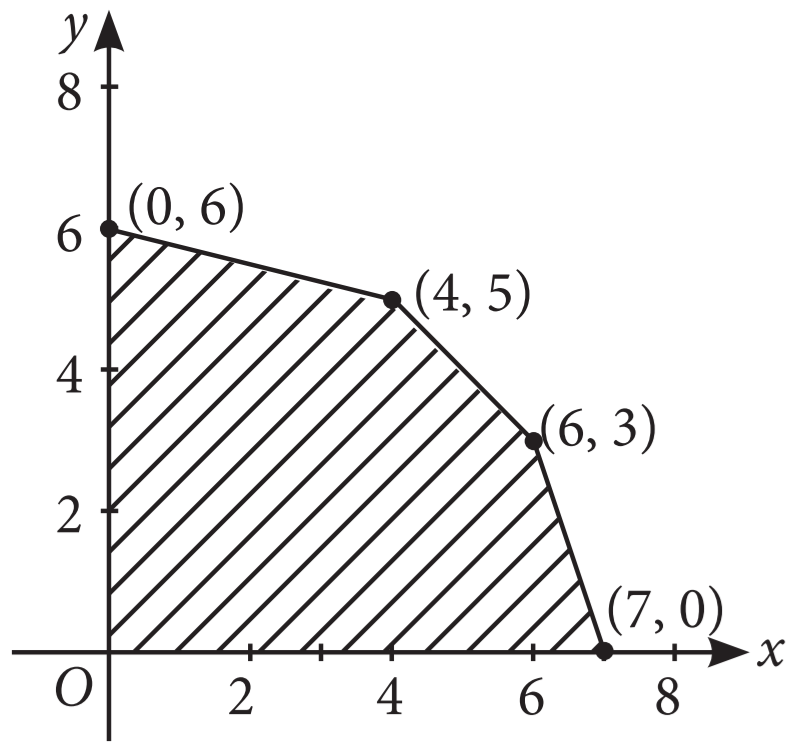
  1. The feasible region for an LPP is shown in the figure. Let Z = 2x + 5y be the objective function. Maximum of Z occurs at:
  1. (7, 0)
  2. (6, 3)
  3. (0, 6)
  4. (4, 5)
  1. The corner points of the feasible region determined by the system of linear constraints are (0, 10), (5, 5), (15, 15), (0, 20). Let Z = px + qy, where p, q > 0. Condition on p and q so that the maximum of Z occurs at both the points ( 15, 15) and (0, 20) is:
  1. p = q
  2. p = 2q
  3. q = 2p
  4. q = 3p
  1. The comer points of the feasible region determined by the system of linear constraints are (0, 0), (0, 40), (20, 40), (60, 20), (60, 0). The objective function is Z = 4x + 3y.
Compare the quantity in Column A and Column B
Column A
Column B
Maximum of Z
325
  1. The quantity in column A is greater.
  2. The quantity in column Bis greater.
  3. The two quantities are equal.
  4. The relationship cannot be determined on the basis of the information supplied.
To hire a marketing manager, it's important to find a way to properly assess candidates who can bring radical changes and has leadership experience. Ajay, Ramesh and Ravi attend the interview for the post of a marketing manager.
Ajay, Ramesh and Ravi chances of being selected as the manager of a firm are in the ratio $4: 1: 2$ respectively. The respective probabilities for them to introduce a radical change in marketing strategy are $0.3,0.8$, and 0.5 . If the change does take place.

Image

(i) Find the probability that it is due to the appointment of Ajay (A).

(ii) Find the probability that it is due to the appointment of Ramesh (B).

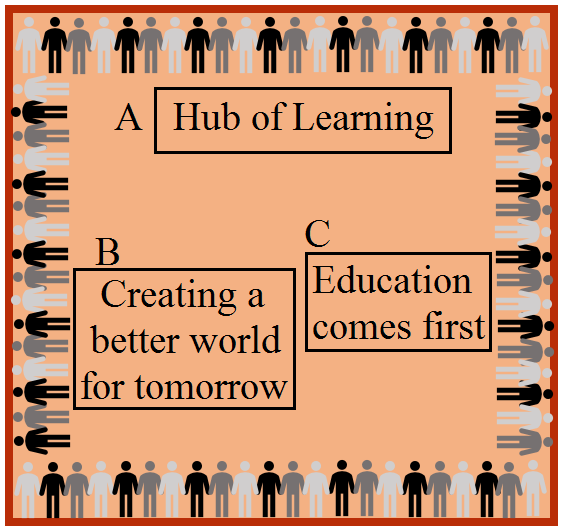
Three slogans on chart papers are to be placed on a school bulletin board at the points A, Band C displaying A (Hub of Learning), B (Creating a better world for tomorrow) and C (Education comes first). The coordinates of these points are (1, 4, 2), (3, -3, -2) and (-2, 2, 6) respectively.

Based on the above information, answer the following questions.
  1. Let $\vec{\text{a}},\vec{\text{b}}$ and $\vec{\text{c}}$ be the position vectors of points A, B and C respectively, then $\vec{\text{a}}+\vec{\text{b}}+\vec{\text{c}}$ is equal to:
  1. $2\hat{\text{i}}+3\hat{\text{j}}+6\hat{\text{k}}$
  2. $2\hat{\text{i}}-3\hat{\text{j}}-6\hat{\text{k}}$
  3. $2\hat{\text{i}}+8\hat{\text{j}}+3\hat{\text{k}}$
  4. $2(7\hat{\text{i}}+8\hat{\text{j}}+3\hat{\text{k}})$
  1. Which of the following is not true?
  1. $\overline{\text{AB}}+\overline{\text{BC}}+\overline{\text{CA}}=\vec{0}$
  2. $\overline{\text{AB}}+\overline{\text{BC}}-\overline{\text{AC}}=\vec{0}$
  3. $\overline{\text{AB}}+\overline{\text{BC}}-\overline{\text{CA}}=\vec{0}$
  4. $\overline{\text{AB}}-\overline{\text{CB}}+\overline{\text{CA}}=\vec{0}$
  1. Area of $\triangle\text{ABC}$ is:
  1. 19 sq. units
  2. $\sqrt{1937}\text{sq}.\text{units}$
  3. $\frac{1}{2}\sqrt{1937}\text{sq}.\text{units}$
  4. $\sqrt{1837}\text{sq}.\text{units}$
  1. Suppose, if the given slogans are to be placed on a straight line, then the value of $|\vec{\text{a}}\times\vec{\text{b}}+\vec{\text{b}}\times\vec{\text{c}}+\vec{\text{c}}\times\vec{\text{a}}|$ will be equal to:
  1. -1
  2. -2
  3. 2
  4. 0
  1. If $\vec{\text{a}}=2\hat{\text{i}}+3\hat{\text{j}}+6\hat{\text{k}},$ then unit vector in the direction of vector $\vec{\text{a}}$ is:
  1. $\frac{2}{7}\hat{\text{i}}-\frac{3}{7}\hat{\text{j}}-\frac{6}{7}\hat{\text{k}}$
  2. $\frac{2}{7}\hat{\text{i}}+\frac{3}{7}\hat{\text{j}}+\frac{6}{7}\hat{\text{k}}$
  3. $\frac{3}{7}\hat{\text{i}}+\frac{2}{7}\hat{\text{j}}+\frac{6}{7}\hat{\text{k}}$
  4. None of these
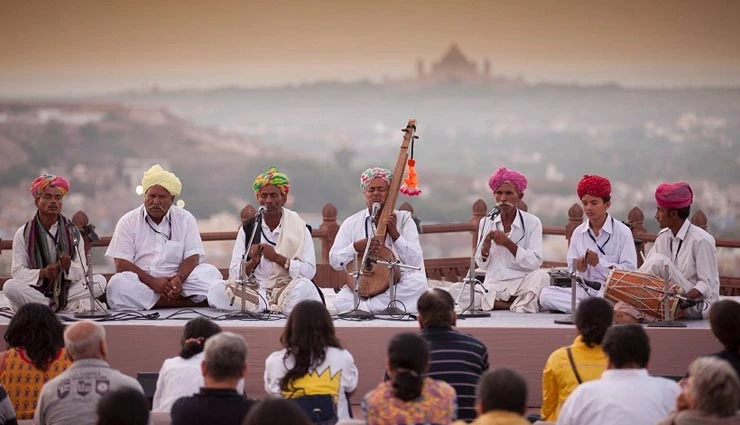
One day, a sangeet mahotsav is to be organised in an open area of Rajasthan. ln recent years, it has rained only $6$ days each year. Also, it is given that when it actually rains, the weatherman correctly forecasts rain $80\%$ of the time. When it doesn't rain, he incorrectly forecasts rain $20\%$ of the time.

If leap year is considered, then answer the following questions.
  1. The probability that it rains on chosen day is:
  1. $\frac{1}{366}$
  2. $\frac{1}{73}$
  3. $\frac{1}{60}$
  4. $\frac{1}{61}$
  1. The probability that it does not rain on chosen day is:
  1. $\frac{1}{366}$
  2. $\frac{5}{366}$
  3. $\frac{360}{366}$
  4. None of these.
  1. The probability that the weatherman predicts correctly is:
  1. $\frac{5}{6}$
  2. $\frac{7}{8}$
  3. $\frac{4}{5}$
  4. $\frac{1}{5}$
  1. The probability that it will rain on the chosen day, if weatherman predict rain for that day, is:
  1. $0.0625$
  2. $0.0725$
  3. $0.0825$
  4. $0.0925$
  1. The probability that it will not rain on the chosen day, if weatherman predict rain for that day, is:
  1. $0.94$
  2. $0.84$
  3. $0.74$
  4. $0.64 $
Ankit wants to construct a rectangular tank for his house that can hold $80 \mathrm{ft}^3$ of water. He wants to construct on one corner of terrace so that sufficient space is left after construction of tank. For that he has to keep width of tank constant $5 \mathrm{ft}$, but the length and heights are variables. The top of the tank is open. Building the tank cost ₹20 per sq. foot for the base and ₹10 per sq. foot for the side.

Image

(i) Express cost of tank as a function of height(h).

(ii) Verify by second derivative test that cost is minimum at critical point.

(iii) Find the value of $\mathrm{h}$ at which $\mathrm{c}(\mathrm{h})$ is minimum.

OR

Find the minimum cost of tank?

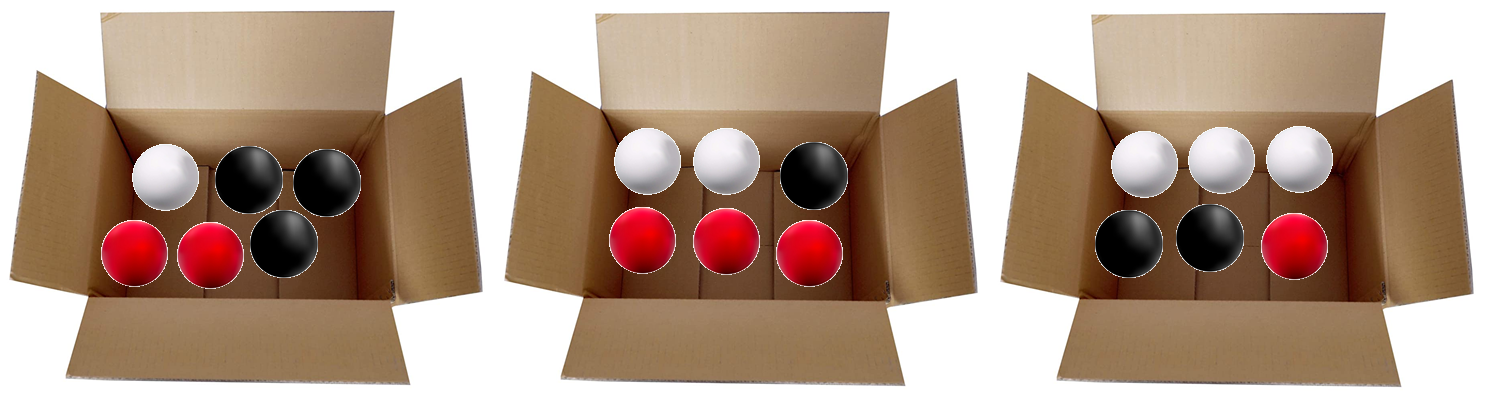
Box $I$ contains $1$ white, $3$ black and $2$ red balls. Box $II$ contains $2$ white, $1$ black and $3$ red balls. Box $III$ contains $3$ white, $2$ black and $1$ red balls. One box is chosen at random and two balls are drawn with replacement.
If $E_1, E_2, E_3$ be the events that the balls drawn from box $I,$ box $II$ and box $III$ respectively and $E$ be the event that balls drawn are one white and one red, then answer the following questions.
  1. Probability of occurrence of event $E$ given that the balls drawn are from box $I,$ is:
  1. $\frac{1}{9}$
  2. $\frac{2}{6}$
  3. $\frac{3}{5}$
  4. $\frac{1}{7}$
  1. Probability of occurrence of event $E,$ given that the balls drawn are from box $II,$ is:
  1. $\frac{1}{3}$
  2. $\frac{1}{4}$
  3. $\frac{3}{4}$
  4. $\frac{3}{5}$
  1. Probability of occurrence of event $E,$ given that balls drawn are from box $III,$ is:
  1. $\frac{1}{12}$
  2. $\frac{3}{11}$
  3. $\frac{1}{6}$
  4. $\frac{4}{11}$
  1. The value of $\displaystyle{\sum^3_{\text{i}=1}}\text{P(E}|\text{E}_\text{i})$ is equal to.
  1. $\frac{5}{18}$
  2. $\frac{1}{2}$
  3. $\frac{1}{18}$
  4. $\frac{11}{18}$
  1. The probability that the balls drawn are from box $II,$ given that event $E$ has already occurred, is:
  1. $\frac{1}{11}$
  2. $\frac{6}{11}$
  3. $\frac{5}{11}$
  4. None of these
A spherical ball of salt is dissolving in water in such a manner that the rate of decrease of the volume at any instant is propotional to the surface. Prove that the radius is decreasing at a constant rate.
Read the following text carefully and answer the questions that follow :
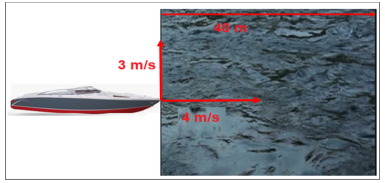
Once Ramesh was going to his native place at a village near Agra. From Delhi and Agra he went by flight, In the way, there was a river. Ramesh reached the river by taxi. Then Ramesh used a boat for crossing the river. The boat heads directly across the river $40$ m wide at $4 m/s$. The current was flowing downstream at $3 m/s.$
Image
$i.$  What is the resultant velocity of the boat? $(1)$
$ii.$  How much time does it take the boat to cross the river? $(1)$
$iii$. How far downstream is the boat when it reaches the other side? $(2)$​​​​​​​
OR
If speeds of boat and current were $1.5 m/s$ and $2.0 m/s$ then what will be resultant velocity? $(2)$