MCQ
Let the volume of a parallelopiped whose coterminous edges are given by $\overrightarrow{\mathrm{u}}=\hat{\mathrm{i}}+\hat{\mathrm{j}}+\lambda \hat{\mathrm{k}}, \overrightarrow{\mathrm{v}}=\hat{\mathrm{i}}+\hat{\mathrm{j}}+3 \hat{\mathrm{k}} $ and $\overrightarrow{\mathrm{w}}=2 \hat{\mathrm{i}}+\hat{\mathrm{j}}+\hat{\mathrm{k}}$ be $1\; cu.$ unit. If $\theta$ be the angle between the edges $\overrightarrow{\mathrm{u}}$ and $\overrightarrow{\mathrm{w}},$ then $\cos \theta$ can be
  • $\frac{7}{6 \sqrt{3}}$
  • B
    $\frac{5}{7}$
  • C
    $\frac{7}{6 \sqrt{6}}$
  • D
    $\frac{5}{3 \sqrt{3}}$

Answer

Correct option: A.
$\frac{7}{6 \sqrt{3}}$
a
$\left|\begin{array}{lll}{1} & {1} & {\lambda} \\ {1} & {1} & {3} \\ {2} & {1} & {1}\end{array}\right|=1 \Rightarrow \lambda=2,4$

$\mathrm{Now}, \quad \cos \theta=\frac{\overrightarrow{\mathrm{u}} \cdot \overrightarrow{\mathrm{w}}}{|\overrightarrow{\mathrm{u}}||\overrightarrow{\mathrm{w}}|}$

$=\frac{5}{\sqrt{6} \sqrt{6}}$ or $\frac{7}{\sqrt{6} \sqrt{18}}=\frac{5}{6}$ or $\frac{7}{6 \sqrt{3}}$

Need a full question paper?

Generate a complete, print-ready paper with questions like this in minutes — across 16+ boards, with answer keys.

Start Generating Free

Similar questions

If $f$ is an even function defined on the interval $(-5, 5),$ then four real values of $x$ satisfying the equation $f(x) = f\left( {\frac{{x + 1}}{{x + 2}}} \right)$ are
The area of region bounded by curve  $\text{y}=\cos2\text{x},$ line $\text{x}=0$ $\text{x}=\frac{\pi}{3}$ is:
  1. $\frac{2-\sqrt{3}}{4}$
  2. $\frac{\sqrt{3}}{4}$
  3. $\frac{4-\sqrt{3}}{4}$
  4. $\frac{\sqrt{3}-4}{4}$
A population  $p(t) $ of $ 1000 $ bacteria introduced into nutrient medium grows according to the relation $p(t) = 1000 + {{1000t} \over {100 + {t^2}}}$. The maximum size of this bacterial population is
Let $P ( S )$ denote the power set of $S =\{1,2,3, \ldots, 10\}$. Define the relations $R_1$ and $R_2$ on $P(S)$ as $A R_1 B$ if $\left( A \cap B ^{ c }\right) \cup\left( B \cap A ^{ c }\right)=\varnothing$ and $AR _2 B$ if $A \cup B ^{ c }=$ $B \cup A ^{ c }, \forall A , B \in P ( S )$. Then :
If $g$ $(x)$ is the inverse of $f$ $(x) $ and $f$ $(x)$ has domain $x \in  [1, 5], $ where $f (1) = 2$ and $f(5) = 10$ then the values of $\int\limits_1^5 {f(x)} dx$ $+\int\limits_2^{10} {g(y)} dy$ equals
The solution of $\frac{{dy}}{{dx}} + \frac{y}{3} = 1$ is
$\int\frac{1}{7+5\cos\text{x}}\text{ dx}=$
  1. $\frac{1}{\sqrt{6}}\tan^{-1}\Big(\frac{1}{\sqrt{6}}\tan\frac{\text{x}}{2}\Big)+\text{C}$
  2. $\frac{1}{\sqrt{3}}\tan^{-1}\Big(\frac{1}{\sqrt{3}}\tan\frac{\text{x}}{2}\Big)+\text{C}$
  3. $\frac{1}{4}\tan^{-1}\Big(\tan\frac{\text{x}}{2}\Big)+\text{C}$
  4. $\frac{1}{7}\tan^{-1}\Big(\tan\frac{\text{x}}{2}\Big)+\text{C}$
The cartesian equation of line which is parallel to $3 \hat{i}+2 \hat{j}-8 \hat{k}$ and passes through the point $(5,2,-4)$ is __________ .
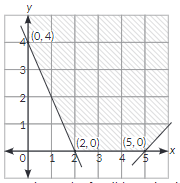
A linear programming problem (LPP) along with the graph of its constraints is shown below. The corresponding objective function is
Minimize: $Z=3 x+2 y$. The minimum value of the objective function is obtained at the corner point ( 2 , 0).
The optimal solution of the above linear programming problem $\qquad$
Image
If $A =$ $\left[ {\begin{array}{*{20}{c}}0&1&2\\1&2&3\\3&a&1\end{array}} \right]$ ,$A^{-1} =$$\left[ {\begin{array}{*{20}{c}}{1/2}&{ - 1/2}&{1/2}\\{ - 4}&3&c\\{5/2}&{ - 3/2}&{1/2}\end{array}} \right]$, then