MCQ
Lorentz force is given by the formula:
- AF = q(v + B + E)
- BF = q(v – B – E)
- CF = q(v × B × E)
- DF = q(v × B + E)
Explanation:
Lorentz force is given by the formula F= q(v × B + E)
Generate a complete, print-ready paper with questions like this in minutes — across 16+ boards, with answer keys.
When an unpolarized light of intensity  is incident on a polarizing sheet, the intensity of the light which does not get transmitted is
|
(a) Zero |
(b) |
(c) |
(d) |
The relation between the linear magnification m, the object distance u and the focal length f is
|
(a) |
(b) |
(c) |
(d) |
The maximum peak to peak voltage of an AM wire is 24 mV and the minimum peak to peak voltage is 8 mV. The modulation factor is
|
(a) 10% |
(b) 20% |
(c) 25% |
(d) 50% |
The wavelength of sodium light in air is 5890 Å. The velocity of light in air is 3  The wavelength of light in a glass of refractive index 1.6 would be close to
|
(a) 5890 Å |
(b) 3681 Å |
(c) 9424 Å |
(d) 15078 Å |
$\text{zero}$
$\frac{1}{8}\omega\text{Bl}^2$
$\frac{1}{2}\omega\text{Bl}^2$
$\text{B}\omega\text{l}^2$
A wire carrying a current i is placed in a uniform magnetic field in the form of the curve y = asin 0 ≤ x ≤ 2L. The force acting on the wire is
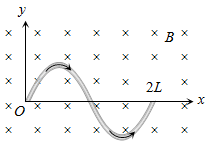
|
(a) |
(b) iBL |
(c) 2iBL |
(d) Zero |
Assertion : Interference pattern is made by using blue light instead of red light, the fringes becomes narrower.
Reason : In Young’s double slit experiment, fringe width is given by relation B = 
|
(a) If both assertion and reason are true and the reason is the correct explanation of the assertion. |
|
(b) If both assertion and reason are true but reason is not the correct explanation of the assertion. |
|
(c) If assertion is true but reason is false. |
|
(d) If the assertion and reason both are false. |
Which of the following diagrams, shows correctly the dispersion of white light by a prism
|
(a)
|
(b)
|
(c)
|
(d)
|


