Question
Match the compounds/elements given in Column I with uses given in Column II.
 
Column I (Compound/element)
 
Column II (Use)
(i)
Lanthanoid oxide
(a)
Production of iron alloy
(ii)
Lanthanoid
(b)
Television screen
(iii)
Misch metal
(c)
Petroleum cracking
(iv)
Magnesium based alloy is constituent of
(d)
Lanthanoid metal + iron
(v)
Mixed oxides of lanthanoids are employed
(e)
Bullets
 
 
(f)
In X-ray screen
 

Answer

 
Column I (Compound/element)
 
Column II (Use)
(i)
Lanthanoid oxide
(b)
Television screen
(ii)
Lanthanoid
(a)
Production of iron alloy
(iii)
Misch metal
(d)
Lanthanoid metal + iron
(iv)
Magnesium based alloy is constituent of
(e)
Bullets
(v)
Mixed oxides of lanthanoids are employed
(c)
Petroleum cracking
Explanation:
Compound/ element- use
  1. Lanthanoid oxide /television screen
  2. Lanthanoid – production of iron alloy
  3. Misch metal- Lanthanoid metal + iron
  4. Magnesium based alloy- bullets
  5. Mixed oxide of lanthanoids are employed – petroleum cracking.

Need a full question paper?

Generate a complete, print-ready paper with questions like this in minutes — across 16+ boards, with answer keys.

Start Generating Free

Similar questions

i. Write structures of different isomeric amines corresponding to the molecular formula$, \ce{C4H11N}$.
ii. Write $\text{IUPAC}$ names of all the isomers.
iii. What type of isomerism is exhibited by different pairs of amines?
The experimental data for decomposition of $\ce{N2O5}$
$[\ce{2N2O5 \rightarrow 4NO2 + O2}]$
in gas phase at $318K$ are given below:
$t/s$ $0$ $400$ $800$ $1200$ $1600$ $2000$ $2400$ $2800$ $3200$
$10^2 \times [\ce{N2O5}]/mol \ L^{-1}$ $1.63$ $1.36$ $1.14$ $0.93$ $0.78$ $0.64$ $0.53$ $0.43$ $0.35$
  1. Plot $[\ce{N2O5}]$ against $t$.
  2. Find the half-life period for the reaction.
  3. Draw a graph between $\log[\ce{N2O5}]$ and $t$.
  4. What is the rate law?
  5. Calculate the rate constant.
  6. Calculate the half$-$life period from $k$ and compare it with $(ii)$.
$19.5 g$ of $\ce{CH2FCOOH}$ is dissolved in $500 g$ of water. The depression in the freezing point of water observed is $1.0^\circ C$. Calculate the van’t Hoff factor and dissociation constant of fluoroacetic acid.
Write the principle of manufacture of ammonia by Haber's process. How does it react with $ CuSO_{4} $ solution?
What are the similarities between lanthanoids and actinoids?
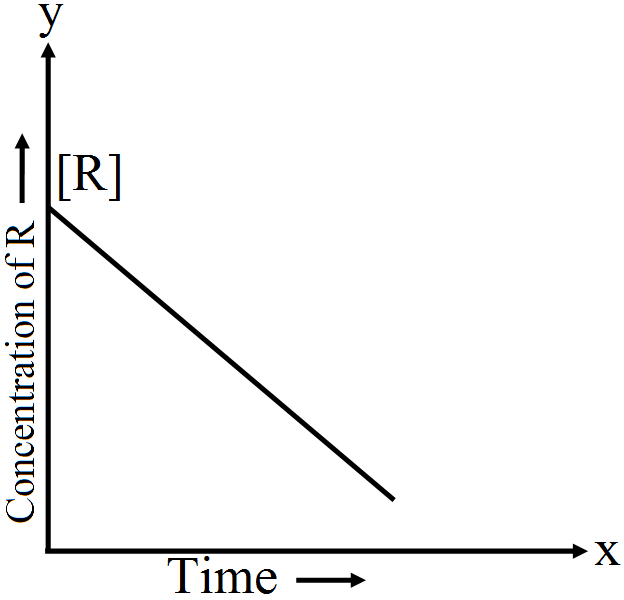
In the reaction
$Q + R \rightarrow$ Products
The time taken for $99\%$ reaction of $Q$ is twice the time taken for $90\%$ reaction of $R.$ The concentration of $R$ varies with time as shown in the figure given alongside.

What is the overall order of the reaction? Give the units of the rate constant for the same. Write the rate expression for the above reaction.
Explain the limitations of valence bound theory.
Answer the following questions:
Draw the structures of chromate and dichromate ions.
A hydrocarbon $'A', (C_4H_8)$ on reaction with $HCl$ gives a compound $'B', (C_4H_9Cl)$, which on reaction with $1 \ mol$ of $NH_3$ gives compound $'C', (C_4H_{11}N)$. On reacting with $NaNO_2$ and $HCl$ followed by treatment with water, compound $'C\ '$ yields an optically active alcohol,$'D\ '$. Ozonolysis of $'A\ '$ gives $2$ mols of acetaldehyde. Identify compounds $'A\ '$ to $'D\ '$. Explain the reactions involved.
Match the property given in Column $I$ with the element given in Column $II.$
 
Column $I ($Property$)$
 
Column $II ($Element$)$
$(i)$
Lanthanoid which shows $+4$ oxidation state
$(a)$ $Pm$
$(ii)$
Lanthanoid which can show $+2$ oxidation state
$(b)$ $Ce$
$(iii)$
Radioactive lanthanoid
$(c)$ $Lu$
$(iv)$
Lanthanoid which has $4f^7$ electronic configuration in $+3$ oxidation state
$(d)$ $Eu$
$(v)$
 Lanthanoid which has $4f^{14}$ electronic configuration in $+3$ oxidation state
$(e)$ $Gd$
 
 
$(f)$ $Dy$