MCQ
Photoelectric effect can be explained by:
  • A
    Wave theory of light.
  • B
    Bohr’s theory.
  • C
    Quantum theory of light.
  • Corpuscular theory of light.

Answer

Correct option: D.
Corpuscular theory of light.

Need a full question paper?

Generate a complete, print-ready paper with questions like this in minutes — across 16+ boards, with answer keys.
Start Generating Free

Similar questions

Which of the following gives the value of magnetic field according to, Biot-Savart’s law’
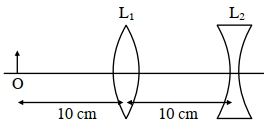
An extended object is placed at point $O, 10 cm$ in front of a convex lens $L_1$ and a concave lens $L_2$ is placed $10 cm$ behind it, as shown in the figure. The radii of curvature of all the curved surfaces in both the lenses are $20 cm$. The refractive index of both the lenses is $1.5$ . The total magnification of this lens system is
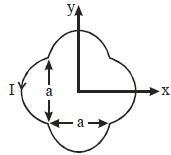
A loop in form of four connected semi-circular wires carrying current $I$ lies in the $x-y$ plane as shown in the figure. The unit vector $\hat k$ is coming out of the plane of the paper. The magnetic moment of the current loop is
An electron is travelling along the $x$-direction. It encounters a magnetic field in the $y$-direction. Its subsequent motion will be
The alternating current is given by

${i}=\left\{\sqrt{42} \sin \left(\frac{2 \pi}{{T}} {t}\right)+10\right\} {A}$

The $r.m.s.$ value of this current is ${A}$
The wavelength associated with an electron accelerated through a potential difference of $100 V$ is nearly .............. $\mathop {\rm{A}}\limits^o $
Two charged particles traverse identical helical paths in a completely opposite sense in a uniform magnetic field $B$ = $B_0\hat{k}$
An element A decays into element C by a two step process :
A → B + ${2^{He}}^4$
B → C + ${2^e}^{-}$
Then
A radioactive sample decays by $\beta$  -emission. In first two seconds $‘n’$  $\beta$ -particles are emitted and in next $2\ seconds$ , $‘0.25n’$ $\beta$ -particles are emitted. The half life of radioactive nuclei is ...... $sec$
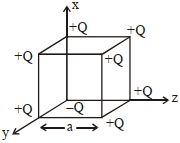
A cube of side $'a'$ has point charges $+Q$ located at each of its vertices except at the origin where the charge is $- Q$. The electric field at the centre of cube is