MCQ
Photoelectric effect supports quantum nature of light because:
  • A
    There is a minimum frequency below which no photoelectrons are emitted.
  • B
    The maximum kinetic energy of photoelectrons depends only on the frequency of light and not on its intensity.
  • C
    Even when the metal surface is faintly illuminated the photoelectrons leave the surface immediately.
  • All of the above

Answer

Correct option: D.
All of the above
Photoelectric effect can be explained on the basis of quantum nature of light. According to the quantum nature of light, energy in light is not uniformly spread. It is contained in packets or quanta known as photons.
Energy of a photon, $E = hv$, where h is Planck's constant and $v$ is the frequency of light.
Above a particular frequency, called threshold frequency, energy of a photon is sufficient to emit an electron from the metal surface and below which, no photoelectron is emitted, as the energy of the photon is low. Hence, option $(a)$ supports the quantum nature of light.
Now, kinetic energy of an electron,
$\text{K}=\text{hv}_0-\varphi$
Thus, kinetic energy of a photoelectron depends only on the frequency of light $($or energy$)$. This shows that if the intensity of light is increased, it only increases the number of photons and not the energy of photons. Kinetic energy of photons can be increased by increasing the frequency of light or by increasing the energy of photon, which supports $E = hv$ and, hence, the quantum nature of light. Hence, option $(b)$ also supports the quantum nature of light.
hotoelectrons are emitted from a metal surface even if the metal surface is faintly illuminated; it means that less photons will interact with the electrons. However, few electrons absorb energy from the incident photons and come out from the metal. This shows the quantum nature of light.
Hence, $(c)$ also supports the quantum nature of light.
Electric charge of the photoelectrons is quantised; but this statement does not support the quantum nature of light.

Need a full question paper?

Generate a complete, print-ready paper with questions like this in minutes — across 16+ boards, with answer keys.

Start Generating Free

Similar questions

In the gas equation $\text{PV = RT, V}$ is the volume of:
A uniform cylinder of length $L$ and mass $M$ having crosssectional area $A$ is suspended, with its length vertical, from a fixed point by a massless spring such that it is half submerged in a liquid of density $\sigma$ at equilibrium position. The extension $x_0$ of the spring when it is in equilibrium is
$Assertion :$ In $SHM$, acceleration is always directed towards the mean position.
$Reason :$ In $SHM$, the body has to stop momentary at the extreme position and move back to mean position.
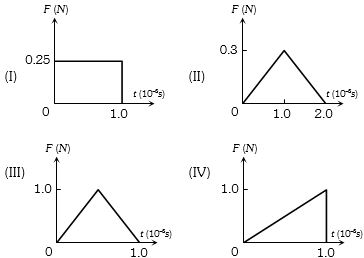
Figures $I, II, III$ and $IV$ depict variation of force with time. The impulse is highest in the case of situations depicted. Figure
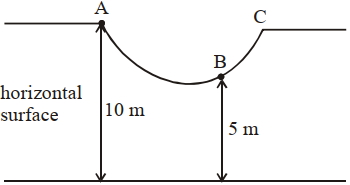
As shown in the figure, a particle of mass $10$ $kg$ is placed at a point $A$. When the particle is slightly displaced to its right, it starts moving and reaches the point $B$. The speed of the particle at $B$ is $x\, m / s$. (Take $\left. g =10\, m / s ^{2}\right)$ The value of $'x'$ to the nearest integer is.........
Three particles start from origin at the same time with a velocity $2ms^{-1}$ along positive $x-$axis the second with a velocity $6ms^{-1}$ aling negative $y -$ axis. Find the velocity of the third particle along $x = y$ line so that the three particles may always lie in a straight line:
A body $X$ is projected upwards with a velocity of $98\ ms^{-1}$, after $4s,$ a second body $Y$ is also projected upwards with the same $Y$ is also projected upwards with the same initial velocity. Two bodies will meet after:
The speed of sound in a gas is $v$. The $\text{rms}$ speed of molecules of this gas is $C.$ If $\gamma=\frac{\text{C}_{\text{p}}}{\text{C}_{\text{v}}},$ then the ratio of $v$ and $C$ is:
An elevator is going down with a constant acceleration. A coin dropped from a point $1.8m$ above the elevator floor takes one second to reach the floor. The magnitude of the acceleration of the the elevator in $ms^{-2}$ is: Given: $g = 10\ ms^{-2}$ 
Cooking gas containers are kept in a lorry moving with uniform speed. The temperature of the gas molecules inside will