MCQ
Pick the correct statements:
  • A
    Average speed of a particle in a given time is never less than the magnitude of the average velocity.
  • B
    It is possible to have a situation in which $\Big|\frac{\text{d}\vec{\text{v}}}{\text{dt}}\Big|\neq0$ but $\frac{\text{d}}{\text{dt}}|\vec{\text{v}}|=0.$
  • C
    The average velocity of a particle is zero in a time interval. It is possible that the instantaneous velocity is never zero in the interval.
  • D
    The average velocity of a particle moving on a straight line is zero in a time interval. It is possible that the instantaneous velocity is never zero in the interval.

Answer

  1. Average speed of a particle in a given time is never less than the magnitude of the average velocity.
  2. It is possible to have a situation in which $\Big|\frac{\text{d}\vec{\text{v}}}{\text{dt}}\Big|\neq0$ but $\frac{\text{d}}{\text{dt}}|\vec{\text{v}}|=0.$
  3. The average velocity of a particle is zero in a time interval. It is possible that the instantaneous velocity is never zero in the interval.

Explanation:

  1. Average speed of a particle in a given time is never less than the magnitude of the average velocity.
  2. It is possible to have a situation in which $\Big|\frac{\text{d}\vec{\text{v}}}{\text{dt}}\Big|\neq0$ but $\frac{\text{d}}{\text{dt}}|\vec{\text{v}}|=0.$
  3. The average velocity of a particle is zero in a time interval. It is possible that the instantaneous velocity is never zero in the interval.

Example, the motion of a particle on a circular track with a constant speed.

Average velocity $=\frac{\text{Displacement}}{\text{Total time}}$

$\text{Displacement}\leq\text{Distance}$

$\therefore\text{Average velocrty}\leq\text{Average speed}$

In uniform circular motion, speed is constant but velocity is not.

$\text{i.e.},\Big|\frac{\text{d}\vec{\text{v}}}{\text{dt}}\Big|\neq0$ but $\frac{\text{d}}{\text{dt}}=|\vec{\text{v}}|=0$ which proves case (b)

  1. In one complete circle of uniform motion, average velocity is zero. Instantaneous velocity is never zero in the interval.
Need a full question paper?

Generate a complete, print-ready paper with questions like this in minutes — across 16+ boards, with answer keys.

Start Generating Free

Similar questions

The value of Stefan’s constant is
A sphere and a cube of same material and same volume are heated upto same temperature and allowed to cool in the same surroundings. The ratio of the amounts of radiations emitted will be
The specific heat of a gas at constant pressure is more than that of the same gas at constant volume because
A projectile is fired with a speed $u$ at an angle $\theta$ with the horizontal. Its speed when its direction of motion makes an angle ‘$\alpha $’ with the horizontal is
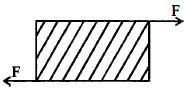
As shown in the figure, forces of $10^5\,N$ each are applied in opposite directions, on the upper and lower faces of a cube of side $10\,cm$, shifting the upper face parallel to itself by $0.5\,cm$ . If the side of another cube of the same material is, $20\,cm$ then under similar conditions as above, the displacement will be......... $cm$
The gas thermometers are more sensitive than liquid thermometers because
A physical quantity is measured and its value is found to be $nu$ where $n = $ numerical value and $u = $ unit. Then which of the following relations is true
The internal energy of an ideal gas increases during an isothermal process when the gas is 
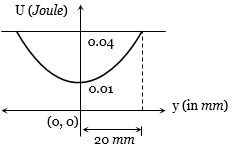
The variation of potential energy of harmonic oscillator is as shown in figure. The spring constant is
A railway line is taken round a circular arc of radius $1000\ m$ , and is banked by raising the outer rail $h$ $m$ above the inner rail. If the lateral force on the inner rail when a train travels round the curve at $10\ ms^{-1}$ is equal to the lateral force on the outer rail when the train's speed is $20\ ms^{-1}$ . The value of $4g\ tan\theta $ is equal to : (The distance between the rails is $1.5\ m$ )