MCQ
Polarisation of light establishes:
- ACorpuscular theory of light
- BQuantum nature of light
- CTransverse nature of light
- DAll of the above
Explanation:
Polarisation of light establishes that light are transverse in nature, otherwise it was believed that they are longitudinal waves, like the sound waves.
Generate a complete, print-ready paper with questions like this in minutes — across 16+ boards, with answer keys.
The phase difference between input and output voltages of a CE circuit is
|
(a) 0o |
(b) 90o |
(c) 180o |
(d) 270o |
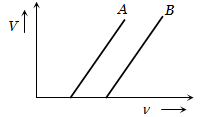
The stopping potential as a function of the frequency of the incident radiation is plotted for two different photoelectric surfaces A and B. The graphs show that work function of A is
|
(a) Greater than that of B |
|
(b) Smaller than that of B |
|
(c) Equal to that of B |
|
(d) No inference can be drawn about their work functions from the given graphs |
The work functions of metals A and B are in the ratio 1 : 2. If light of frequencies f and 2f are incident on the surfaces of A and B respectively, the ratio of the maximum kinetic energies of photoelectrons emitted is (f is greater than threshold frequency of A, 2f is greater than threshold frequency of B)
|
(a) 1 : 1 |
(b) 1 : 2 |
(c) 1 : 3 |
(d) 1 : 4 |
Consider the points lying on a straight line joining two fixed opposite charges. Between the charges there is
|
(a) No point where electric field is zero |
|
(b) Only one point where potential is zero |
|
(c) Only one point where electric field is zero |
|
(d) a, b |