MCQ
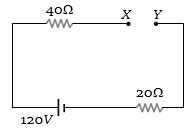
Potential difference across the $40\,\Omega $ resistance will be ............ $V$
  • $0$
  • B
    $80$
  • C
    $40$
  • D
    $120$

Answer

Correct option: A.
$0$
a
(a) Zero (Circuit open means no current and hence no potential difference across resistance).

Need a full question paper?

Generate a complete, print-ready paper with questions like this in minutes — across 16+ boards, with answer keys.

Start Generating Free

Similar questions

The value of the horizontal component of the earth's magnetic field and angle of dip are $1.8\times 10^{-5}$weber/m$^2$  and 30° respectively at some place. The total intensity of earth's magnetic field at that place will be
The half-life of a radioactive substance is $20\, min$. The approximate time interval $\left(t_{2}-t_{1}\right)$ between the time $t_{2},$ when $\frac{2}{3}$ of it has decayed and time $t_{1},$ when $\frac{1}{3}$ of it had decayed is (in $min$)
Compare the dispersive powers of two prisms if one of them deviates the blue and red rays through $10^{\circ}$ and $6^{\circ}$ respectively and the second prism through $8^{\circ}$ and $4.5^{\circ}$
To a germanium sample, traces of gallium are added as an impurity. The resultant sample would behave like
The direction of induced e.m.f. during electromagnetic induction is given by
Electric charge is measured in:
The magnetic moment of a bar magnet is $0.5 \mathrm{Am}^2$. It is suspended in a uniform magnetic field of $8 \times 10^{-2} \mathrm{~T}$. The work done in rotating it from its most stable to most unstable position is:
A bullet of mass 2 gm is having a charge of 2μC. Through what potential difference must it be accelerated, starting from rest, to acquire a speed of 10 m/s
A compass needle whose magnetic moment is $60 \,amp × m^2$ pointing geographical north at a certain place, where the horizontal component of earth's magnetic field is $40\, \mu Wb/m^2$, experiences a torque $1.2 \times {10^{ - 3}}\,N \times m.$ What is the declination at this place......$^o$
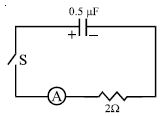
A charged capacitor is allowed to discharge through a resistance $2\,\Omega $ by closing the switch $S $ at the instant $t = 0$. At time $t = ln$ $2$ $\mu s$, the reading of the ammeter falls half of its initial value. The resistance of the ammeter equal to