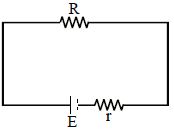
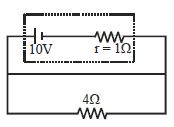
Potential difference across the terminals of the battery shown in figure is .................... $V$ ($r =$ internal resistance of battery)
Medium
Download our app for free and get started
As battery is short circuited
$\mathrm{I}=\frac{\mathrm{E}}{r}=\frac{10}{1}=10 \mathrm{A}$
$v=E-I r$
$V=10-10 \times 1$
$V=0$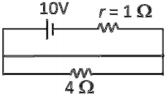

Download our appand get started for free
Experience the future of education. Simply download our apps or reach out to us for more information. Let's shape the future of learning together!No signup needed.*
Similar Questions
- 1A $500\, W$ heating unit is designed to operate from a $115\, volt$ line. If the line voltage drops to $110\, volt$, the percentage drop in heat output will be ............... $\%$View Solution
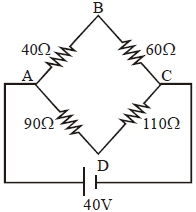
- 2Four resistances $40 \ \Omega, 60\ \Omega, 90\ \Omega$ and $110\ \Omega$ make the arms of a quadrilateral $A,B,C,D$. Across $AC$ is a battery of emf $40\, V$ and internal resistance negligible. The potential difference across $BD$ is $V$ is......View Solution
- 3If the resistance of a conductor is $5\,\Omega\,\,$ at $\,50\,^oC$ and $7\, \Omega\,$ at $\,100\,^oC$ then the mean temperature coefficient of resistance of the material is ............... $^oC$View Solution
- 4In order to increase the resistance of a given wire of uniform cross section to four times its value, a fraction of its length is stretched uniformly till the full length of the wire becomes $\frac{3}{2}$ times the original length what is the value of this fraction?View Solution
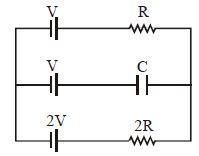
- 5View SolutionIn the given circuit, with steady current, the potential drop across the capacitor must be
- 6Voltmeter reads potential difference across the terminals of an old battery as $1.2\,volt$ , while a potentiometer reads $1.4\,volt$ . The internal resistance of battery is $40\,\Omega $ , then voltmeter resistance is .............. $\Omega$View Solution
- 7$10$ wires (same length, same area, same material) are connected in parallel and each has $1$ $\Omega$ resistance, then the equivalent resistance will be .............. $\Omega$View Solution
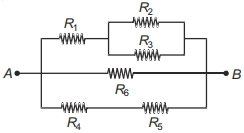
- 8View SolutionConsider the combination of resistors as shown in figure and pick out the correct statement
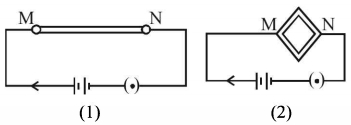
- 9A wire is connected to a battery between the point $M$ and $N$ as shown in the figure $(1)$. The same wire is bent in the form of a square and then connected to the battery between the points $M$ and $N$ as shown in the figure $(2)$. Which of the following quantities increases?View Solution
- 10If power in external resistance $R$ is maximum thenView Solution
$(i) R = r$ $(ii)$ Power in $R$ is $\frac{{{E^2}}}{{4R}}$
$(iii)$ Input power $\frac{{{E^2}}}{{2R}}$ $(iv)$Efficiency is $50\%$