Question
Read the following and answer any four questions from (i) to (v) given below:
Embryo develops at the micropylar end of the embryo sac, where the zygote is situated. Most zygotes divided only after certain amount of endosperm is formed. The early stages of embryo development are similar in both monocotyledons and dicotyledons. The zygote gives rise to the proembryo and subsequently to the globular heart-shaped and mature embryo. A typical dicotyledonous embryo consists of an embryonal axis and two cotyledons. Embryo of monocotyledons possess only one cotyledon.
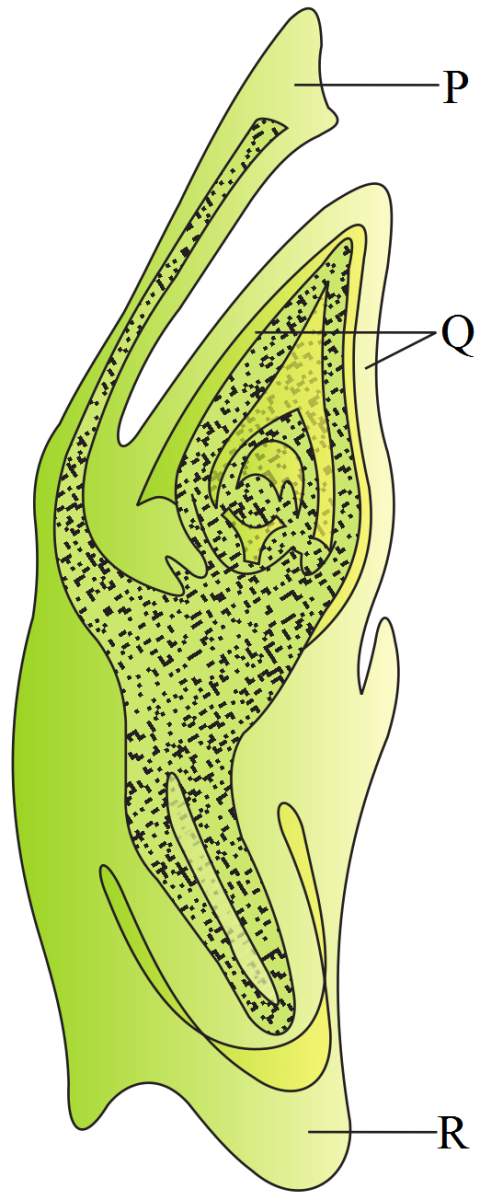
  1. True embryo develops as a result of fusion of:
  1. Two polar nuclei of embryo sac.
  2. An egg cell and a male gamete.
  3. Synergid and male gamete.
  4. A male gamete and antipodals.
  1. Refer to the given diagram of the embryo of an angiospermous plant with parts labelled P, Q and R. Select the correct statement(s) regarding this.
  1. Part 'P' supplies nutrition to the developing embryo.
  2. Part 'Q' is the protective sheath of radicle and root cap.
  3. Part 'R' is the protective sheath of shoot apex and leaf primordia.
  4. The embryo shown in the diagram is present in members of Family Poaceae.
  1. (IV) only.
  2. (II) and (III) only.
  3. (I) and (IV) only.
  4. (I), (II), (III) and (IV).
  1. Which of the given statements are true?
  1. During the development of a dicot embryo, heart-shaped embryo is followed by globular embryo.
  2. The part of embryonal axis above the level of cotyledons is epicotyl, while the part below the level of cotyledons is hypocotyl.
  3. Monocot seeds possess a single cotyledon, represented by scutellum.
  1. (I) and (II).
  2. (II) and (III).
  3. (I) and (III).
  4. (I), (II) and (III).
  1. Consider the following parts of an embryonal axis of a dicot seed.
  1. Hypocotyl.
  2. Epicotyl.
  3. Radicle.
  4. Plumule.
In which of the following the above parts are correctly arranged from top to base?
  1. (III) → (I) → (II) → (IV).
  2. (II) → (I) → (III) → (IV).
  3. (IV) → (II) → (I) → (III).
  4. (III) → (IV) → (II) → (I).
  1. In grass family, the cotyledon, is called:
  1. Epiblast.
  2. Plumule.
  3. Scutellum.
  4. Perisperm.

Answer

  1. (b) An egg cell and a male gamete.
​​​​​​​​​​​​​​​​​​​​​​​​​​​​​​​​​​​​​​​​​​​​​​​​​​​​​​​​Explanation:

In double fertilisation, out of the two male gametes, one fuses with egg or oosphere to perform generative fertilisation. Generative fertilisation is also called syngamy or true fertilisation. It gives rise to a diploid zygote or oospore.
  1. (c) (I) and (IV) only.
  2. (b) (II) and (III).
​​​​​​​​​​​​​​​​​​​​​​​​​​​​​​​​​​​​​​​​​​​​​​​​​​​​​​​​​​​​​​​​​​​​​​Explanation:

During the development of dicot embryo, initially the dicot embryo is globular and undifferentiated. Early embryo with radial symmetry is called proembryo. It is transformed into embryo with the development of radicle, plumule and cotyledons. Two cotyledons differentiate from the sides with a faint plumule in the center. At this time the embryo becomes heart-shaped.
  1. (c) (IV) → (II) → (I) → (III).
  2. (c) Scutellum.
​​​​​​​​​​​​​​​​​​​​​​​​​​​​​​​​​​​​​​​​​​​​​​​​​​​​​​​​​​​​​​​​​​​​​​​​​​​​​Explanation:

In the grass family, the cotyledon is called scutellum that is situated towards one side (lateral) of the embryonal axis.

Need a full question paper?

Generate a complete, print-ready paper with questions like this in minutes — across 16+ boards, with answer keys.

Start Generating Free

Similar questions

Column IColumn II
(1) August Weismann(a) Mutation theory
(2) Hugo de Vries(b) Germplasm theory
(3) Charles Darwin(c) Theory of acquired characters
(4) Lamarck(d) Theory of natural selection
Distinguish between: Long day plants and Short day plants
Match the disorder with the gland associated with it.
Column A (Disorder)Column B (Associated Gland)
(1) Addison’s disease(A) Hypothalamus
(2) Grave’s disease(B) Pituitary
(3) Diabetes insipidus(C) Thyroid
(4) Acromegaly(D) Adrenal 


Column I [Organs]Column II [Functions]
(1) Epididymis(a) Transport of sperms
(2) Sertoli cells(b) Copulatory organ
(3) Vas deferens(c) Nourishment to developing sperms
(4) Penis(d) Maturation of sperms
Distinguish between: Passive absorption of Minerals and Active absorption of minerals
Distinguish between: Autogamy (Self-pollination) – Xenogamy (cross pollination)
Diffusion and Osmosis.
Geological timeAnimal life
(1) Cambrian(a) Amphibians
(2) Ordovician(b) First terrestrial animals
(3) Silurian(c) Jawless fishes
(4) Devonian(d) Trilobite
Read the following and answer any four questions from (i) to (v) given below:
Age sex structure of a population can be depicted in the form of a pyramid by plotting the percentage of population of each sex in each age class. Two age sex pyramids are as follows.
  1. Which of the following is correct regarding pyramid B?
  1. It represents stable population.
  2. It represents expanding population.
  3. It represents declining population.
  4. Both (a) and (b).
  1. Total number of individuals of a species per unit area per unit time is called.
  1. Population size.
  2. Population density.
  3. Demography.
  4. Population dynamics.
  1. Which of the following is correct regarding age sex pyramid A and B?
  1. A represents the age sex pyramid of developed country.
  2. B represents the age sex pyramid of developing country.
  3. A represents rapidly growing population.
  4. Both (a) and (b).
  1. A population with a large proportion of older individuals than younger ones will likely to:
  1. Grow larger first and then decline.
  2. Continue to grow indefinitely.
  3. Decline.
  4. None of these.
  1. Assertion: Bell shaped age pyramid represents a stable population.
Reason: ln a stable population, proportion of individuals in reproductive age group is higher than the individuals in pre reproductive age group.
  1. Both assertion and reason are true and reason is the correct explanation of assertion.
  2. Both assertion and reason are true but reason is not the correct explanation of assertion.
  3. Assertion is true but reason is false.
  4. Both assertion and reason are false.
Distinguish between: Menarche and Menopause.