Question
Distinguish between: Menarche and Menopause.

Answer

MenarcheMenopause
1. Menarche is the beginning of menstrual cycle.1. Menopause is the stoppage of menstrual cycle.
2. Menarche is at the age of 10 to 14.2. Menopause is at the age of 45 to 50.
3. Menarche begins with secretion of FSH and LH.3. Menopause is caused due to decline of FSH and LH secretion.
4. Menarche is the beginning of the reproductive period.4. Menopause is the end of the reproductive period.

Need a full question paper?

Generate a complete, print-ready paper with questions like this in minutes — across 16+ boards, with answer keys.

Start Generating Free

Similar questions

Distinguish between : Natural ecosystem and artificial ecosystem.
Read the following and answer any four questions from (i) to (v) given below:
Age sex structure of a population can be depicted in the form of a pyramid by plotting the percentage of population of each sex in each age class. Two age sex pyramids are as follows.
  1. Which of the following is correct regarding pyramid B?
  1. It represents stable population.
  2. It represents expanding population.
  3. It represents declining population.
  4. Both (a) and (b).
  1. Total number of individuals of a species per unit area per unit time is called.
  1. Population size.
  2. Population density.
  3. Demography.
  4. Population dynamics.
  1. Which of the following is correct regarding age sex pyramid A and B?
  1. A represents the age sex pyramid of developed country.
  2. B represents the age sex pyramid of developing country.
  3. A represents rapidly growing population.
  4. Both (a) and (b).
  1. A population with a large proportion of older individuals than younger ones will likely to:
  1. Grow larger first and then decline.
  2. Continue to grow indefinitely.
  3. Decline.
  4. None of these.
  1. Assertion: Bell shaped age pyramid represents a stable population.
Reason: ln a stable population, proportion of individuals in reproductive age group is higher than the individuals in pre reproductive age group.
  1. Both assertion and reason are true and reason is the correct explanation of assertion.
  2. Both assertion and reason are true but reason is not the correct explanation of assertion.
  3. Assertion is true but reason is false.
  4. Both assertion and reason are false.
Natality and Mortality.
What is the cause of frameshift mutation?
Column AColumn B (New Terminology)
(1) D.P.D.(a) Osmotic potential
(2) O.E(b) Pressure potential
(3) T.P(c) Water potential
Read the following and answer any four questions from (i) to (v) given below:
Haemophilia is a sex linked disease which is also known as bleeder's disease as the patient will continue to bleed even from a minor cut since he or she does not possess the natural phenomenon of blood clotting due to absence of anti -haemophilic globulin or factor VIII and plasma thromboplastin factor IX essential for it. As a result of continuous bleeding the patient may die of blood loss. Colour blindness is another type of sex linked trait in which the eye fails to distinguish red and green colours. Vision is however, not affected and the colour blind can, lead a normal life, reading, writing and driving (distinguishing traffic lights by their position).
  1. If a haemophilic man marries a woman whose father was haemcphihc and mother was normal then which of the following holds true for their progenies?
  1. Of the total number of daughters, 50% daughters are carrier and $50 \%$ are haemophilic.
  2. All the daughters are haemophilic.
  3. All sons are haemophilic and all daughters are normal.
  4. All sons are normal, all daughters are carriers.
  1. A man whose father was colourblind and mother was normal marries a woman whose father was haemophilic and mother was normal. Which of the following is true for their progenies? [Note: Percentage is from the total number of progenies]
  1. $25 \%$ female progenies carry the gene for both haemophilia and colourblindness.
  2. $25 \%$ male progenies carry only the gene of colourblindness.
  3. $25 \%$ female progenies carry only the gene of colourblindness.
  4. $25 \%$ male progenies and 25% female progenies carry the gene of haemophilia.
  1. Which of the following statements is incorrect regarding haemophilia?
  1. It is a dominant disease.
  2. A single protein involved in clotting of blood is affected.
  3. It is recessive disease.
  4. It is Mendelian disorder.
  1. Anup is having colourblindness and is married to Soni who is normal. What is the chance that their son will have the disease?
  1. $100 \%$
  2. $50 \%$
  3. $25 \%$
  4. $0 \%$
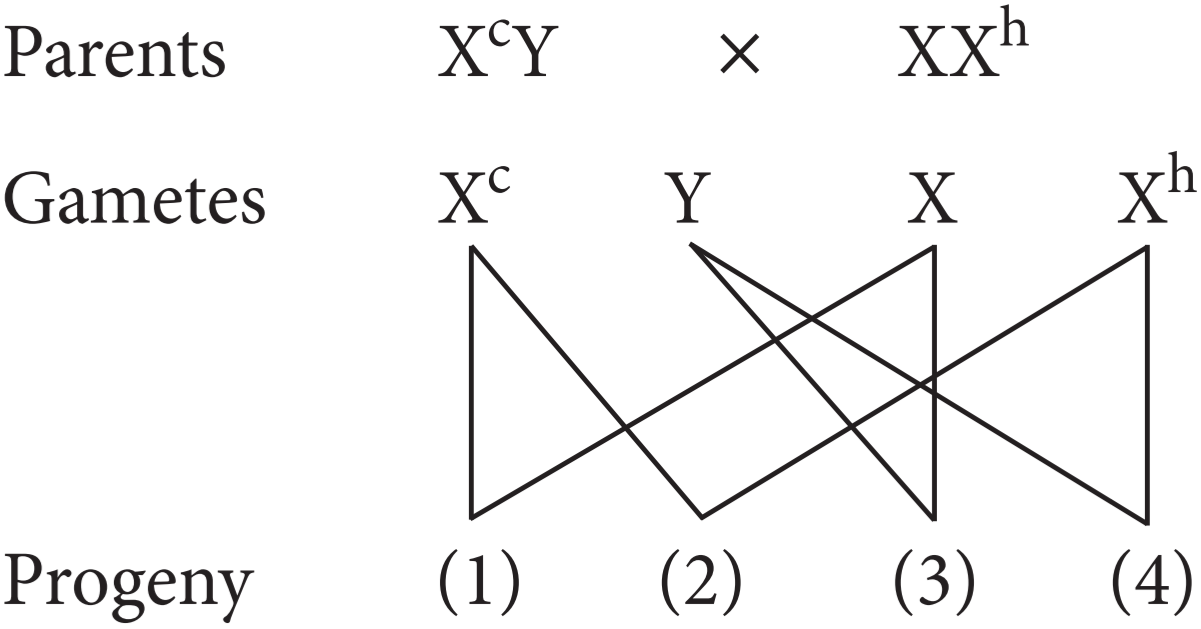
  1. Refer to the given cross?


Select the correct option regarding $1, 2, 3$ and $4$.
  1. The options are as follow:
  1. Colourblind carrier female.
  2. Colourblind haemophilic female.
  3. Normal male.
  4. Haemophilic male
  1. The options are as follow:
  1. Colourblind people
  2. Haemophilic female.
  3. Normal male
  4. Haemophilic male
  1. The options are as follow:
  1. Colourblind female
  2. Colourblind and haemophilic female
  3. Normal male
  4. Normal male.
  1. The options are as follow:
  1. Colourblind carrier female.
  2. Normal female.
  3. Normal male.
  4. Haemophilic male.
Read the following and answer any four questions from (i) to (v) given below:
ln a plant species that follows Mendelian inheritance yellow flower colour is dominant over white and round fruits shape is dominant over elongated. Crossing was performed between two purelines-one having yellow-flower and round fruit and another with white flower and elongated fruits. About 20 plants survived in $F_1$ progeny. Plants of $F_1$ were allowed to self fertilise and about 960 plants survived in $F_2$
  1. How many plants would have yellow flower and round fruit in $F_1$ generation?
  1. 20
  2. 10
  3. 5
  4. 0
  1. How many plants would have yellow flower and round fruit in $F_2$​​​​​​​ generation?
  1. 960
  2. 540
  3. 180
  4. 60
  1. Which of the following is correct for the condition when plant heterozygous for yellow flower and round fruit is back crossed with the double recessive parent?
  1. 9 : 3 : 3 : 1 ratio of phenotype only.
  2. 9 : 3 : 3 : 1 ratio of genotype only.
  3. 1 : 1 : 1 : 1 ratio of phenotype only.
  4. 1 : 1 : 1 : 1 ratio of phenotype and genotype.
  1. When the plant heterozygous for yellow flower and round fruit are self crossed, then the plant with yellow flower and elongated fruit will be represented by the genotype?
  1. YyRr, YyRR, YYRr
  2. Yyrr, YYrr, yyrr
  3. yyRr, yyRR
  4. Yyrr, YYrr
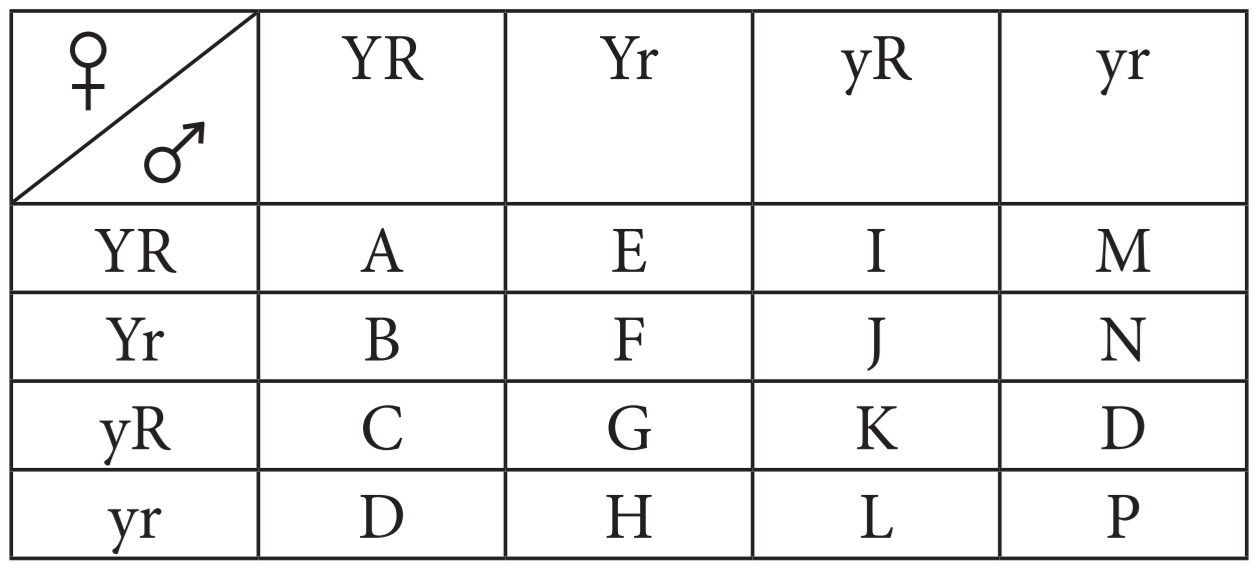
  1. 'Tile given Punnett's square represents the pattern of inheritance in a dihybrid cross where yellow flower and round fruit (R) condition is dominant over white flower (y) and elongated fruit (r) condition.


Plant 'C' will produce fruits with the genotype identical to fruits produced by the plant of
  1. type H
  2. type E
  3. type K
  4. type 1
Read the following and answer any four questions from (i) to (v) given below:
The endosperm makes the main source of food for the embryo. Generally the endosperm nucleus divides after the division of the oospore, but in several cases the endosperm is formed to a great extent even before the first division of the oospore. There are three general types of endosperm formation: (a) nuclear type, (b) cellular type and (c) helobial type. The endosperm is usually triploid, but haploid endosperm is also found. Endosperm may either be completely consumed by the developing embryo before seed maturation, or it may persist in the mature seed.
  1. Haploid endosperm is found in:
  1. Pin us.
  2. Cauliflower.
  3. Sunflower.
  4. Pea.
  1. Persistent endosperm is found in:
P. Pea Q. Castor R. Bean S. Coconut T. Groundnut.
  1. Q and S.
  2. P and T.
  3. R, S and T.
  4. P, S and T.
  1. Milk of tender coconut represents (A) and the surrounding white coconut meal represents (B).
S. No
A
B
(a)
Cellular endosperm
Free- nuclear endosperm
(b)
Free-nuclear endosperm
Cellular endosperm
(c)
Helobial endosperm
Cellular endosperm
(d)
Free-nuclear endosperm
Helobial endosperm
  1. If an endosperm cell of a gymnosperm contains 12 chromosomes, the number of chromosomes in each cell of the root will be:
  1. 4
  2. 24
  3. 16
  4. 6
  1. In angiosperms, normally after fertilization:
  1. The zygote divides earlier than the primary endosperm nucleus.
  2. The primary endosperm nucleus divides earlier than the zygote.
  3. Both the zygote and primary endosperm nucleus divide simultaneously.
  4. Both the zygote and primary endosperm nucleus undergo a resting period.
Column IColumn II
(1) Mechanical means(a) Saheli
(2) Physiological device(b) Jellies
(3) Chemical device(c) Vasectomy
(4) Permanent method(d) Diaphragm
Distinguish between: Directional, Stabilizing and Disruptive selection.