Question
Need a full question paper?
Generate a complete, print-ready paper with questions like this in minutes — across 16+ boards, with answer keys.
Explore more
Similar questions
Read the passage given below and answer the following questions: Werner, a Swiss chemist in 1892 prepared and characterised a large number of coordination compounds and studied their physical and chemical behaviour. He proposed that, in coordination compounds, metals possess two types of valencies, viz. primary valencies, which are normally ionisable and secondary valencies which are non-ionisable. ln a series of compounds of cobalt (III) chloride with ammonia, it was found that some of the chloride ions could be precipitated as AgCl on adding excess of AgNO3 solution in cold, but some remained in solution. The number ofions furnished by a complex in a solution can be determined by precipitation reactions. The measurement of molar conductance of solutions of coordination compounds helps to estimate the number of ions furnished by the compound in solution. In these questions (Q. No. i-iv), a statement of assertion followed by a statement ofreason is given. Choose the correct answer out of the following choices.
- Assertion and reason both are correct statements and reason is correct explanation for assertion.
- Assertion and reason both are correct statements but reason is not correct explanation for assertion.
- Assertion is correct statement but reason is wrong statement.
- Assertion is wrong statement but reason is correct statement.
- Assertion: The complex [Co(NH3)3Cl3] does not give precipitate with silver nitrate solution.
Reason: The given complex is non-ionisable.
- Assertion: The complex [Co(NH3)4Cl2]Cl gives precipitate corresponding to 2 mol of AgCl with AgNO3 solution.
Reason: It ionises as [Co(NH3)4Cl2]+ + Cl-.
- Assertion: CoCl3. 4NH3 gives 1 mol of AgCl on reacting with AgNO3, its secondary valency is 6.
Reason: Secondary valency corresponds to coordination number.
- Assertion: 1 mol of [CrCl2(H2O)4]Cl· 2H2O will give 1 mol of AgCl on treating with AgNO3.
Reason: Cl- ions satisfying secondary valanceis will not be precipitated.
- Assertion: CoCl3. 3NH3 is not conducting while CoCl3. 5NH3 is conducting.
Reason: The complex of CoCl3. 3NH3 is [CoCl3(NH3)3] while that of CoCl3· 5NH3 is [CoCl(NH3)5]Cl3.
Read the passage given below and answer the following questions:
The transition elements have incompletely filled d-subshells in their ground state or in any of their oxidation states. The transition elements occupy position in betweens- and p-blocks in groups 3-12 of the Periodic table. Starting from fourth period, transition elements consists of four complete series : Sc to Zn, Y to Cd and La, Hf to Hg and Ac, Rf to Cn. In general, the electronic configuration of outer orbitals of these elements is (n - 1)d1-10 n1-2. The electronic configurations of outer orbitals of Zn, Cd, Hg and Cn are represented by the general formula (n - 1)d10ns2. All the transition elements have typical metallic properties such as high tensile strength, ductility, malleability. Except mercury, which is liquid at room temperature, other transition elements have typical metallic structures. The transition metals and their compounds also exhibit catalytic property and paramagnetic behaviour. Transition metal also forms alloys. An alloy is a blend of metals prepared by mixing the components. Alloys may be homogeneous solid solutions in which the atoms of one metal are distributed randomly among the atoms of the other.
The following questions are multiple choice questions. Choose the most appropriate answer:
The transition elements have incompletely filled d-subshells in their ground state or in any of their oxidation states. The transition elements occupy position in betweens- and p-blocks in groups 3-12 of the Periodic table. Starting from fourth period, transition elements consists of four complete series : Sc to Zn, Y to Cd and La, Hf to Hg and Ac, Rf to Cn. In general, the electronic configuration of outer orbitals of these elements is (n - 1)d1-10 n1-2. The electronic configurations of outer orbitals of Zn, Cd, Hg and Cn are represented by the general formula (n - 1)d10ns2. All the transition elements have typical metallic properties such as high tensile strength, ductility, malleability. Except mercury, which is liquid at room temperature, other transition elements have typical metallic structures. The transition metals and their compounds also exhibit catalytic property and paramagnetic behaviour. Transition metal also forms alloys. An alloy is a blend of metals prepared by mixing the components. Alloys may be homogeneous solid solutions in which the atoms of one metal are distributed randomly among the atoms of the other.
The following questions are multiple choice questions. Choose the most appropriate answer:
- Which of the following characteristics of transition metals is associated with higher catalytic activity?
- High enthalpy of atomisation.
- Variable oxidation states.
- Paramagnetic behaviour.
- Colour of hydrated ions.
- Transition elements form alloys easily because they have.
- Same atomic number.
- Same electronic configuration.
- Nearly same atomic size.
- Same oxidation states.
- The electronic configuration of tantalum (Ta) is:
- [Xe]4f05d16s2
- [Xe]4f145d26s2
- [Xe]4f145d36s2
- [Xe]4f145d46s2
- Which one of the following outer orbital configurations may exhibit the largest number of oxidation states?
- 3d54s1
- 3d54s2
- 3d24s2
- 3d34s2
- The correct statement(s) among the following is/ are:
- All d and f-block elements are metals.
- All d and f-block elements form coloured ions.
- All d and f-block elements are paramagnetic.
- (I) only
- (I) and (II) only
- (II) and (III) only
- (I), (II) and (III)
The progress of the reaction, $\text{A}\rightleftharpoons\text{nB}$ with time is represented in the following figure:
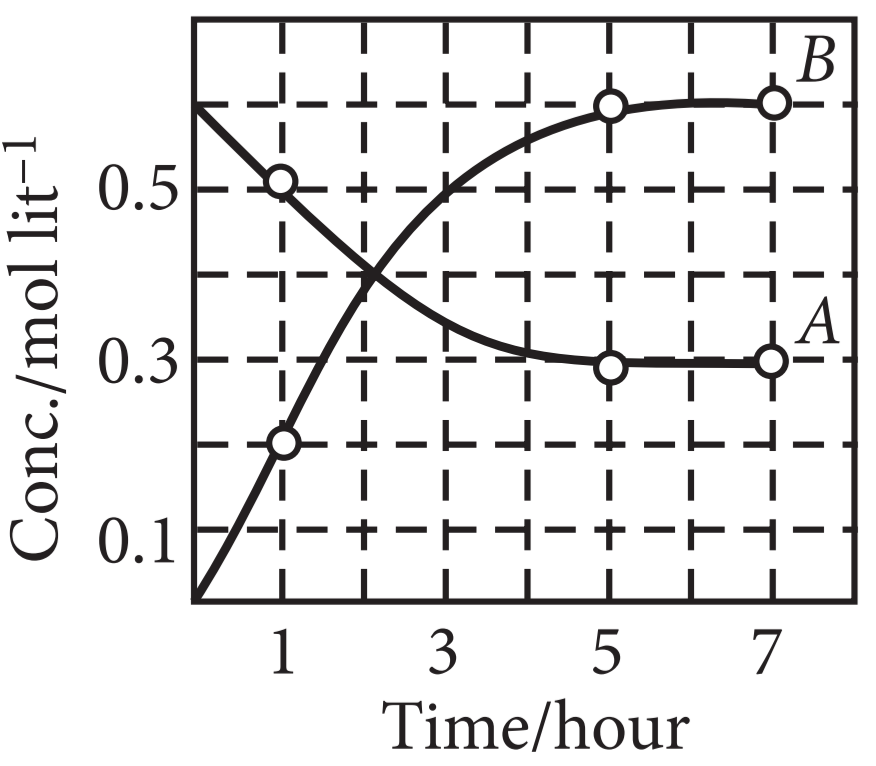
The following questions are multiple choice questions. Choose the most appropriate answer:
→The following questions are multiple choice questions. Choose the most appropriate answer:
- What is the value of n?
- 1
- 2
- 3
- 4
- Find the value of the equilibrium constant.
- 0.6M
- 1.2M
- 0.3M
- 2.4M
- The initial rate of conversion of A will be:
- 0.1 mol L-1hr-1
- 0.2 mol L-1hr-1
- 0.4 mol L-1hr-1
- 0.8 mol L-1hr-1
- For the reaction, if $\frac{\text{d}[\text{B}]}{\text{dt}}=2\times10^{-4},$ value of $-\frac{\text{d}[\text{A}]}{\text{dt}}$ will be:
- 2 × 10⁻⁴
- 10-4
- 4 × 10⁻⁴
- 0.5 × 10⁻⁴
- Which factor has no effect on rate of reaction?
- Temperature.
- Nature of reactant.
- Concentration of reactant.
- Molecularity.
Read the passage given below and answer the following questions:
Valence bond theory considers the bonding between the metal ion and the ligands as purely covalent. On the other hand, crystal field theory considers the metal-ligand bond to be ionic arising from electrostatic interaction between the metal ion and the ligands. In coordination compounds, the interaction between the ligand and the metal ion causes the five d-orbitals to split-up. This is called crystal field splitting and the energy difference between the two sets of energy level is called crystal field splitting energy. The crystal field splitting energy $(\Delta_0)$ depends upon the nature of the ligand. The actual configuration of complexes is divided by the relative values of $\Delta_0$ and P (pairing energy).
If $\Delta_0<\text{P},$ then complex will be high spin.
If $\Delta_0>\text{P},$ then complex will be low spin
The following questions are multiple choice questions. Choose the most appropriate answer:
→Valence bond theory considers the bonding between the metal ion and the ligands as purely covalent. On the other hand, crystal field theory considers the metal-ligand bond to be ionic arising from electrostatic interaction between the metal ion and the ligands. In coordination compounds, the interaction between the ligand and the metal ion causes the five d-orbitals to split-up. This is called crystal field splitting and the energy difference between the two sets of energy level is called crystal field splitting energy. The crystal field splitting energy $(\Delta_0)$ depends upon the nature of the ligand. The actual configuration of complexes is divided by the relative values of $\Delta_0$ and P (pairing energy).
If $\Delta_0<\text{P},$ then complex will be high spin.
If $\Delta_0>\text{P},$ then complex will be low spin
The following questions are multiple choice questions. Choose the most appropriate answer:
- Which of the following ligand has lowest $\Delta_0$ value?
- CN-
- CO
- F-
- NH3
- The crystal field splitting energy for octahedral $(\Delta_0)$ and tetrahedral $(\Delta_t)$ complex is related as:
- $\Delta_\text{t}=\frac{1}{2}\Delta_0$
- $\Delta_\text{t}=\frac{4}{9}\Delta_0$
- $\Delta_\text{t}=\frac{3}{5}\Delta_0$
- $\Delta_\text{t}=\frac{2}{5}\Delta_0$
- On the basis of crystal field theory, the electronic configuration of d4 in two situations : (i) t.0 > P and (ii) t.0
| (i) | (ii) | |
| (a) | $\text{t}^4_{2\text{g}}\text{e}^0_\text{g}$ | $\text{t}^3_{2\text{g}}\text{e}^1_\text{g}$ |
| (b) | $\text{t}^3_{2\text{g}}\text{e}^1_\text{g}$ | $\text{t}^4_{2\text{g}}\text{e}^0_\text{g}$ |
| (c) | $\text{t}^3_{2\text{g}}\text{e}^1_\text{g}$ | $\text{t}^3_{2\text{g}}\text{e}^1_\text{g}$ |
| (d) | $\text{t}^4_{2\text{g}}\text{e}^0_\text{g}$ | $\text{t}^4_{2\text{g}}\text{e}^0_\text{g}$ |
- Using crystal field theory, calculate magnetic moment of central metal ion of [FeF6]4-.
- 1.79B.M.
- 2.83B.M.
- 3.85B.M.
- 4.9B.M.
- Electronic configuration of d-orbitals in [Ti(H2O)6]3+ ion in an octahedral crystal field is:
- $\text{t}^1_{2\text{g}}\text{e}^0_\text{g}$
- $\text{t}^2_{2\text{g}}\text{e}^0_\text{g}$
- $\text{t}^0_{2\text{g}}\text{e}^1_\text{g}$
- $\text{t}^1_{2\text{g}}\text{e}^1_\text{g}$
Read the passage given below and answer the following questions: Glucose is known as dextrose because it occurs in nature as the optically active dextrorotatory isomer. lt is essential constituent of human blood. The blood normally contains 65 to 110mg of glucose per 100mL (hence named Blood sugar). The level may be much higher in diabetic persons. The urine of diabetic persons also contain considerable amount of glucose. ln combined form, it occurs in cane sugar and polysaccharides such as starch and cellulose. Glucose has an aldehyde group (-CHO), one primary alcoholic group (-CH2OH) and four secondary alcoholic groups (-CHOH) in their structure. Due to the presence five hydroxyl groups (-OH). glucose undergoes acetylation. Glucose also undergoes oxidation with mild oxidising agents like bromine water as well as with strong oxidising agents like nitric acid. Since glucose is readily oxidised, it acts as a strong reducing agent and reduces Tollen's reagent and Fehling solution. Glucose exists in two crystalline forms: $\alpha$-D-glucose and $\beta$-D-glucose. If either of the two forms is dissolved in water and allowed to stand, the specific rotation of the solution changes gradually, until a constant value is obtained. This change is called mutarotation. A statement of assertion followed by a statement of reason is given. Choose the correct answer out of the following choices.
→→→- Assertion and reason both are correct statements and reason is correct explanation for assertion.
- Assertion and reason both are correct statements but reason is not correct explanation for assertion.
- Assertion is correct statement but reason is wrong statement.
- Assertion is wrong statement but reason is correct statement.
- Assertion: A diabetic person carries a packet of glucose with him always.
Reason: Glucose increases the blood sugar level almost instantaneously.
- Assertion: On oxidation with nitric acid, glucose as well as gluconic acid both yield saccharic acid.
Reason: The pentaacetate of glucose does not react with hydroxylamine indicating the absence of free -CHO group.
- Assertion: Glucose reacts with acetyl chloride to form pentaacetyl glucose.
Reason: The formation of pentaacetyl derivative confirms the presence of five -OH groups in glucose.
- Assertion: A certain compound gives negative test with ninhydrin and positive test with Benedict's solution, the compound is an amino acid.
Reason: Glucose is a monosaccharide.
- Assertion: The rapid interconversion of $\alpha$-D-glucose and $\beta$-D-glucose in solution is known as racemisation.
Reason: Hydrolysis reaction will take place when a mineral acid is treated with sugar.
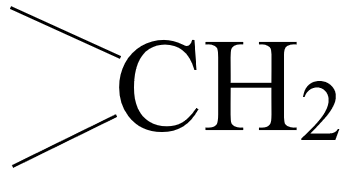 group on treatment with Zn-Hg and cone. HCl (Clemmensen reduction) or with hydrazine followed by NaOH or KOH in highly boiling solvent such as ethylene glycol (Wolff-Kishner reduction).Aldehydes differ from ketones in their oxidation reactions. Aldehydes are easily oxidised to carboxylic acids on treatment with HNO3, KMnO4, K2Cr2O7 etc. Even mild oxidising agents mainlyTollens' reagent and Fehling's solution also oxidise aldehydes. Ketones are generally oxidised under vigorous conditions i.e., strong oxidising agents and at elevated temperatures, to give mixture of carboxylic acids having lesser number of C-atoms than the parent ketone.
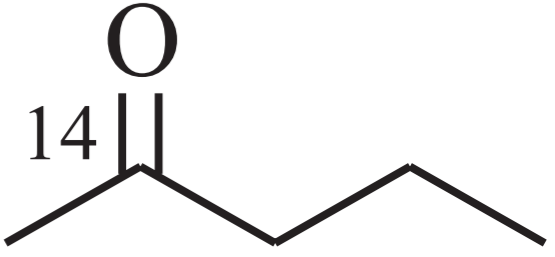 by acidified K2Cr2O7, the products are: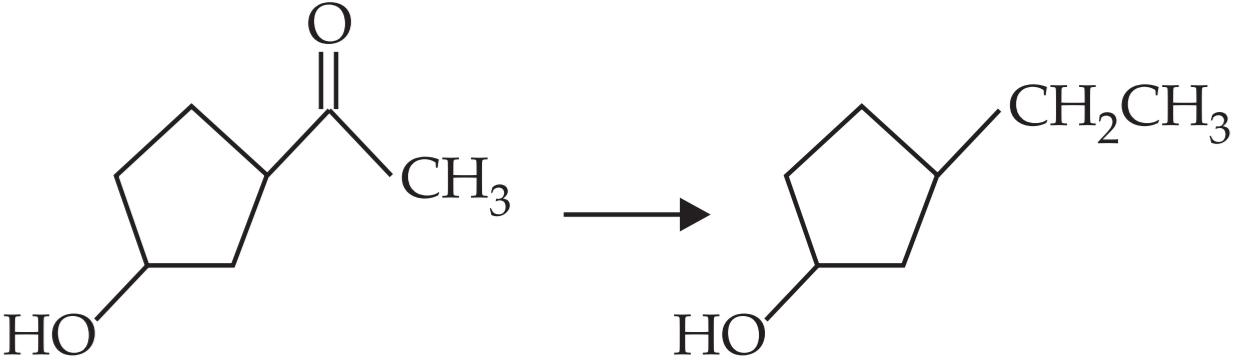
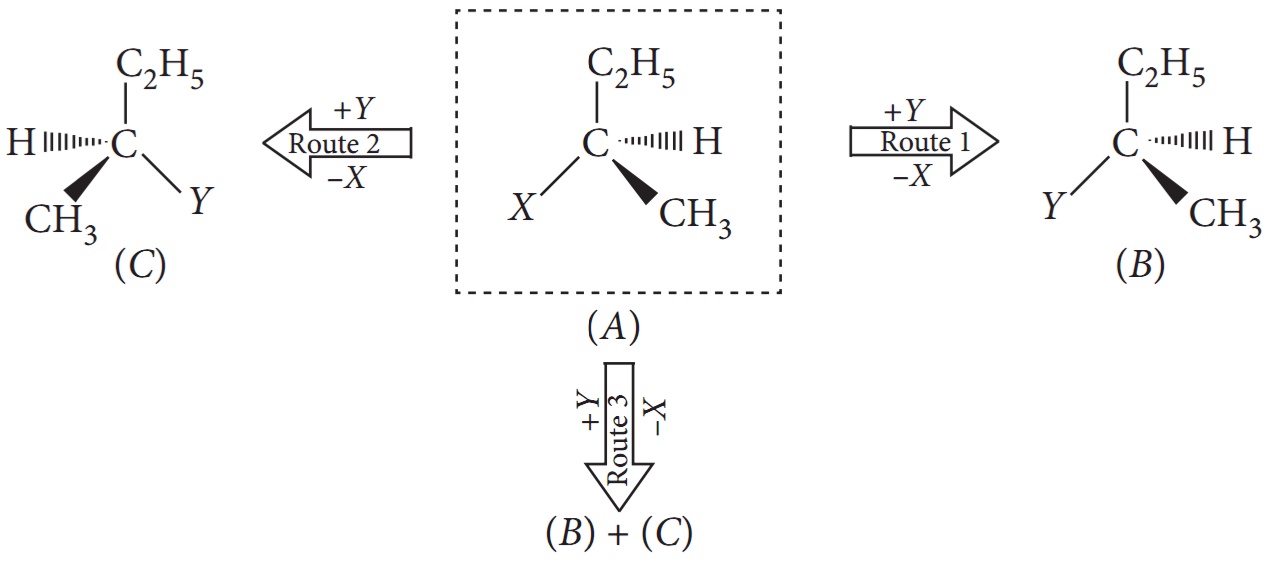
Read the passage given below and answer the following questions:
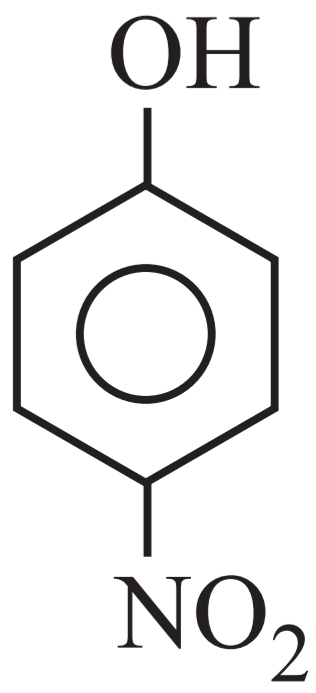
An organic compound (A) having molecular formula C6H6O gives a characteristic colour with aqueous FeCl3 solution. (A) on treatment with CO2 and NaOH at 400K under pressure gives (B), which on acidification gives a compound (C). The compound (C) reacts with acetyl chloride to give (D) which is a popular pain killer.
The following questions are multiple choice questions. Choose the most appropriate answer:
An organic compound (A) having molecular formula C6H6O gives a characteristic colour with aqueous FeCl3 solution. (A) on treatment with CO2 and NaOH at 400K under pressure gives (B), which on acidification gives a compound (C). The compound (C) reacts with acetyl chloride to give (D) which is a popular pain killer.
The following questions are multiple choice questions. Choose the most appropriate answer:
- Compound (A) is:
- 2-Hexanol.
- Dimethyl ether.
- Phenol.
- 2-Methyl pentanol.
- Compound (C) is:
- Salicylic acid.
- Salicyladehyde.
- Benzoic acid.
- Benzaldehyde.
- Number of carbon atoms in compound (D) is:
- 7
- 6
- 8
- 9
- The conversion of compound (A) to (C) is known as:
- Reimer-Tiemann reaction.
- Kolbe's reaction.
- Schimdt reaction.
- Swarts reaction.
- Compound (A) on heating with compound (C) in presence of POCl3 gives a compound (D) which is used:
- In perfumery as a ftavouring agent
- As an antipyretic
- As an analgesic
- As an intestinal antiseptic.
Read the passage given below and answer the following questions:
The unique behaviour of Cu, having a positive E° accounts for its inability to liberate H2 from acids. Only oxidising acids (nitric and hot concentrated sulphuric acid) react with Cu, the acids being reduced. The stability of the half-filled (d5) subshell in Mn2+ and the completely filled (d10) configuration in Zn2+ are related to their $\text{E}^\circ\frac{\text{M}^{3+}}{\text{M}^{2+}}$ values. The low value for Sc reflects the stability of Sc3+ which has a noble gas configuration. The comparatively high value for Mn shows that Mn2+(d5) is particularly stable, whereas a comparatively low value for Fe shows the extra stability of Fe3+(d5). The comparatively low value for Vis related to the stability of v2+ (half-filled t2g level).
The following questions are multiple choice questions. Choose the most appropriate answer:
→The unique behaviour of Cu, having a positive E° accounts for its inability to liberate H2 from acids. Only oxidising acids (nitric and hot concentrated sulphuric acid) react with Cu, the acids being reduced. The stability of the half-filled (d5) subshell in Mn2+ and the completely filled (d10) configuration in Zn2+ are related to their $\text{E}^\circ\frac{\text{M}^{3+}}{\text{M}^{2+}}$ values. The low value for Sc reflects the stability of Sc3+ which has a noble gas configuration. The comparatively high value for Mn shows that Mn2+(d5) is particularly stable, whereas a comparatively low value for Fe shows the extra stability of Fe3+(d5). The comparatively low value for Vis related to the stability of v2+ (half-filled t2g level).
The following questions are multiple choice questions. Choose the most appropriate answer:
- Standard reduction electrode potential of $\frac{\text{Zn}^{2+}}{\text{Zn}}$ is 0.76V. This means
- ZnO cannot be reduced to Zn by H2 under standard conditions.
- Zn cannot liberate H2 with concentrated acids.
- Zn is generally the anode in an electrochemical cell.
- Zn is generally the cathode in an electrochemical cell.
- $\text{E}^\circ$ values for the couples $\frac{\text{Cr}^{3+}}{\text{Cr}^{2+}}$ and $\frac{\text{Mn}^{3+}}{\text{Mn}^{2+}}$ are -0.41 and +1.51 volts respectively. These values suggest that.
- Cr2+ acts as a reducing agent whereas Mn3+ acts as an oxidizing agent.
- Cr2+ is more stable th an Cr3+ state.
- Mn3+ is more stable than Mn2+.
- Cr2+ acts as an oxidizing agent whereas Mn3+ acts as a reducing agent..
- The reduction potential values of M, N and O are +2.46, -1.13 and -3.13V respectively. Which of the following order is correct regarding their reducing property?
- O > N > M
- O > M > N
- M > N > O
- M > O > N
- Which of the following statements are true?
- Mn2+ compounds are more stable than Fe2+ towards oxidation to +3 state.
- Titanium and copper both in the first series of transition metals exhibits +1 oxidation state most frequently.
- Cu+ ion is stable in aqueous solutions.
- The $\text{E}^\circ$ value for the $\frac{\text{Mn}^{3+}}{\text{Mn}^{2+}}$ couple is much more positive than that for $\frac{\text{Cr}^{3+}}{\text{Cr}^{2+}}$ or $\frac{\text{Fe}^{3+}}{\text{Fe}^{2+}}.$.
- (II) and (III)
- (I) and (IV)
- (I) and (III)
- (II) and (IV)
- The stability of $\text{Cu}^{2+}_\text{(aq)}$ rather than $\text{Cu}^{+}_\text{(aq)}$ is due to.
- More negative $\Delta_\text{hyd}\text{H}^\circ$ of $\text{Cu}^{2+}_\text{(aq)}.$
- Less negative $\Delta_\text{hyd}\text{H}^\circ$ of $\text{Cu}^{2+}_\text{(aq)}.$
- More positive $\Delta_\text{hyd}\text{H}^\circ$ of $\text{Cu}^{2+}_\text{(aq)}.$
- Less positive $\Delta_\text{hyd}\text{H}^\circ$ of $\text{Cu}^{2+}_\text{(aq)}.$
Electrical work done in unit time is equal to electrical potential multiplied by total charge passed. ln order to obtain maximum work from a cell, the charge has to be passed reversibly. The reversible work done by a cell is equal to decrease in its Gibb's energy. Hence, Gibb's energy of reaction is given by $\Delta\text{G}=\text{nFE}_\text{cell}$ Hence, Eis the emfof the cell and nFis the amount of energy. In these questions (Q. No. i-Iv), a statement of assertion followed by a statement ofreason is given. Choose the correct answer out of the following choices.
→- Assertion and reason both are correct statements and reason is correct explanation for assertion.
- Assertion and reason both are correct statements but reason is not correct explanation for assertion.
- Assertion is correct statement but reason is wrong statement.
- Assertion is wrong statement but reason is correct statement.
- Assertion: $\Delta\text{G}^\circ=-\text{nFE}^\circ$
Reason: Eº should be positive for a spontaneous reaction.
- Assertion: An electrochemical cell can be set up only if the red ox reaction is spontaneous.
Reason: A reaction is spontaneous if free energy change is negative.
- Assertion: For an electrochemical cell, $\Delta\text{G}<0$ and $\text{E}_\text{cell}>0.$
Reason: The given cell is non-spontaneous.
- Assertion: Current stops flowing when Ecell = 0.
Reason: Equilibrium of the cell reaction is attained.
- Assertion: Ecell should have a positive value for the cell to function.
Reason: Ecell = Ecathode - Eanode