Question
Read the source given below and answer the following questions:
Ever since humans appeared on the earth, they have used different means of communication. But, the pace of change, has been rapid in modern times. Long-distance communication is far easier without the physical movement of the communicator or receiver. Personal communication and mass communication including television, radio, press, films, etc. are the major means of communication in the country.
Mass communication provides entertainment and creates awareness among people about various national programmes and policies. It includes radio, television, newspapers, magazines, books and films. All India Radio (Akashwani) broadcasts a variety of programmes in national, regional and local languages for various categories of people, spread over different parts of the country. Doordarshan, the national television channel of India, is one of the largest terrestrial networks in the world. It broadcasts a variety of programmes from entertainment, educational to sports, etc. for people of different age groups.
India publishes a large number of newspapers and periodicals annually. They are of different types depending upon their periodicity. Newspapers are published in about 100 languages and dialects. India is the largest producer of feature films in the world. It produces short films; video feature films and video short films. The Central Board of Film Certification is the authority to certify both Indian and foreign films.
Answer the following MCQs by choosing the most appropriate option:
  1. What does AIR stand for?
  1. All India Radio.
  2. American Indian Radio.
  3. Asian Indo Radio.
  4. None of these.
  1. Which is the authority to certify both Indian and foreign films?
  1. Censorship Board.
  2. Central Board of Film Certification.
  3. Central Bureau of Certification.
  4. Central Board.
  1. Following are the features of mass communication, except:
  1. Mass communication includes television, radio, press, films, etc.
  2. It is one of the major means of communication in the country.
  3. It provides entertainment as well as creates awareness among the masses.
  4. It is a communication between person to person.
  1. Which is the largest terrestrial networks in the world?
  1. BBC.
  2. CNN.
  3. Doordarshan.
  4. Reuters.

Answer

(i)
(a)
All India Radio.
(ii)
(b)
Central Board of Film Certification.
(iii)
(d)
It is a communication between person to person.
(iv)
(d)
Reuters.

Need a full question paper?

Generate a complete, print-ready paper with questions like this in minutes — across 16+ boards, with answer keys.

Start Generating Free

Similar questions

Read the extract given below and answer the questions that follow:

Source - Swaraj in the Plantations

Workers too had their own understanding of Mahatma Gandhi and the notion of Swaraj. For plantation workers in Assam, freedom meant the right to move freely in and out of the confined space in which they were enclosed, and it meant retaining a link with the village from which they had come. Under the Inland Emigration Act of 1859, plantation workers were not permitted to leave the tea gardens without permission, and in fact they were rarely given such permission. When they heard of the Non-Cooperation Movement, thousands of workers defied the authorities, left the plantations and headed home. They believed that Gandhi Raj was coming and everyone would be given land in their own villages. They, however, never reached their destination. Stranded on the way by a railway and steamer strike, they were caught by the police and brutally beaten up.
Q.1. Explain the understanding of 'Swaraj' for plantation workers in Assam.
Q.2. Explain the Inland Emigration Act of 1859 as a barrier to freedom of plantation workers.

Read the extract given below and answer the questions that follow:
''Here are many activities that are undertaken by directly using natural resources. Since most of the natural products we get are from agriculture, dairy, fishing, forestry, this sector is also called agriculture and related sectors. The secondary sector covers activities in which natural products are changed into other forms through ways of manufacturing. This could be in a factory, a workshop, or at home. For example, using cotton fibre from the plant, we spin yarn and weave cloth. Since this sector gradually became associated with the different kinds of industries that came up, it is also called the industrial sector. After primary and secondary, there is a third category of activities that falls under the tertiary sector and are different from the above two. These are activities that help in the development of the primary and secondary sectors. These activities, by themselves, do not produce a good but they are an aid or support for the production process. For example, goods that are produced in the primary or secondary sector would need to be transported by trucks or trains and then sold in wholesale and retail shops. At times, it may be necessary to store these in godowns. Transport, storage, communication, banking, trade are some examples of tertiary activities. Since these activities generate services rather than goods, the tertiary sector is also called the service sector. The service sector also includes some essential services that may not directly help in the production of goods. For example, we require teachers, doctors, and those who provide personal services such as washermen, barbers, cobblers, lawyers, and people to do administrative and accounting work''
  1. Secondary sector: Workers in a match factory, Tertiary sector: _______.
  1. Beekeeper.
  2. Milk vendor.
  3. Handloom worker.
  4. Tailor.
  1. Which is the correct option for classification based on nature of activities?
  1. Organised and unorganised sector.
  2. Public sector and private sector.
  3. Primary, secondary and tertiary sector.
  4. None of these.
  1. "After primary and secondary, there is a third category of activities that falls under the tertiary sector and is different from the above two." Which of the following is incorrect regarding the given statement?
  1. These activities do not produce a good by themselves.
  2. These activities help in the development of the primary and secondary sectors.
  3. These activities are an aid or support for the production process.
  4. These activities generate goods rather than services.
  1. Choose the incorrect pair:
  1. Call centre employee-Secondary sector.
  2. IT specialists-Quaternary sector.
  3. Potter-Primary Sector.
  4. Money Lender-Tertiary sector.
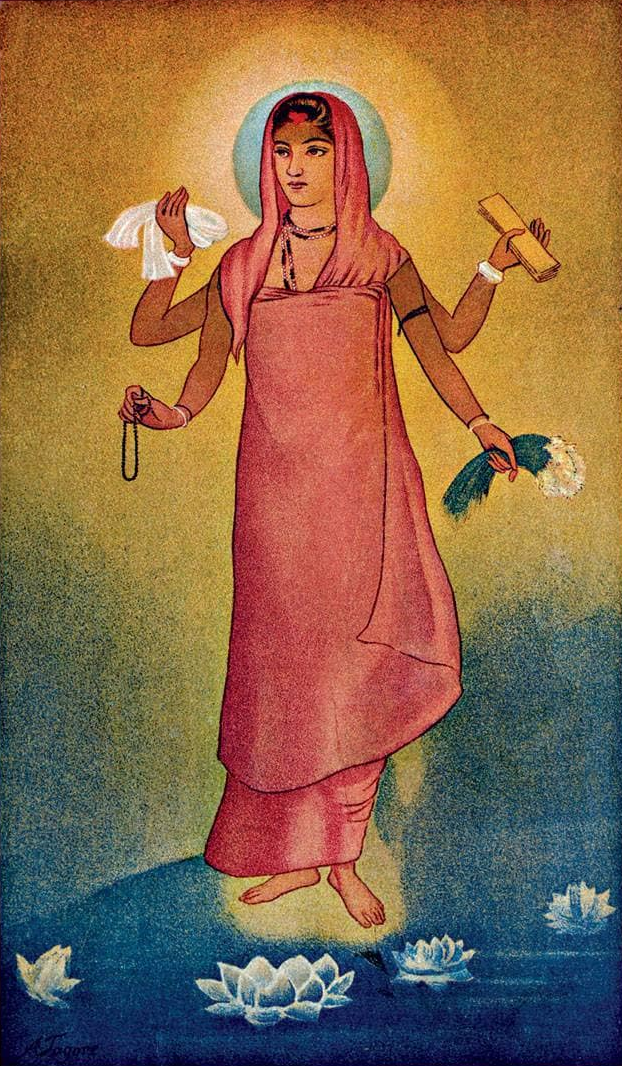
Observe the picture below and answer the questions that follow:
  1. How is Bharat Mata portrayed in the above picture?
  2. Who has painted this image?
  3. What does the mala in one hand emphasise?
What are Tripitika Koreana and Jikji? Write about them in brief.
Read the following text carefully and answer the questions that follow:
The income of countries is considered to be one of the most important attributes for making comparisons between countries. Intuitively, the income of the country is the income of all the residents of the country. This gives us the total income of the country. However, for comparison between countries, total income is not such a useful measure. Since, countries have different populations, comparing total income will not tell us what an average person is likely to earn. Hence, we compare the average income which is the total income of the country divided by its total population. In World Development Reports, brought out by the World Bank, this criterion is used in classifying countries. Countries with per capita income of US dollar 12,056 per annum and above in 2017, are called rich countries and those with per capita income of US dollar 955 or less are called low-income countries. India comes in the category of low-middle-income countries. The rich countries, excluding countries of the Middle East and certain other small countries, are generally called developed countries.
I. What is the other name of average income? (1)
II. In which category is India classified based on its average income? Explain. (1)
III. Is the average income an important criterion for development? Why? (2)
Read the passage given below and answer the following questions:
Besides banks, the other major source of cheap credit in rural areas are the cooperative societies (or cooperatives). Members of a cooperative pool their resources for cooperation in certain areas. There are several types of cooperatives possible such as farmers cooperatives, weavers cooperatives, industrial workers cooperatives, etc. Krishak Cooperative functions in a village not very far away from Sonpur. It has 2300 farmers as members. It accepts deposits from its members. With these deposits as collateral, the Cooperative has obtained a large loan from the bank. These funds are used to provide loans to members. Once these loans are repaid, another round of lending can take place. Krishak Cooperative provides loans for the purchase of agricultural implements, loans for cultivation and agricultural trade, fishery loans, loans for construction of houses and for a variety of other expenses.
Q.1. List the various sources of credit in Sonpur.
Q.2. Underline the various difficulties faced by the small and marginal farmers of Sonpur.
Read the given extract and answer the following questions.
Different organs of government placed at the same level to exercise different powers. Such a separation ensures that none of the organs can exercise unlimited power. Each organ checks the others. This results in a balance of power among various institutions. Last year, we studied that in a democracy, even though ministers and government officials exercise power, they are responsible to the Parliament or State Assemblies. Similarly, although judges are appointed by the executive, they can check the functioning of executive or laws made by the legislatures. This arrangement is called a system of checks and balances.
Answer the following MCQs by choosing the most appropriate option:
  1. The above extract related to which of the following options:
  1. Horizontal Power Sharing.
  2. Vertical Power Sharing.
  3. Regional Power Sharing.
  4. None of these.
  1. Which among the following option is correct regarding power sharing?
  1. When power is shared among different organs of the government.
  2. When power is shared among at different levels.
  3. When power is shared among different social groups.
  4. All of these.
  1. Match List I with List II:
List I
List II
1.
Power shared among different organs of government.
(A)
Community Government
2.
Power shared among governments at different levels.
(B)
Separation of Powers
3.
Power shared by different social groups.
(C)
Coalition Government
4.
Power shared by two or more political parties.
(D)
Federal Government
  1. 1-(D), 2-(A), 3-(B), 4-(C)
  2. 1-(B), 2-(C), 3-(D), 4-(A)
  3. 1-(B), 2-(D), 3-(A), 4-(C)
  4. 1-(C), 2-(D), 3-(A), 4-(B)
  1. Which among the following is called a system of checks and balances?
  1. The judges are appointed by the executive and further judges can check the functioning of executive or laws made by the legislature.
  2. The President of India appoints the Prime Minister and further the Prime Minister checks the powers of the President.
  3. The Supreme Court judges checks the powers of the High Court.
  4. All of these.
Read the extract given below and answer the questions that follow:
The value of final goods and services produced in each sector during a particular year provides the total production of the sector for that year. And the sum of production in the three sectors gives what is called the Gross Domestic Product (GDP) of a country. It is the value of all final goods and services produced within a country during a particular year. GDP shows how big the economy is. In India, the mammoth task of measuring GDP is undertaken by a central government ministry. This Ministry, with the help of various government departments of all the Indian states and union territories, collects information relating to total volume of goods and services and their prices and then estimates the GDP. When we produce a good by exploiting natural resources, it is an activity of the primary sector. The secondary sector in which natural products are changed into other forms through ways of manufacturing that we associate with industrial activity. After primary and secondary, there is a third category of activities that falls under the tertiary sector and is different from the above two. These are activities that help in the development of the primary and secondary sectors. These activities, by themselves, do not produce a good but they are an aid or a support for the production process.
  1. The money value of all the final goods and services produced within a country during a particular year is called:
  1. Gross domestic product.
  2. Net domestic product.
  3. National product.
  4. Production of secondary sector.
  1. Which sector has emerged as the largest producing sector in India?
  1. Primary sector
  2. Secondary sector
  3. Tertiary sector
  4. Science and technology sector
  1. Information and communication technology is associated with:
  1. Primary sector.
  2. Secondary sector.
  3. Tertiary sector.
  4. None of the above.
  1. Life insurance is an activity of the:
  1. Primary sector.
  2. Secondary sector.
  3. Tertiary sector.
  4. None of the above.
Read the extract given below and answer the questions that follow:
Suppose for the present that a particular country is quite developed. We would certainly like this level of development to go up further or at least be maintained for future generations. This is obviously desirable. However, since the second half of the twentieth century, a number of scientists have been warning that the present type, and levels, of development are not sustainable.
Groundwater is an example of renewable resources. These resources are replenished by nature as in the case of crops and plants. However, even these resources may be overused. For example, in the case of groundwater, if we use more than what is being replenished by rain then we would be overusing this resource.
Consequences of environmental degradation do not respect national or state boundaries; this issue is no longer region or nation specific. Our future is linked together. Sustainability of development is comparatively a new area of knowledge in which scientists, economists, philosophers and other social scientists are working together.
  1. Pick out the cause that enhances environmental degradation.
  1. Planting trees.
  2. Prevention of factory wastes getting mixed up with river water.
  3. Ban on using plastic bags.
  4. Allowing an increase in the level of exhaust fumes emited by cars, buses trucks etc.
  1. Which of the following statement defines sustainable development?
  1. Sustainable use of natural resources without considering the need of future generations.
  2. The present generation fulfills its needs while considering the needs of the future generations as well.
  3. It means the utilisation of natural resources by the past, present and the future generations.
  4. To meet the needs of the future generations even if the needs of the present generation is not met.
  1. What kind of development should be achieved by making a sincere attempt to preserve the environment and resources.
  1. Economic Development.
  2. Social Development.
  3. Sustainable Development.
  4. Political Development.
  1. The future generation may not have sufficient resources as compared to the present generation because:
  1. Resources are being used judiciously by the present generation, which will make them exhausted.
  2. Resources are being used optimally by the present generation which will make them exhausted.
  3. Resources are being overused by present generation, which will make them exhausted.
  4. Resources are not being used by the present generation, which will make them exhausted.
Shanghai became the hub of the new print culture, catering to the Western-style schools. From hand printing, there was now a gradual shift to mechanical printing.
Buddhist missionaries from China introduced hand-printing technology into Japan around AD 768-770. The oldest Japanese book, printed in AD 868, is the Buddhist Diamond Sutra.
In the late eighteenth century, in the flourishing urban circles at Edo, illustrated collections of paintings depicted an elegant urban culture, involving artists, courtesans, and teahouse gatherings. Libraries and bookstores were packed with hand-printed material of various types-books on women, musical instruments, calculations, tea ceremony, flower arrangements, proper etiquette, cooking and famous places.
i. Give ancient name of Tokyo.
ii. Name the centre of the new print culture in China and describe it.
iii. What is the name of the oldest printed book of Japan? Mention its feature.