MCQ
Red light differs from blue light as they have :
  • Different frequencies and different wavelengths
  • B
    Different frequencies and same wavelengths
  • C
    Same frequencies and same wavelengths
  • D
    Same frequencies and different wavelengths

Answer

Correct option: A.
Different frequencies and different wavelengths
a
Red light and blue light have different wavelength and different frequency.

Need a full question paper?

Generate a complete, print-ready paper with questions like this in minutes — across 16+ boards, with answer keys.
Start Generating Free

Similar questions

Two slits are made one millimetre apart and the screen is placed one metre away. What is the fringe separation (in $mm$) when bluegreen light of wavelength $500\; nm$ is used?
In a parallel plate capacitor the separation between the plates is $3\,mm$ with air between them. Now a $1\,mm$ thick layer of a material of dielectric constant $2$ is introduced between the plates due to which the capacity increases. In order to bring its capacity to the original value the separation between the plates must be made......$mm$
The energy of electron in the $n^{th}$ orbit of hydrogen atom is expressed as $E_n = \frac{{ - 13.6}}{{{n^2}}}\,eV$. The shortest and longest wavelength of Lyman series will be
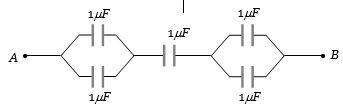
The equivalent capacitance between $A$ and $B$ is.......$\mu \,F$
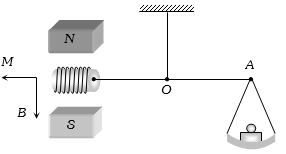
A small coil $C $ with $N = 200$ $turns$ is mounted on one end of a balance beam and introduced between the poles of an electromagnet as shown in figure. The cross sectional area of coil is $A= 1.0\, cm^2$, length of arm $OA$ of the balance beam is $l = 30\,cm.$ When there is no current in the coil the balance is in equilibrium. On passing a current $I = 22\, mA$ through the coil the equilibrium is restored by putting the additional counter weight of mass $\Delta m = 60\,mg$ on the balance pan. Find the magnetic induction at the spot where coil is located.....$T$
A card sheet divided into squares each of size $1\,mm^2$ is being viewed at a distance of $9\,cm$ through a magnifying glass (a converging lens of focal length $9\,cm$ ) held close to the eye what is the angular magnification (magnifying power) of the lens
Magnetic flux during time interval $\tau$ varies through a stationary loop of resistance $R$, as $\phi_\text{B}=\text{at}(\tau-\text{t})$ Find the amount of heat generated during that time. Neglect the inductance of the loop.
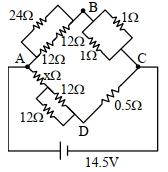
The value of unknown resistance $(x)$ for which the potential difference between $B$ and $D$ will be zero in the arrangement shown, is:
Which resistor has color bands on it?
A double convex lens $({R_1} = {R_2} = 10\,cm)$$(\mu = 1.5)$ having focal length equal to the focal length of a concave mirror. The radius of curvature of the concave mirror is.......$cm$