Question
Resistance of semiconductor at 0 K  is(a) Zero  (b) Infinite(c) Large (d) Small
       

Answer

(b) Infinite

Need a full question paper?

Generate a complete, print-ready paper with questions like this in minutes — across 16+ boards, with answer keys.
Start Generating Free

Similar questions

A double convex lens of glass of m = 1.5 has radius of curvature of each of its surface is 0.2 m.  The power of the lens is(a) + 10 dioptres (b) – 10 dioptres(c) – 5 dioptres(d)  +5 dioptres
       
Light waves travel in vaccum along the y-axis. Then the wave front is:
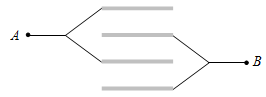
Four plates of the same area of cross$-$section are joined as shown in the figure. The distance between each plate is $d$. The equivalent capacity across $A$ and $B$ will be
Surface temperature of the sun is of the order of(a) 5000 K(b) 7000 K(c) 6000 K(d) 12000 K
       
A parallel plate capacitor has capacitance $C.$ If it is equally filled with parallel layers of materials of dielectric constants $K_1$ and $K_2$ its capacity becomes $C_1$. The ratio of $C_1$ to $C $ is
The magnitude of the vector product of two vectors $\big|\overrightarrow{\text{A}}\big|$ and $\big|\overrightarrow{\text{B}}\big|$ may be:
  1. Greater than AB.
  2. Equal to AB.
  3. Less than AB.
  4. Equal to zero.
When NPN transistor is used as an amplifier(a) Electrons move from base to collector (b) Holes move from emitter to base(c) Electrons move from collector to base(d) Holes move from base to emitter


A man standing in a swimming pool looks at a stone lying at the bottom. The depth of the swimming pool is h. At what distance from the surface of water is the image of the stone formed  (Line of vision is normal; Refractive index of water is n)(a) h/n(b) n/h (c) h  (d) hn
       
A radioactive material undergoes decay by ejecting electrons. The electron ejected in this process is:
The unit of susceptance is.