Question
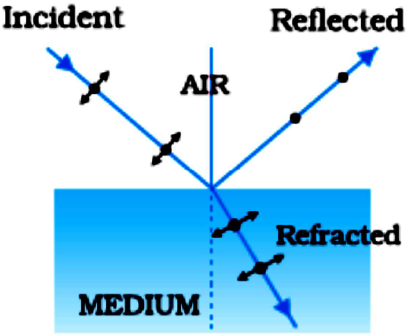
  1. Show, giving a suitable diagram, how unpolarized light can be polarised by reflection.
  2. Two polaroids P1 and P2  are placed with their pass axes perpendicular to each other. Unpolarised light of intensity Io is incident on P1 A third polaroid P3 is kept in between P1 and P2 such that its pass axis makes an angle of $60^{\circ}$with that of P1. Determine the intensity of light transmitted through P1, P2 and P3.
Answer

  1. When unpolarised light is incident on the boundary between two transparent media, the reflected light gets plane polarized with its electric vector perpendicular to the plane of incidence.

The polarization is complete when the reflected and refracted rays are at right angles to each other. This condition occurs for an angle of incidence, ip, where tan ip = $\mu$

  1. Intensity of light through $\text{P}_1=\frac{I_0}{2}$

Intensity of light through $\text{P}_2=\frac{I_0}{2}\cos^260$

$\frac{I_0}{2}.\bigg(\frac{1}{2}\bigg)^2=\frac{I_0}{8}$

Intensity of light through $ \text{P}_3=\frac{I_0}{8}\cos^230=\frac{I_0}{8}\times\bigg(\frac{\sqrt{3}}{2}\bigg)^2=\frac{3I_0}{32}$

Need a full question paper?

Generate a complete, print-ready paper with questions like this in minutes — across 16+ boards, with answer keys.

Start Generating Free

Similar questions

Show that a force that does no work must be a velocity dependent force.
Suppose the circuit in Exercise 7.18 has a resistance of $15\Omega.$ Obtain the average power transferred to each element of the circuit, and the total power absorbed
Drive the formula of electric field for points on the equatorial plane at distance $r$ from the centre of electric dipole.
A 10cm long rod carries a charge of $+50\mu\text{C}$ distributed uniformly along its length. Find the magnitude of the electric field at a point 10cm from both the ends of the rod.
Find the ratio of the lengths of an iron rod and an aluminium rod for which the difference in the lengths is independent of temperature. Coefficients of linear expansion of iron and aluminium are 12 × 10-6 °C-1 and 23 × 10-6 °C-1 respectively.
A wire AB is carrying a steady current of 12 A and is lying on the table. Another wire CD carrying 5A is held directly above AB at a height of 1 mm. Find the mass per unit length of the wire CD so that it remains suspended at its position when left free. Give the direction of the current flowing in CD with respect to that in AB. [Take the value of g = 10 ms–2]
If a piece of paper is placed at the position of a virtual image of a strong light source, will the paper burn after sufficient time? What happens if the image is real? What happens if the image is real but the source is virtual?
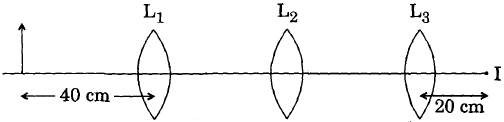
You are given three lenses L1, L2 and L3 each of focal length 20 cm. An object is kept at 40 cm in front of L1, as shown. The final real image is formed at the focus I of L3. Find the separations between L1, L2 and L3.

What is forward bias ? Explain the change happening in the junction under the effect of forward bias.