50 questions · timed · auto-graded


$\text{x}=\text{n}\lambda_1\bigg(\frac{\text{D}}{\text{d}}\bigg)$
For third bright fringe, n = 3
$\therefore\ \text{x}=3\times650\frac{\text{D}}{\text{d}}=1950\bigg(\frac{\text{D}}{\text{d}}\bigg)\ \text{nm}$
$\text{n}\lambda_2=\big(\text{n}-1\big)\lambda_1$
520n = 650n - 650
650 = 130n
$\therefore\ \text{n}=5$
Hence, the least distance from the central maximum can be obtained by the relation:
$\text{x}=\text{n}\lambda_2\frac{\text{D}}{\text{d}}$
$=5\times520\frac{\text{D}}{\text{d}}=2600\frac{\text{D}}{\text{d}}\text{nm}$
Note: The value of d and Dare not given in the question.

Speed of light, c = 3 × 10⁸ m/s
Speed of light in glass is given by the relation,
$\text{v}=\frac{\text{c}}{\mu}$
$=\frac{3\times10^8}{1.5}=2\times10^8\ \text{m/s}$
Hence, the speed of light in glass is 2 × 10⁸ m/s.
The refractive index of a violet component of white light is greater than the refractive index of a red component. Hence, the speed of violet light is less than the speed of red light in glass. Hence, violet light travels slower than red light in a glass prism.

$ =\tan60^{o} =\sqrt{3} = 1.7.$

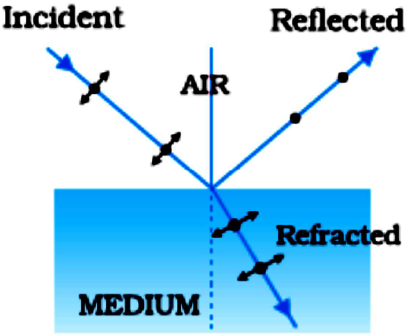
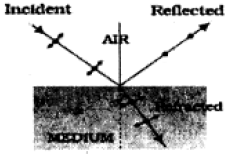
The polarization is complete when the reflected and refracted rays are at right angles to each other. This condition occurs for an angle of incidence, ip, where tan ip = $\mu$
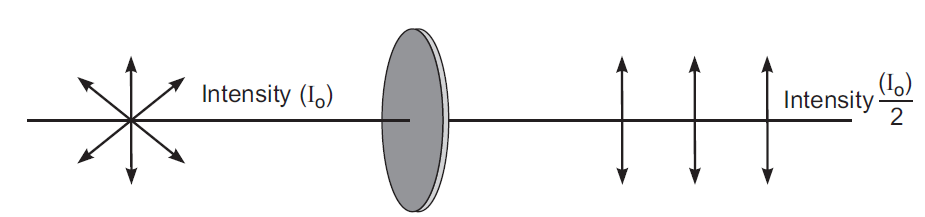
Intensity of light through $\text{P}_2=\frac{I_0}{2}\cos^260$
$\frac{I_0}{2}.\bigg(\frac{1}{2}\bigg)^2=\frac{I_0}{8}$
Intensity of light through $ \text{P}_3=\frac{I_0}{8}\cos^230=\frac{I_0}{8}\times\bigg(\frac{\sqrt{3}}{2}\bigg)^2=\frac{3I_0}{32}$

Alternate Answer
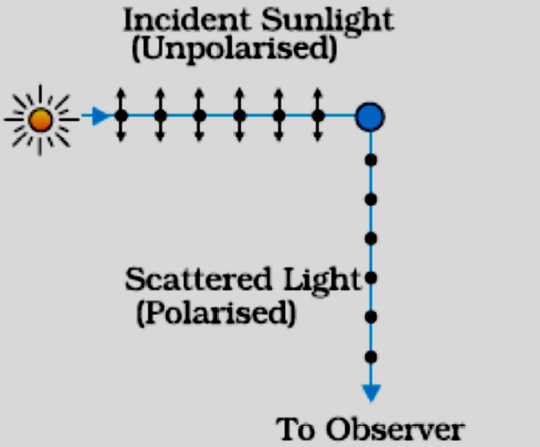
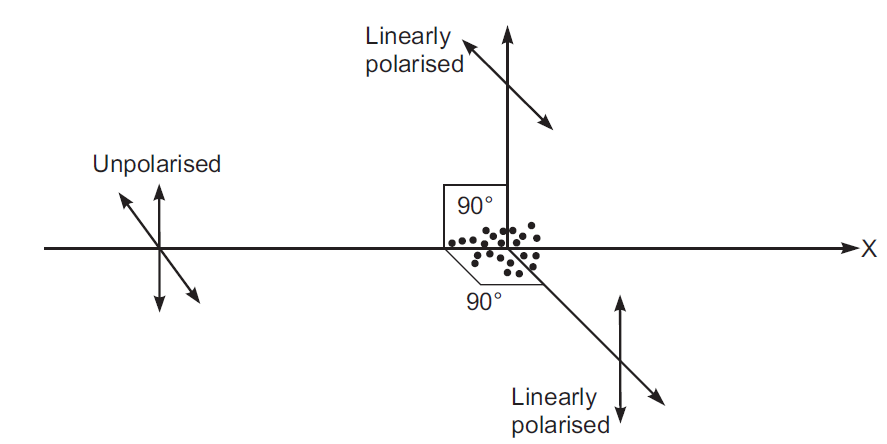
The acceleration, of the charges, in the scattering molecules, due to the electric field of the incident radiation, can be in two mutually perpendicular directions.
The observer, however, receives the scattered light, corresponding to only one of these two sets of the accelerated charges.
This causes scattered light to get polarised. Alternatively: The observer receives scattered light corresponding to only one of the two sets of accelerated charges i.e. electrons oscillating perpendicular to the direction of propagation
Intensity of light through $\text{P}_2=\frac{I_0}{2}\cos^245$
$\frac{I_0}{2}.\frac{1}{2}=\frac{I_0}{4}$
Intensity of light through $\text{P}_3=\frac{I_0}{4}\cos^245=\frac{I_0}{4}\times\frac{1}{2}=\frac{I_0}{8}$
$ = \frac{3 \times 520 \times10^{−9}\times 1}{1.5 \times 10^{−3}}$
$ = 1.04 \times 10^{−3}\text{𝑚}\simeq1\text{ 𝑚𝑚}$.
$\therefore \text{𝑛} \times 650 \times10^{−9} =(\text{ n} + 1 )520 \times 10^{−9}$
$\Rightarrow\text{n} = 4$
$\therefore$ The least distance of the point is given by
$\text{y} =\frac{\text{nD}\lambda_{1}}{\text{d}}$
$ = \frac{4\times 1 \times 650 \times 10^{−9}}{1.5 \times 10^{−3}}\text{m} = 1.733 \times 10^{−3}\text{𝑚}\simeq 1.7\text{𝑚𝑚}$.

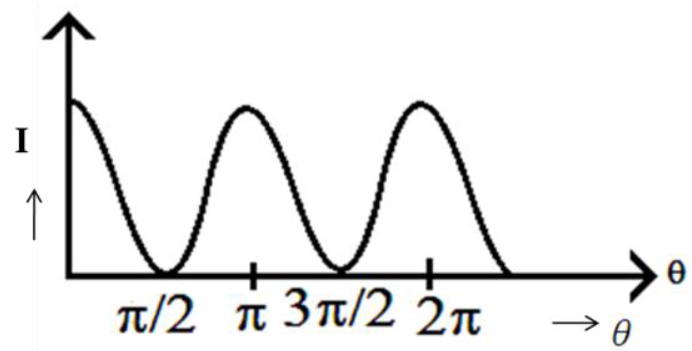
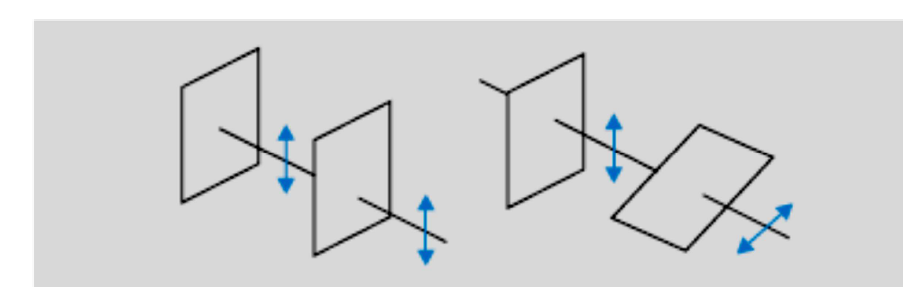
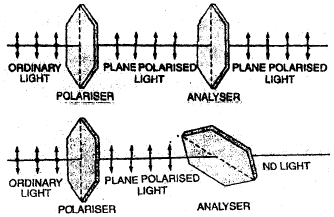
Light from the sodium lamp passing through the single Polaroid sheet ( P1) does not show any variation in intensity when this sheet is rotated. However, if the light, transmitted by P1, is made to pass through another Polaroid sheet (P2) the light intensity, coming out of P2, varies from a maximum to zero, and again to maximum, when P2 is rotated. These observations are consistent only with the transverse nature of light waves.
Intensity of light transmitted through P3 = (I0 / 2) x cos2 300.
= 3 I0 / 8
Intensity of light transmitted through $\text{P}_{2} = \frac{3}{8}\text{I}_{o}\cos^{2}60^{o}$
$=\frac{3}{32}\text{I}_{o}.$
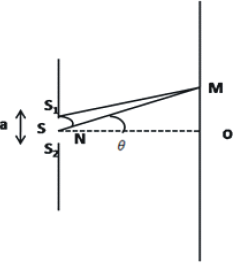
$\text{X}_{n} = \frac{\text{n}\lambda\text{D}}{\text{d}}$
Given: n = 2, d = 0.15 mm, λ = 450 nm and D = 1.0 m
$\text{x}_{2} = \frac{2\times450\times10^{-9}\times1.0}{0.15\times10^{-3}} = 6 \times10^{-3}\text{m} = 6\text{mm}$
Distance of nth minima from central maxima
$\text{y}_{2} = \frac{(2\text{n} - 1 )\lambda\text{D}}{2\text{d}} = \frac{(2\times2-1)450\times10^{-9}\times1}{2\times0.15\times10^{-3}} = 4.5\times10^{-3}\text{m} = 4.5\text{mm}$
When the screen is moved away from the slits fringes become farther apart.
Alternate Answer
Reflected and refracted rays should be perpendicular to each other.Alternate Answer
Light should be incident at polarizing angle. $\text{Derivation:}\mu = \frac{\sin\text{i}_{p}}{\sin\text{r}} =\frac{\sin\text{i}}{\sin\bigg(\frac{\pi}{2} - \text{i}_{p}\bigg)}$ $\tan\text{i}_{p}.$

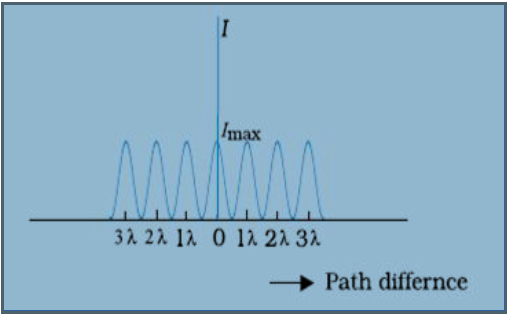
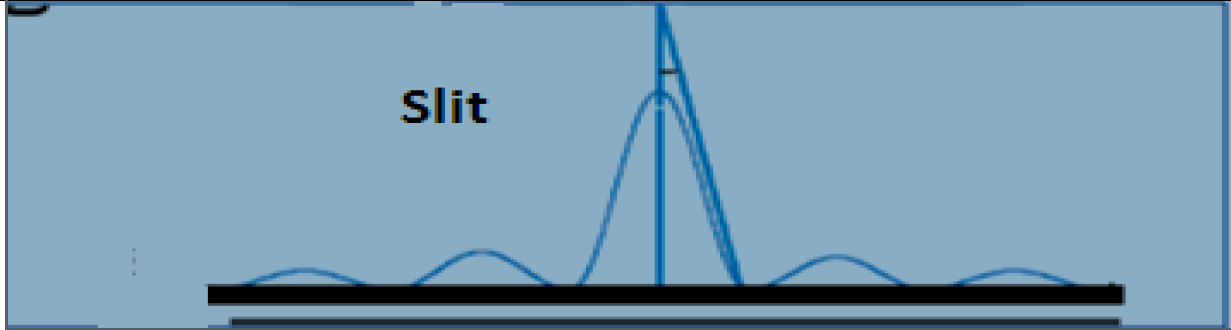
S.no | Interference | Diffraction |
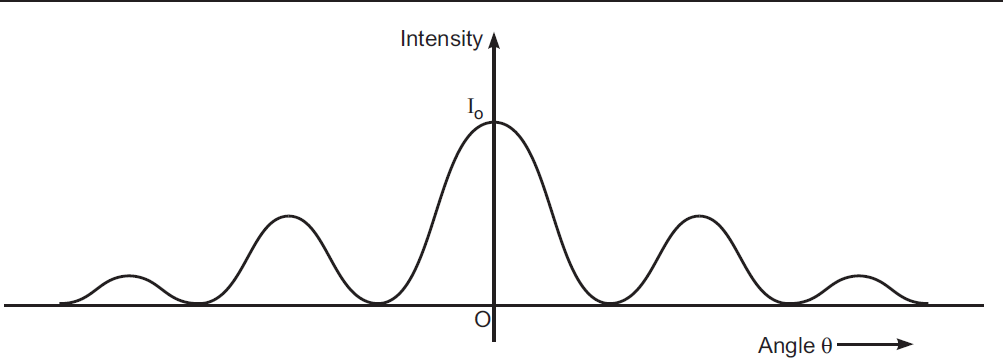
1. | All fringes are equal in width | Central bright maxima is twice as wide as the other maxima. |
2. | Intensity of all bright fringes is same. | Intensity falls as we go to successive maxima away from centre. |
3. | Conditions for maxima and minima are opposite to diffraction pattern. | Condition for maxima and minima are opposite to interference pattern. |
4. | Pattern is formed by superposing two waves originating from two narrow slits. | Diffraction pattern is a superposition of wavelets originating from different parts of a single wave front. |

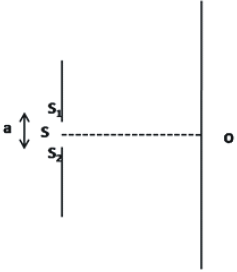
$\theta =\lambda/\text{d},$ where d = separation between two slits
Here $\theta = 0.1^{\circ} = 0.1\times\frac{\pi}{180}\text{radian}$
$\therefore\text{d} = \frac{600\times10^{-9}\times180}{0.1\times\pi}$
= 3.43 X 10⁻⁴ m
= 0.34 m
For Refracted light: Wavelength decreases½ Frequency remains same.
Coherent sources are needed to ensure that the positions of maxima and minima do not change with time.
Alternate Answer
Coherent sources have constant phase difference and, therefore, produce a sustained interference pattern.
For path difference $\lambda,$ phase difference
$\Phi = 2\pi$
$\text{Hence}, \text{k} = 4\text{I}_{0}\cos^{2}\pi =4 \text{ I}_{0}$
For path difference $\lambda\big/3$
Phase difference $\Phi = 2\pi\big/3$
Intensity
$\text{I}' = 4\text{I}_{0}\cos^{2}\pi\big/3$
$ = 4\text{I}_{0}\bigg(\frac{1}{2}\bigg)^{2} = \text{I}_{0}$
Therefore, $\text{I}' = \frac{\text{k}}{4}.$

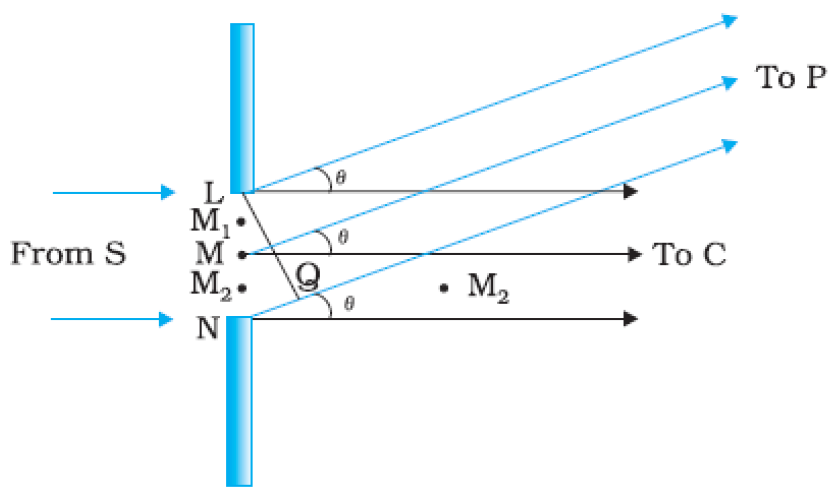
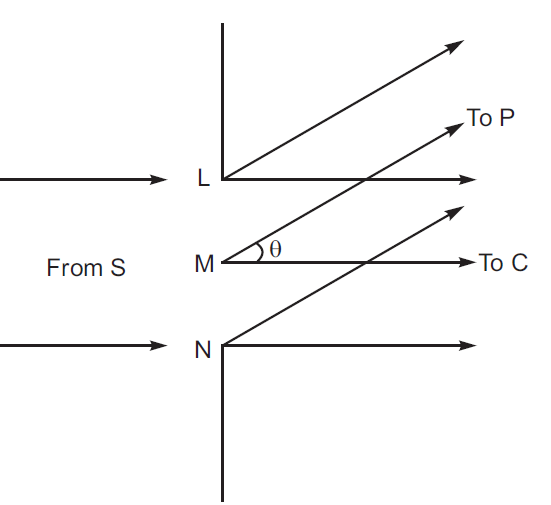
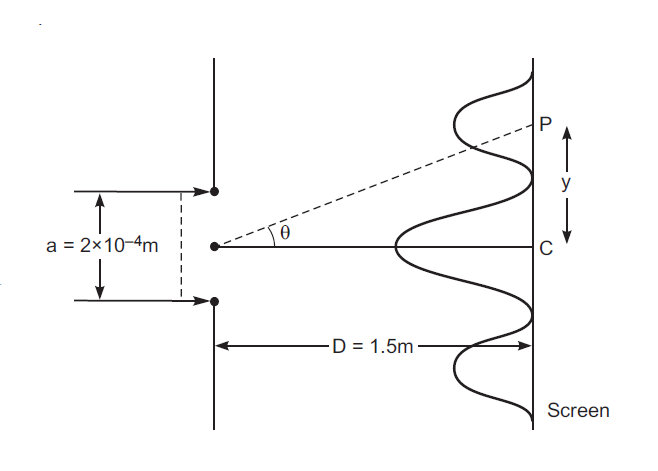
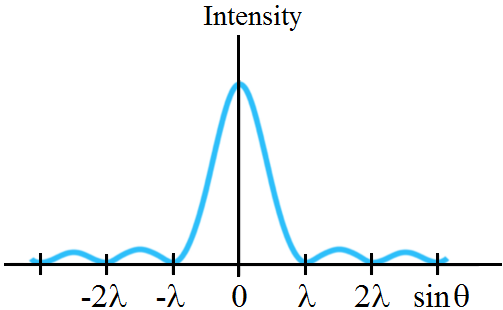
Half angular width of central maxima= $\lambda$/a $\therefore$, Size of central maxima will be reduced to half and intensity of central maxima will be four times.
State two points of difference between the interference pattern obtained in Young’s double slit experiment and the diffraction pattern due to a single slit.

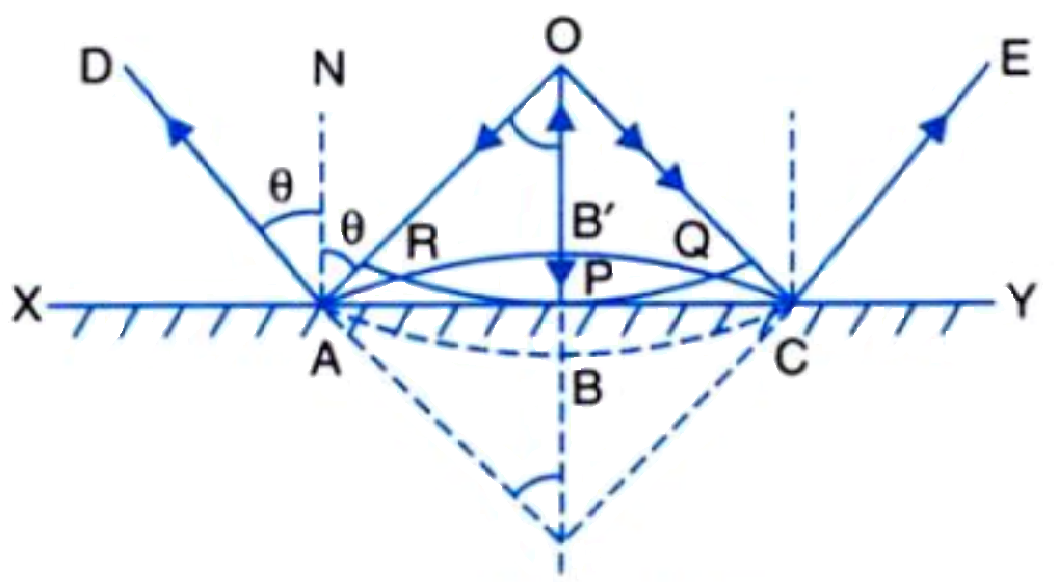
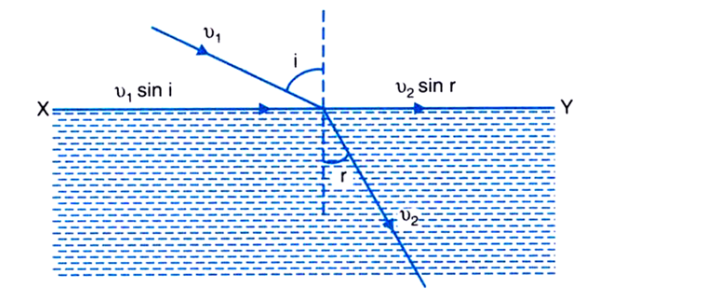
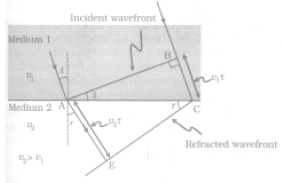
$\sin\text{r} = \frac{\text{AE}}{\text{AC}}$
$\therefore \frac{\sin\text{i}}{\sin\text{r}} = \frac{\text{BC}}{\text{AE}}$
$ = \frac{c_1\text{t}}{c_2\text{t}} = \frac{c_1}{\text{c}_{2}} = n =\text{ constant}$
$\text{I}_2=\text{I}$
$\frac{\text{I}_{\text{max}}}{\text{I}_{\text{min}}}=\bigg(\frac{\sqrt{\text{I}_1}+\sqrt{\text{I}_2}}{\sqrt{\text{I}_1}-\sqrt{\text{I}_2}}\bigg)^2$
$=\Bigg(\frac{\sqrt{\frac{\text{I}}{2}}+\sqrt{\text{I}}}{\sqrt{\frac{\text{I}}{2}}-\sqrt{\text{I}}}\Bigg)^2$
$=\bigg(\frac{1+\sqrt{2}}{1-\sqrt{2}}\bigg)^2$
$=\frac{2+1+2\sqrt{2}}{2+1-2\sqrt{2}}$
$=\frac{3+2\sqrt{2}}{3-2\sqrt{2}}$
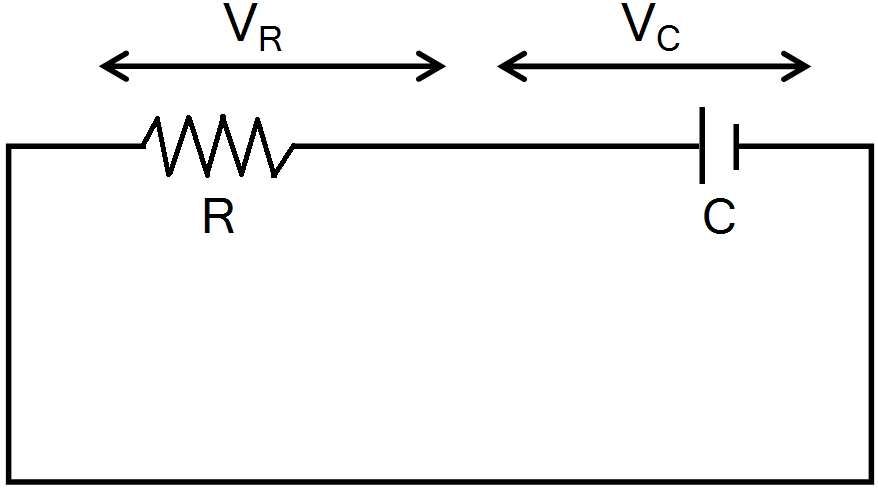
$\therefore\text{I}=\frac{\text{V}}{\text{Z}}=\frac{\text{v}_1\sin\omega\text{t}}{\sqrt{\text{R}^2+\text{X}^2_\text{C}}}$

$\text{V}_\text{R}=\text{IR}$
$\text{V}_\text{C}=\text{IX}_\text{C}$
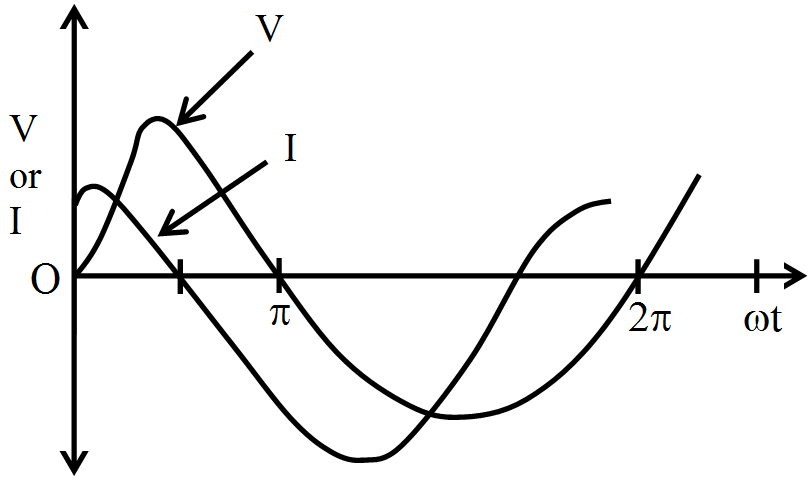
In phase of 1 lags I by $\frac{\pi}{2}$

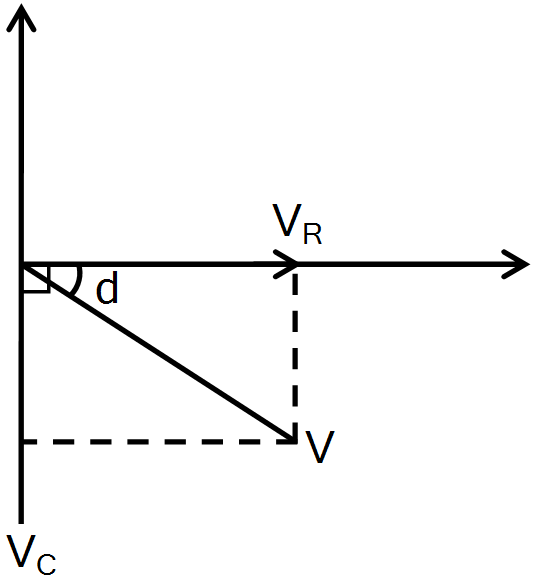
$\text{V}=\sqrt{\text{V}^2\text{R}+\text{V}^2_\text{C}}$
$=\sqrt{(\text{IR})^2+(\text{IX}_\text{C})^2}$
$\Rightarrow\text{I}=\frac{\text{V}}{\sqrt{\text{R}^2+\text{X}^2_\text{C}}}=\frac{\text{r}_0\sin\omega\text{t}}{\sqrt{\text{R}^2+\text{X}^2_\text{C}}}$
$\phi=$ phase diff bet V & I
$\tan\phi=\frac{\text{V}_\text{C}}{\text{V}_\text{R}}=\frac{\text{X}_\text{C}}{\text{R}}$


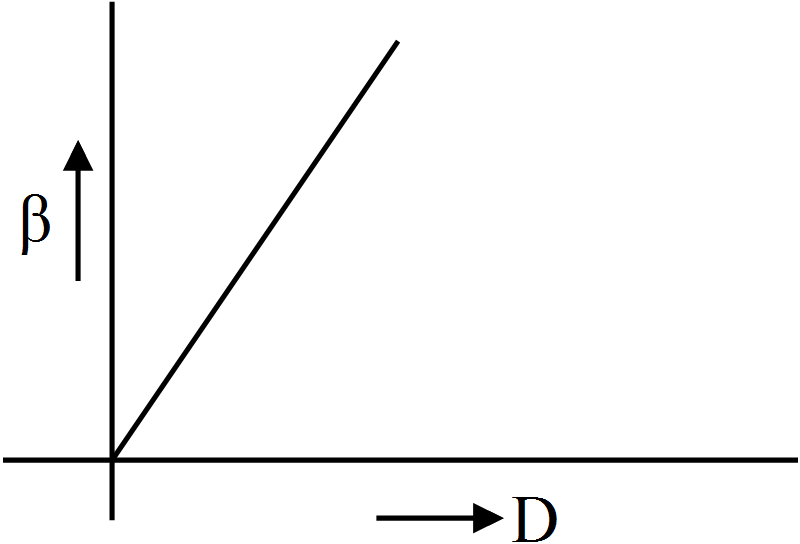
$\Rightarrow\beta\propto\text{D}$
No effect on angular fringe width $\Big(\text{Q}=\frac{\lambda}{\text{d}}\Big).$
So,
$\frac{1472}{1}=\frac{3\times10^8}{\text{v}_{400}}\Rightarrow\text{v}_{400}=2.04\times10^8\text{m/sec}.$[because, for air,
$\mu=1\ \text{and v}=3\times10^8\text{m/s}]$Again,
$\frac{1452}{1}=\frac{3\times10^8}{\text{v}_{760}}\Rightarrow\text{v}_{760}=2.07\times10^8\text{m/sec}.$$\beta=\lambda\frac{\text{D}}{\text{d}}$
$\Rightarrow \beta=\frac{\lambda}{\text{d}}\text{D}$
The graph between β and D is shown alongside
The slope of graph $=\frac{\lambda}{\text{d}}$

Knowing d, the wavelength of light used can be calculated to be
$\lambda= \text{Slope of graph}\times \text{d.}$


$\varphi=2\text{n}\pi(\text{n}=0,1,2,\dots)\Rightarrow\cos\varphi=1$
$\therefore\text{I}_\max=2\text{I}+2\text{I}=4\text{I}$
$\Rightarrow\cos\varphi=0 $
$\therefore \text { I}_\min=\text{2I}-\text{2I}=0$


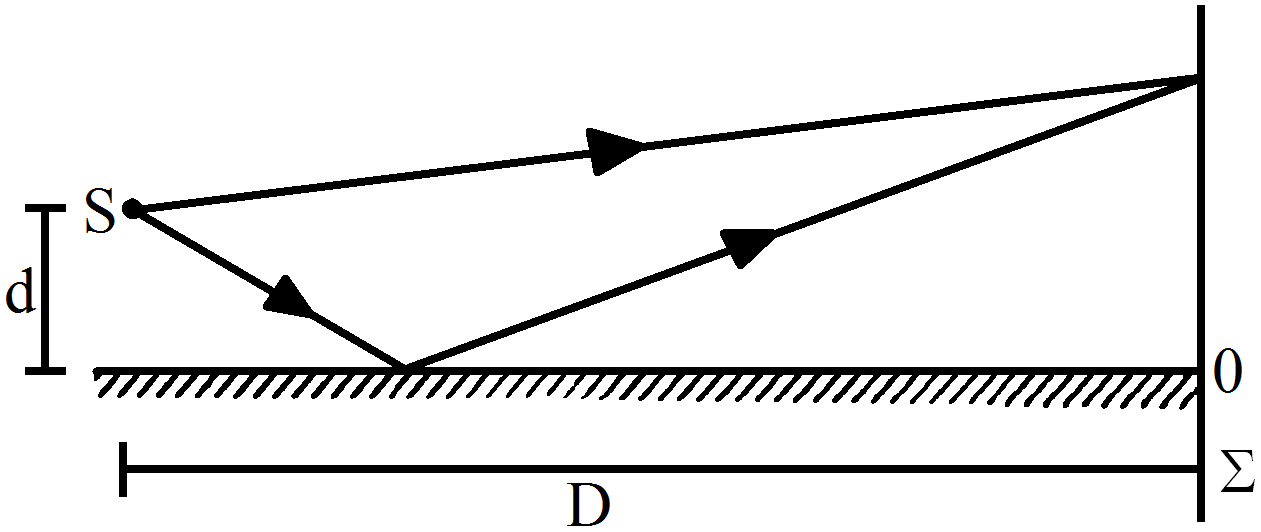
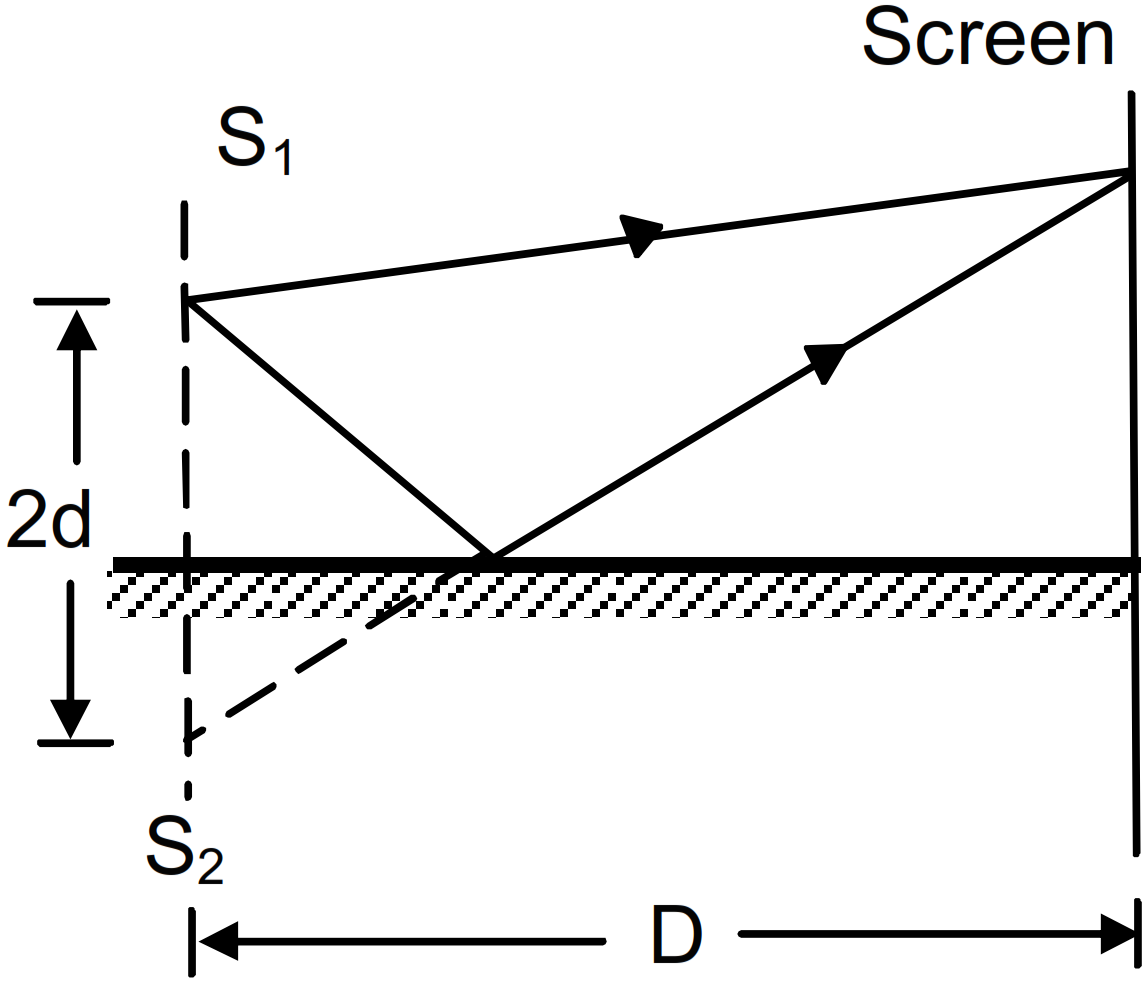
D = Distance between slit and screen.
We know for bright fringe, $\Delta\text{x}=\frac{\text{y}\times2\text{d}}{\text{D}}=\text{n}\lambda$
But as there is a phase reversal of $\frac{\lambda}{2}.$
$\Rightarrow\frac{\text{y}\times2\text{d}}{\text{D}}+\frac{\lambda}{2}=\text{n}\lambda$
$\Rightarrow\frac{\text{y}\times2\text{d}}{\text{D}}=\text{n}\lambda-\frac{\lambda}{2}\Rightarrow\text{y}=\frac{\lambda\text{D}}{4\text{d}}$