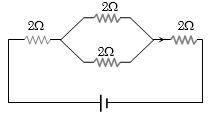
Specific resistance of a conductor increases with
AIPMT 2002, Easy
Download our app for free and get started
specific resistance is a property of a material and it will increase with the increase of temperature, but will not vary with the dimensions (length, crosssection) of the conductor

Download our appand get started for free
Experience the future of education. Simply download our apps or reach out to us for more information. Let's shape the future of learning together!No signup needed.*
Similar Questions
- 1Four resistances $10$ $\Omega$, $5$ $\Omega$, $7$ $\Omega$ and $3$ $\Omega$ are connected so that they form the sides of a rectangle $AB$, $BC$, $CD$ and $DA$ respectively. Another resistance of $10$ $\Omega$ is connected across the diagonal $AC$. The equivalent resistance between $A$ and $B $ is .............. $\Omega$View Solution
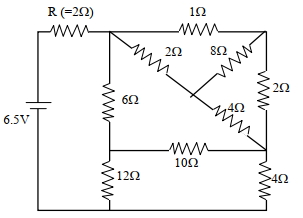
- 2In the following circuit, the current through the resistor $R(=2 \Omega)$ is $I$ Amperes. The value of $I$ isView Solution
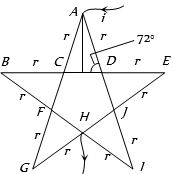
- 3In the following star circuit diagram (figure), the equivalent resistance between the points $A$ and $H$ will be ..............$r$View Solution
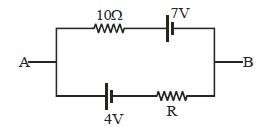
- 4In the following circuit if $V_A -V_B = 6\,V$ then the value of resistance $R$ (in $ohm$) is ............... $\Omega$View Solution
- 5A new flashlight cell of $e.m.f.$ $1.5\, volts$ gives a current of $15\, amps$, when connected directly to an ammeter of resistance $0.04\,\Omega $. The internal resistance of cell is ........... $\Omega$View Solution
- 6For what value of unknown resistance $X$, the potential difference between $B$ and $D$ will be zero in the circuit shown in the figure ............... $\Omega$View Solution
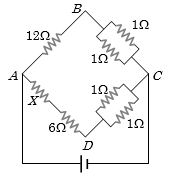
- 7In copper wire each atom releases one free electron. If diameter is $1\, mm$ and current is $1.1\,A$ find drift velocity. ($\rho = 9 \times 10^{+3}\, kg/m^3$ $M = 63\, gm/mole$)View Solution
- 8The value of current through $20\,\Omega $ resistor is .................. $A$View Solution
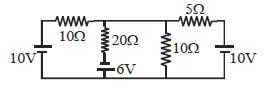
- 9The galvanometer deflection, when key $K_1$ is closed but $K_2$ is open, equals $\theta_0$ (see figure). On closing $K_2$ also and adjusting $R_2$ to $5\,\Omega $ , the deflection in galvanometer becomes $\frac{{\theta _0}}{5}$. The resistance of the galvanometer is, then, given by [Neglect the internal resistance of battery]: .................. $\Omega$View Solution
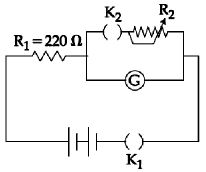
- 10The equivalent resistance of the circuit shown in the figure is ............. $\Omega$View Solution