Question
State and prove Bernoulli's theorem.

Answer

According to Bernoulli's theorem, for an incompressible, non-viscous liquid having streamlined flow, the sum of pressure head, velocity head and gravitational head is a constant,

i.e., $\frac{\text{P}}{\rho\text{g}}+\frac{\text{v}^2}{2\text{g}}+\text{h}=\text{constant}$

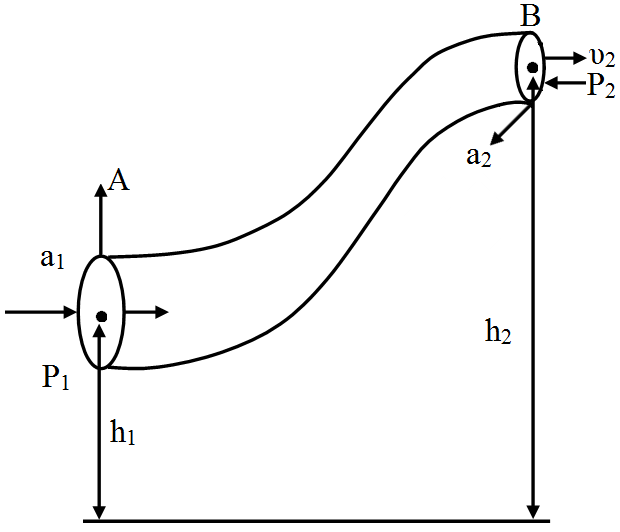
Consider an incompressible non-viscous liquid entering the cross-section A1 at A with a velocity v1 and coming out at a height h2 at B with velocity v2.

The P.E. and K.E. increase since h, and v, are more than h1 and v1 respectively. This is done by the pressure doing work on the liquid. If P1 and P2 are the pressure at A and B, for a small displacement at A and B,

The work done on the liquid at A = (P1 A1)

$\Delta\text{x}_1=\text{P}_1\text{A}_1\text{v}\Delta\text{t}$

The work done by the liquid at B,

$\Delta\text{x}_2=-(\text{P}_2\text{A}_2)$

$\Delta\text{x}_2=-\text{P}_2\text{A}_2\text{V}\Delta\text{t}$

The work done on the liquid at

(Considering a small time $\Delta\text{t}$ so that area may be same)

Net work done by pressure $=(\text{P}_1-\text{P}_2)\text{Av }\Delta\text{ t}$ since A1v1 = A2v2

From conservation of energy,
$(\text{P}_1-\text{P}_2)\text{Av}\Delta\text{t}=\text{Change in }(\text{K.E.}+\text{P.E.})$

$(\text{P}_1-\text{P}_2)\text{A}\text{v}\Delta\text{t}$

$=\text{Av}\rho\Delta\text{tg}(\text{h}_2-\text{h}_1)+\frac{1}{2}\text{Av}\Delta\text{t}\rho(\text{v}_2^2-\text{v}^2_1)$

$\therefore\text{P}_1-\text{P}_2=\rho\text{g}(\text{h}_2-\text{h}_1)+\frac{\rho}{2}(\text{v}^2_2-\text{v}^2_1)$

(i.e.) $\text{P}_1+\rho\text{gh}_1+\frac{\rho}{2}\text{v}^2_1=\text{P}_1+\rho\text{gh}_2+\frac{\rho}{2}\text{v}^2_2$

$\therefore\frac{\text{P}}{\rho\text{g}}+\text{h}+\frac{\text{v}^2}{\text{2g}}=\text{constant}.$

Need a full question paper?

Generate a complete, print-ready paper with questions like this in minutes — across 16+ boards, with answer keys.
Start Generating Free

Similar questions

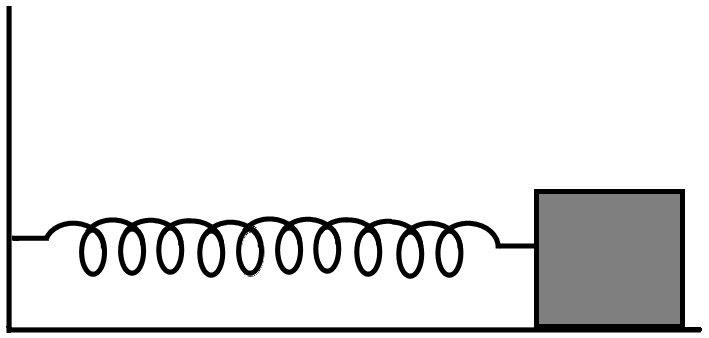
For three situations, the initial and final positions respectively, along x-axis for the block in Fig are (a) - 3cm, 2cm. (b) 2cm, 3 cm and (c) -2cm, 2cm. In each situation, is the work done by the spring force on the block positive, negative or zero?

A voltmeter coil has resistance $50.0\Omega$ and a resistor of $1.15\text{k}\Omega$ is connected in series. It can read potential differences up to 12 volts. If this same coil is used to construct an ammeter that can measure currents up to 2.0A, what should be the resistance of the shunt used?
Two wires carrying equal currents i each, are placed perpendicular to each other, just avoiding a contact. If one wire is held fixed and the other is free to move under magnetic forces, what kind of motion will result?
The unit of length convenient on the nuclear scale is a fermi: 1 f = 10–15m. Nuclear sizes obey roughly the following empirical relation:
$\text{r}=\text{r}_0\text{A}^{1/3}$
where r is the radius of the nucleus, A its mass number, and r o is a constant equal to about, 1.2 f. Show that the rule implies that nuclear mass density is nearly constant for different nuclei. Estimate the mass density of sodium nucleus. Compare it with the average mass density of a sodium atom obtained in Exercise. 2.27.
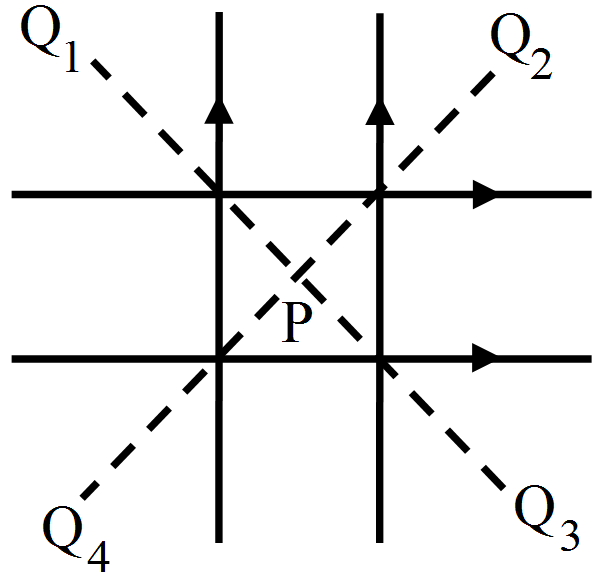
Four long, straight wires, each carrying a current of 5.0A, are placed in a plane as shown in figure. The points of intersection form a square of side 5.0cm.

  1. Find the magnetic field at the centre P of the square.
  2. Q1, Q2, Q3, and Q4 are points situated on the diagonals of the liquare and at a distance from P that is equal to the length of the diagonal of the square. Find the magnetic fields at these points.

Plot the corresponding reference circle for each of the following simple harmonic motions. Indicate the initial $(t=0)$ position of the particle, the readius of the circle, and the angular speed of the rotating particle. For simplicity, the sense of rotation may be fixed to be anticlockwise in every case ( $x$ is in cm and $t$ is in s).
(a) $x=-2 \sin (3 t+\pi / 3)$
(b) $x=\cos (\pi / 6-t)$
(c) $x=3 \sin (2 \pi t+\pi / 4)$
(d) $x=2 \cos \pi t$
A small block of mass 200g is kept at the top of a frictionless incline which is 10m long and 3.2m high. How much work was required.
  1. To lift the block from the ground and put it at the top.
  2. To slide the block up the incline? What will be the speed of the block when it reaches the ground.
  3. It falls off the incline and drops vertically on the ground.
  4. It slides down the incline? Take g = 10m/s2.
A 100kg gun fires a ball of 1kg horizontally from a cliff of height 500m. It falls on the ground at a distance of 400m from the bottom of the cliff. Find the recoil velocity of the gun. (acceleration due to gravity = 10m s–2)
Which of the following functions of time represent (a) periodic and (b) non-periodic motion? Give the period for each case of periodic motion [ $\omega$ is any positive constant].
(i) $\sin \omega t+\cos \omega t$
(ii) $\sin \omega t+\cos 2 \omega t+\sin 4 \omega t$
(iii) $e ^{-\omega t}$
(iv) $\log (\omega t)$
An aircraft is flying at a height of 3400m above the ground. If the angle subtended at a ground observation point by the aircraft positions 10.0s apart is 30°, what is the speed of the aircraft?